music clip of the day

jazz/blues/rock/classical/gospel/more

Tag: Emily Dickinson

Tuesday, August 26th

sounds of Norway

Maja S. K. Ratkje, live (music begins at 1:40), Norway (Punkt Festival, Kristiansand), 2013


**********

lagniappe

reading table

A Prison gets to be a friend —
Between its Ponderous face
And Ours — a Kinsmanship express —
And in its narrow Eyes —

We come to look with gratitude
For the appointed Beam
It deal us — stated as Our food —
And hungered for — the same —

We learn to know the Planks —
That answer to Our feet —
So miserable a sound — at first —
Nor ever now — so sweet —

As plashing in the Pools —
When Memory was a Boy —
But a Demurer Circuit —
A Geometric Joy —

The Posture of the Key
That interrupt the Day
To Our Endeavor — Not so real
The Check of Liberty —

As this Phantasm Steel —
Whose features — Day and Night —
Are present to us — as Our Own —
And as escapeless — quite —

The narrow Round — the Stint —
The slow exchange of Hope —
For something passiver — Content
Too steep for looking up —

The Liberty we knew
Avoided — like a Dream —
Too wide for any night but Heaven —
If That — indeed — redeem —

—Emily Dickinson (1830-1886; Franklin #456)

Sunday, March 23rd

back to church

Bishop G. E. Patterson (1939-2007) Live, Temple of Deliverance (COGIC), Memphis


**********

lagniappe

reading table

The Soul should always stand ajar

—Emily Dickinson (1830-1886; Franklin #1017, fragment)

Thursday, March 20th

spring!

Bob Dorough (1923-; vocals, piano), “Spring Can Really Hang You Up The Most” (T. Wolf, F. Landesman), 1997


*****

Blossom Dearie (1924-2009; vocals, piano), “They Say It’s Spring” (M. Clark, B. Haymes), 1958


*****

Sun Ra Arkestra (SR [1914-1993], piano; June Tyson, vocals; John Gilmore, tenor saxophone, et al.), “Springtime Again” (S. Ra), live, Rome, 1980


**********

lagniappe

reading table

A little Madness in the Spring
Is wholesome even for the King,
But God be with the Clown—
Who ponders this tremendous scene—
This whole Experiment of Green—
As if it were his own!

—Emily Dickinson (1830-1886; Franklin #1356)

***

spring rain—
the uneaten ducks
are quacking

—Kobayashi Issa (1763-1828; translated from Japanese by David G. Lanoue)

Saturday, March 1, 2014

If you wanted to conjure a world of mystery, what better instrument to lead the way than one that possesses neither the brightness of the violin nor the darkness of the cello?

Morton Feldman, Rothko Chapel (1971), live, Houston (Rothko Chapel), 2011; Kim Kashkashian (viola), Brian Del Signore (percussion), Sarah Rothenberg (celeste), Maureen Broy Papovich (soprano), Houston Chamber Choir (Robert Simpson, cond.)

#1

***

#2

***

#3

Another take? Here.

**********

lagniappe

Rothko Chapel

***

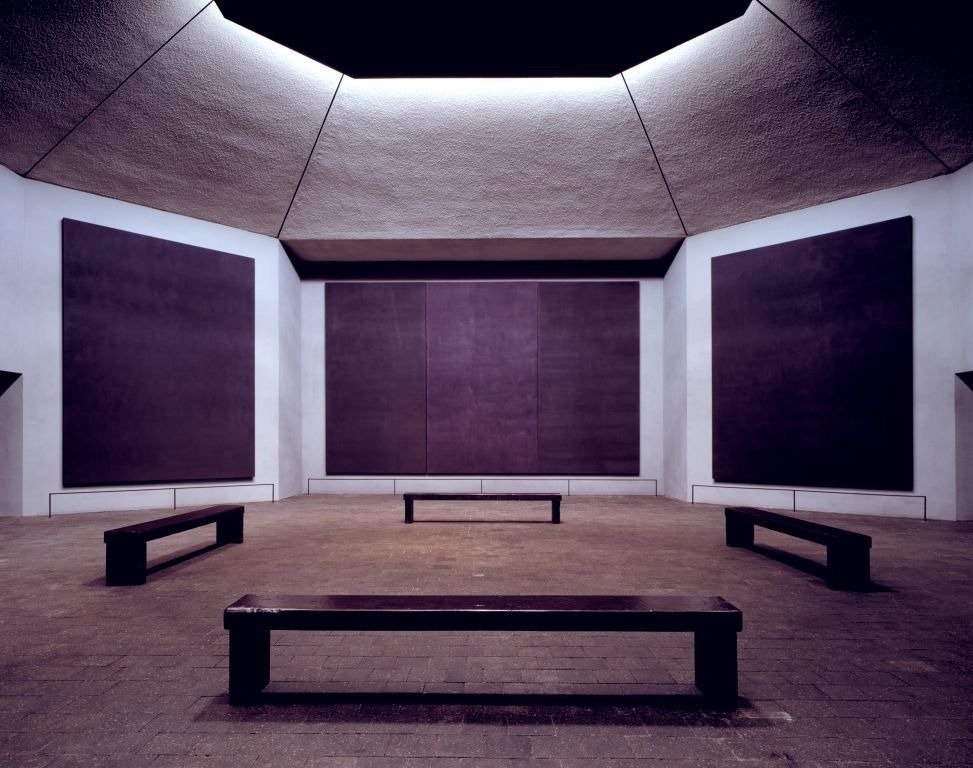
The Rothko Chapel is an interfaith sanctuary, a center for human rights — and a one-man art museum devoted to 14 monumental paintings by abstract expressionist Mark Rothko. The Houston landmark, commissioned by John and Dominique de Menil, opened its doors 40 years ago, in February 1971.

For the past four decades, the chapel has encouraged cooperation between people of all faiths — or of no faith at all. While the chapel itself has become an art landmark and a center for human-rights action, the sanctuary’s creator never lived to see it finished. Rothko committed suicide in 1970.

Approaching the chapel from the south, visitors first see a steel sculpture called Broken Obelisk by Barnett Newman in the middle of a pool — it appears to be floating on the surface of the water. The chapel itself is a windowless, octagonal brick building. Solid black doors open on a tiny glass-walled foyer. (The foyer was walled off from the rest of the interior when the Gulf Coast’s notorious humidity began to affect the paintings.)

The main room is a hushed octagonal space with gray stucco walls, each filled by massive paintings. Some walls feature one canvas, while on others, three canvases hang side by side to form a triptych. A baffled skylight subdues the bright Houston sun, and the surfaces of the paintings change dramatically as unseen clouds pass outside. There are eight austere wooden benches informally arranged, and today, a few meditation mats. A young woman brings the meditation hour to a close by striking a small bowl with a mallet, creating a soft peal of three bells in the intense silence of the room.

Concerts, conferences, lectures, weddings and memorial services all take place in the chapel throughout the year, but on most days you will find visitors — about 55,000 annually come to see, to meditate, to write in the large comment book in the foyer, to read the variety of well-thumbed religious texts available on benches at the entrance.

***

These paintings do not feature the luminous color fields that made Rothko famous. The paintings in the chapel are dark, in purplish or black hues. And there’s a reason for that, says [chapel historian Suna] Umari.

“They’re sort of a window to beyond,” she explains. “He said the bright colors sort of stop your vision at the canvas, where dark colors go beyond. And definitely you’re looking at the beyond. You’re looking at the infinite.”

***

At first glance, the paintings appear to be made up of solid, dark colors. But look closely, and it becomes evident that the paintings are composed of many uneven washes of pigment that create variations in every inch. Stepping back, waves of subtle color difference appear across the broad surfaces — leading to an unmistakable impression of physical depth.

***

Though Mark Rothko didn’t live to see the sanctuary he created, Christopher Rothko says his father knew what it should be.

“It took me a while to realize it, but that’s really my father’s gift, in a sense, to somebody who comes to the chapel. It’s a place that will really not just invite, but also demand a kind of journey.”

—Pat Dowell, “Meditation and Modern Art Meet In Rothko Chapel,” NPR, 3/1/11
*****

reading table

Our lives are Swiss –
So still – so Cool –
Till some odd afternoon
The Alps neglect their Curtains
And we look farther on!

Italy stands the other side!
While like a guard between –
The solemn Alps –
The siren Alps
Forever intervene!

—Emily Dickinson

Sunday, November 24th

two takes

“The Storm Is Passing Over” (C. Tindley, D. Vails)

Detroit Mass Choir (Jimmy Dowell, Director), live, Detroit, 2001

*****

DeLois Barrett Campbell and The Barrett Sisters, live, 1982 (Say Amen, Somebody)

**********

lagniappe

reading table

“Hope” is the thing with feathers—
That perches in the soul—
And sings the tune without the words—
And never stops—at all—

And sweetest—in the Gale—is heard—
And sore must be the storm—
That could abash the little Bird
That kept so many warm—

I’ve heard it in the chillest land—
And on the strangest Sea—
Yet, never, in Extremity,
It asked a crumb—of Me.

—Emily Dickinson (1830-1886)

Sunday, November 17th

another take

Slow, dark, bluesy—this is a world away from the two church performances we heard last Sunday.

Pastor Terry Anderson (and congregation), “Woke Up This Morning with My Mind Stayed on Jesus,” live, Houston (Lilly Grove Missionary Baptist Church), 2010

**********

lagniappe

reading table

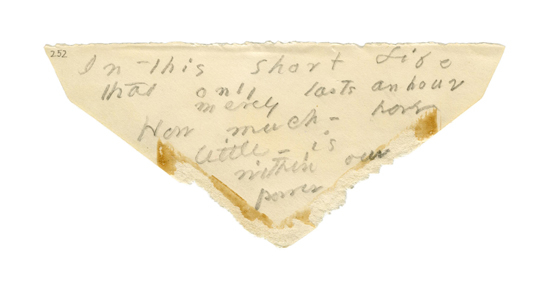
One of Emily Dickinson’s “envelope” poems:

a252_bf_1

In this short Life that only lasts an hour
How much—how little—is within our power

Sunday, June 30th

The moment this ends I want to hear it again.

Rev. E. M. Martin and Pearline Johns, “I’m Going Home On The Morning Train,” Clarksdale, Miss. (Nelson Funeral Home), 1942

**********

lagniappe

reading table

Mortality is fatal
Gentility is fine
Rascality, heroic
Insolvency, sublime

—Emily Dickinson (1830-1886), #2 (excerpt), 1852

Monday, June 24th

two takes

“A House Is Not A Home” (B. Bacharach & H. David)

Luther Vandross (1951-2005), live, 1988


*****

Ronald Isley (1941-) & Burt Bacharach, TV show, 2004


**********

lagniappe

reading table

This is my letter to the World
That never wrote to Me –

—Emily Dickinson (1830-1886), #519 (excerpt)

Sunday, June 9th

If God exists, he wants us—this I am sure of—to dance.

Caffey Brothers, “Make Me Over” (Aura Records, Youngstown, Ohio)


**********

lagniappe

reading table

I know that He exists.
Somewhere – in silence –
He has hid his rare life
From our gross eyes.

—Emily Dickinson (1830-1886), 365 (excerpt)

Saturday, May 11th

Here, following Hélène Grimaud’s the other day and Rudolf Serkin’s a while back, is another take.

Ludwig van Beethoven (1770-1827), Piano Sonata No. 31 in A flat major, Op. 110, third movement, Maurizio Pollini (1942-), live


**********

lagniappe

reading table

I stepped from Plank to Plank
A slow and cautious way
The Stars about my Head I felt
About my Feet the Sea.

I knew not but the next
Would be my final inch —
This gave me that precarious Gait
Some call Experience.

—Emily Dickinson (1830-1886)