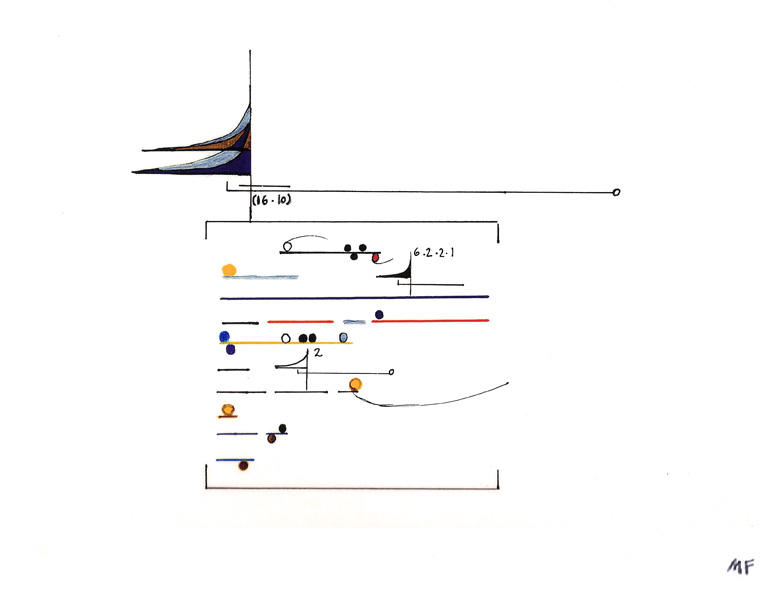
Trying to capture jazz in standard notation can be like trying to translate poetry into another language—what you wind up with is everything but the poetry. So composer/trumpeter Wadada Leo Smith (who, like many of his peers, eschews “jazz” as a label for his music) invented his own system of graphic notation.
***************
Wadada Leo Smith (trumpet) with his Golden Quartet (Vijay Iyer [piano], John Lindberg [bass], Ronald Shannon Jackson [drums]); Eclipse, 2005
Part 1
*****
Part 2
*****
Part 3
*****
Part 4
*****
Part 5
*****
Part 6
*****
Part 7
*****
Part 8
**********
lagniappe
art beat
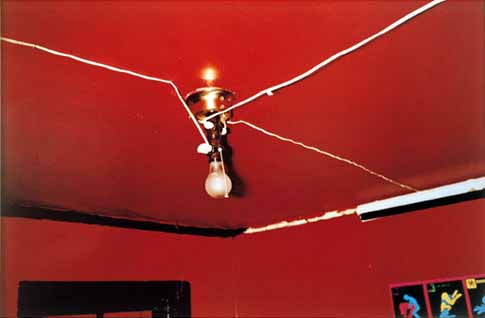
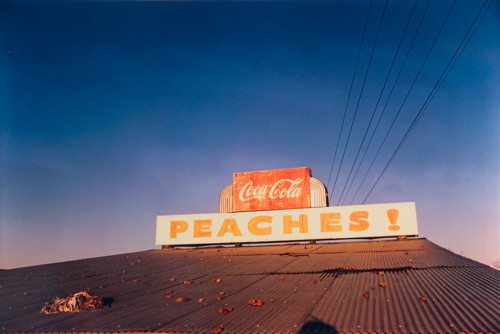
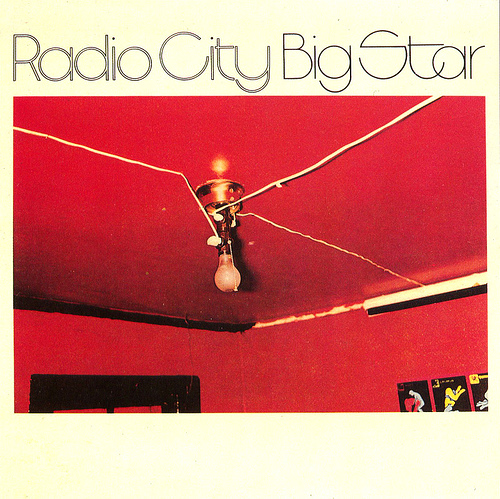
Earlier this month, when I mentioned the exhibit of William Eggleston’s photographs that’s currently at the Art Institute—posting an album cover that you’ll find in a display case there—I didn’t expect that Big Star would appear here again before the month’s end. But then I didn’t expect that Alex Chilton would pass away, either.Alex had more than simply an artistic interest in Eggleston and his work. He’d known the photographer, who was a good friend of his parents, since he was a little boy. Here, again, is the image Alex chose for that album cover, followed by a couple more from this exhibit.
What a nasty one-two punch for Memphis: first Jim Dickinson, then—seven months later—Alex Chilton.
Alex Chilton, December 28, 1950-March 17, 2010
Big Star, “Thirteen” (1972)
*****
Big Star, “September Gurls” (1974)
*****
Alex Chilton, “Bangkok” (1978)
*****
The Replacements, “Alex Chilton” (1987)
*****
Alex Chilton, “There Will Never Be Another You” (1985?)
**********
lagniappe
Alex Chilton, the pop hitmaker, cult icon and Memphis rock iconoclast best known as a member of 1960s pop-soul act the Box Tops and the 1970s power-pop act Big Star, died Wednesday at a hospital in New Orleans.
The singer, songwriter and guitarist was 59.
“I’m crushed. We’re all just crushed,” said John Fry, owner of Memphis’ Ardent Studios and a longtime friend of Chilton’s. “This sudden death experience is never something that you’re prepared for. And yet it occurs.”
***
The Memphis-born Chilton rose to prominence at age 16 when his gruff vocals powered the massive Box Tops hit “The Letter,” as well as “Cry Like a Baby” and “Neon Rainbow.”
After the Box Tops broke up in 1970, Chilton had a brief solo run in New York before returning to Memphis. He soon joined forces with a group of Anglo-pop-obsessed musicians — fellow songwriter/guitarist Chris Bell, bassist Andy Hummel and drummer Jody Stephens — to form Big Star.
The group became the flagship act for Ardent’s Stax-distributed label. Big Star’s 1972 debut album, #1 Record, met with critical acclaim but poor sales.
The group briefly disbanded, but reunited without Bell to record the album Radio City. Released in 1974, the second album suffered a similar fate, plagued by Stax’s distribution woes.
The group made one more album, Third/Sister Lovers, with just Chilton and Stephens — and it, too, was a minor masterpiece. Darker and more complex than the band’s previous pop-oriented material, it remained unreleased for several years.
In 2003, Rolling Stone magazine named all three Big Star albums to its list of the 500 Greatest Albums of All Time.
“It’s a fork in the road that a lot of different bands stemmed from,” said Jeff Powell, a respected local producer who worked on some of Chilton’s records. “If you’re drawing a family tree of American music, they’re definitely a branch.”
***
“When some people pass, you say it was the end of an era. In this case, it’s really true,” said Van Duren, a fellow Memphis musician who knew Chilton for decades. “It puts an end to the Big Star thing, and that’s a very sad thing.”—Jody Callahan, Bob Mehr, Memphis Commericial Appeal (3/17/10)
*****
A day after the death of Memphis music legend Alex Chilton, shock and sadness slowly gave way to fond remembrance by friends, fans and fellow musicians.
Over the course of a remarkably varied 40-plus-year career with the Box Tops, Big Star and as a solo artist, Chilton was a creative chameleon. A teen pop hitmaker, a reluctant cult hero, a champion of Southern roots music, a visionary producer, a punk-rock provocateur and a much underrated guitarist, Chilton had carved his place as one of the most singular figures — both as an artist and as a personality — that Memphis music has ever produced.
***
The news of Chilton’s death sent shockwaves through the annual South by Southwest music conference in Austin, Texas. The massive industry gathering kicked off Wednesday night just as word of his passing began to spread.
Chilton had been scheduled to perform with Big Star on Saturday night, part of a headlining set at Antone’s nightclub, and the group was also set to be the subject of a historical panel earlier in the day.
After consulting with Chilton’s wife and festival organizers, surviving Big Star members Jody Stephens, Jon Auer and Ken Stringfellow confirmed that the panel and performance would go on as scheduled, effectively serving as memorials for Chilton.
“It felt like we had to pay tribute in some form,” said Auer. “In a strange way, it’s amazing that it happened around something like South by Southwest. So many people there are hyper-aware of Chilton and understand what he means musically, so it seems like the perfect place to do something like this.”
The Saturday night Big Star set is shaping up to be an all-star tribute. Though the lineup is still coming together, a variety of artists including X’s John Doe, R.E.M.’s Mike Mills, indie-folk singer M. Ward, the dB’s Chris Stamey, Green on Red veteran Chuck Prophet and Chilton’s longtime New Orleans collaborators Doug Garrison and René Coman are among those expected to appear.
For Coman, the sheer breadth of Chilton’s artistry and the scope of his career remain the true measure of the man. “Alex had such a long career, and all kinds of different stages to it.” said Coman. “The people that stay in it for a really long time and still enjoy it, it seems like they wind up finding different things to keep them interested as the years go by.
Omar Souleyman is a Syrian musical legend. Since 1994, he and his musicians have emerged as a staple of folk-pop throughout Syria, but until now they have remained little known outside of the country. To date, they have issued more than five-hundred studio and live-recorded cassette albums which are easily spotted in the shops of any Syrian city.
Born in rural Northeastern Syria, he began his musical career in 1994 with a small group of local collaborators that remain with him today. The myriad musical traditions of the region are evident in their music. Here, classical Arabic mawal-style vocalization gives way to high-octane Syrian Dabke (the regional folkloric dance and party music), Iraqi Choubi and a host of Arabic, Kurdish and Turkish styles, among others. This amalgamation is truly the sound of Syria. The music often has an overdriven sound consisting of phase-shifted Arabic keyboard solos and frantic rhythms. At breakneck speeds, these shrill Syrian electronics play out like forbidden morse-code, but the moods swing from coarse and urgent to dirgy and contemplative in the rugged anthems that comprise Souleyman’s repertoire. Oud, reeds, baglama saz, accompanying vocals and percussion fill out the sound from track to track. Mahmoud Harbi is a long-time collaborator and the man responsible for much of the poetry sung by Souleyman. Together, they commonly perform the Ataba, a traditional form of folk poetry used in Dabke. On stage, Harbi chain smokes cigarettes while standing shoulder to shoulder with Souleyman, periodically leaning over to whisper the material into his ear. Acting as a conduit, Souleyman struts into the audience with urgency, vocalizing the prose in song before returning for the next verse. Souleyman’s first hit in Syria was “Jani” (1996) which gained cassette-kiosk infamy and brought him recognition throughout the country. Over the years, his popularity has risen steadily and the group tirelessly performs concerts throughout Syria and has accepted invitations to perform abroad in Saudi Arabia, Dubai and Lebanon.—Sublime Frequencies
*****
art beat
Album covers and art museums rarely mix. But in a display case at the Art Institute’s William Eggleston exhibit (which just opened), you’ll find this:



 music clip of the day