music clip of the day

jazz/blues/rock/classical/gospel/more

Tag: Anthony Braxton

Tuesday, 6/26/12

the other night

exhilarating, adj. making you feel happy, excited, and full of energy. E.g., the music of Anthony Braxton.

Ken Vandermark, arrangments, bass clarinet; Nick Mazzarella, alto saxophone; Mars Williams, alto saxophone; Dave Rempis, baritone saxophone; Josh Berman, cornet; Jeb Bishop, trombone; Jason Adasiewicz, vibraphone; Nate McBride, bass; Tim Daisy, drums; live, Chicago (Elastic, 2830 N. Milwaukee), 6/21/12

Composition No. 6 C (A. Braxton)

***

Composition No. 69 J (A. Braxton)

**********

lagniappe

Anthony Braxton sat perched on a piano bench one recent afternoon, hands folded in his lap, wearing an intent but unreadable expression. Angled away from the piano in a no-frills rehearsal space in Brooklyn, he faced the dozen or so vocalists that currently make up his Syntactical Ghost Trance Music Choir. The singers, arranged in a semicircle, were tackling Mr. Braxton’s “Composition No. 256,” staring hard at their sheet music while trying to keep track of their conductor. It was starting to seem as if the piece, a slippery, scalar proposition, were getting the best of them.

“O.K.,” said Taylor Ho Bynum, the conductor, waving the singers to a halt. Mr. Bynum, a cornetist, composer, bandleader and former student of Mr. Braxton’s at Wesleyan University, took a moment to describe the cues and signals that would further convolute the interpretation of the piece. “When in doubt, we follow Braxton,” he said.

“Which is to say, you know it’s going to be wrong!” Mr. Braxton fired back, laughing.

Mr. Bynum nodded, deadpan. “We’d follow Braxton off a cliff.”

***

Mr. Braxton, 66, has been a force in the American avant-garde since the 1960s, when he emerged in his native Chicago as a member of the Association for the Advancement of Creative Musicians. Within the first decade of his arrival, he was being toasted in some circles as “the new messiah, the new Charlie Parker-John Coltrane-Ornette Coleman,” as Whitney Balliett put it in The New Yorker.

As a composer, conceptualist and saxophonist, Mr. Braxton exemplified the steep intellectualization of one wing of jazz’s avant-garde; his compositions often included notation in the form of pictographs and algebraic formulas, and he wrote pieces not only for jazz ensembles but also for classical orchestras (in one memorable instance, for four of them at once). One piece from 1971, “Composition 19 (For 100 Tubas),” finally had its premiere five years ago as a rumbling overture to that year’s Bang on a Can Marathon in Lower Manhattan.

“I wanted to have an experience like my role models,” Mr. Braxton said after the rehearsal, at a nearby pub. “Karlheinz Stockhausen, Charlie Mingus, Iannis Xenakis, Sun Ra, Hildegard von Bingen. The people who were thinking large scale and small scale. I might not have been able to get the money to do what I would have liked to do. But you can still compose it and have the hope that maybe in the future it can be realized.”

Mr. Braxton has often suggested that his sprawling output — and the equally irreducible theoretical discourse surrounding it — should be understood as a single body of work. To that end, his music has become a bit more accessible recently, thanks to a spate of archival releases. But that hasn’t made things easier for Mr. Braxton.

“This is a somewhat frustrating time cycle for me, in the sense that I rarely work anymore,” he said. “My work has been marginalized as far as the jazz-business complex is concerned, or the contemporary-music complex.” Were it not for his tenured post at Wesleyan, where he has taught for more than 20 years, “maybe I would be driving a taxicab or something,” he said.

***

“I had never thought that I would be involved in narrative structures,” Mr. Braxton said [of his new opera Trillium J]. “As a young guy, I was more interested in abstract modeling. But as I got older, I began to see that there was no reason to limit myself to any intellectual or conceptual postulate, when in fact I’m a professional student of music.”

—Nate Chinen, “Celebrating a Master of the Avant-Garde,” New York Times, 10/4/11
Sunday, 4/29/12

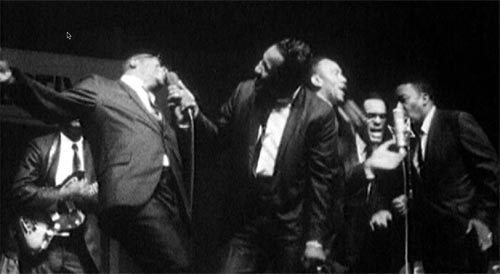
Let’s go to church.

“Until I Die,” Pilgrim Rest Baptist Church, Winston-Salem, N.C., 2001

**********

lagniappe

reading table

On the Death of Friends in Childhood

We shall not ever meet them bearded in heaven,
Nor sunning themselves among the bald of hell;
If anywhere, in the deserted schoolyard at twilight,
Forming a ring, perhaps, or joining hands
In games whose very names we have forgotten.
Come, memory, let us seek them there in the shadows.

—Donald Justice (Collected Poems, 2004)

***

“[We find] it impossible, when we have to analyze death, to imagine it in terms other than those of life.”

—Marcel Proust, The Fugitive (translated from French by Peter Collier)

*****

listening room: (some of) what’s playing

• The Dirtbombs, Ultraglide In Black (In the Red Records)

Wild Flag (Merge Records)

• That’s What They Want: The Best of Jerry McCain (Excello)

The Best of Slim Harpo (Hip-O)

• Ambrose Akinmusire, When the Heart Emerges Glistening (Blue Note)

• Lester Bowie’s Brass Fantasy, I Only Have Eyes For You (ECM)

• Anthony Braxton, 9 Compositions (Iridium)

• Chicago Tentet, American Landscapes 1 & 2 (Okka)

• Steve Lehman Octet, Travail, Transformation, and Flow (Pi Recordings)

• Joe McPhee, Nation Time (Unheard Music Series)

• Weasel Walter, Mary Halvorson, Peter Evans, Electric Fruit (Thirsty Ear)

• J. Berg’s Royal Rarities Vols. 2-3; A Cappella Archives, Vol. 3; Gospel Goldies, Vol. 2 (Rare Gospel)

• The Fisk Jubilee Quartet, There Breathes A Hope (Archeophone)

This May Be My Last Time Singing: Raw African-American Gospel On 45 RPM 1957-1982 (Tompkins Square)

• Bach, Suites for Unaccompanied Cello, Pierre Fournier, (Archiv Production/DG)

• Mozart, Piano Sonatas Nos. 16 and 17, Peter Serkin, piano (Pro Arte)

• Arnold Schoenberg, Das Klavierwerk, Peter Serkin, piano (Arcana)

The Art of Joseph Szigeti (Biddulph Recordings)

• Anton Webern, Five Movements For String Quartet, Op. 5; Six Bagatelles For String Quartet, Op. 9; String Quartet, Op. 28; Quartetto Italiano (Philips)

• Anton Webern, Complete Works for String Quartet and String Trio, Artis Quartet Wien (Nimbus)

Music of Stefan Wolpe, Vol. 6, David Holzman, piano (Bridge)

• WKCR-FM (broadcasting from Columbia University)

Bird Flight (Phil Schaap, jazz [Charlie Parker])
Traditions in Swing (Phil Schaap, jazz)
Eastern Standard Time (Carter Van Pelt, Jamaican music)
Rag Aur Taal (various, Indian)

• WFMU-FM

Mudd Up! (DJ/Rupture“new bass and beats”)
Sinner’s Crossroads 
(Kevin Nutt, gospel)
Cherry Blossom Clinic (Terre T, rock, etc.)
Fool’s Paradise (Rex; “Vintage rockabilly, R & B, blues, vocal groups, garage, instrumentals, hillbilly, soul and surf”)

• WHPK-FM (broadcasting from University of Chicago)

The Blues Excursion (Arkansas Red)

*****

radio

Happy Birthday, Duke!

All Ellington, all day: WKCR-FM.

Monday, 4/9/12

Shabazz Palaces, live (studio performance, KEXP-FM), 2011

These guys—their mix of drums, mbira, electronics—call to mind the AACM’s* tagline: ancient to the future.

*Association for the Advancement of Creative Musicians (Art Ensemble of Chicago, Anthony Braxton, Fred Anderson, Leroy Jenkinset al.).

Saturday, 11/12/11

Labels are often worse than useless. This guy, for instance, is often tagged as “cerebral.” But here’s something you can’t—I can’t, anyway—listen to without smiling.

Anthony Braxton, Composition No. 58
Taylor Ho Bynum Chicago Big Band,* live, 2009, Chicago

*****

Here’s another take—Braxton’s original recording (The Complete Arista Recordings of Anthony Braxton [Mosaic], rec. 1976).

More? Here.

**********

lagniappe

reading table

To obtain the value
of a sound, a movement,
measure from zero.

***

A sound has no legs to stand on.

***

The world is teeming: anything can
happen.

—John Cage, “2 Pages, 122 Words on Music and Dance” (excerpts)

*Taylor Ho Bynum & Josh Berman (cor), Jaimie Branch (tpt), Jeb Bishop & Nick Broste (tb), Nicole Mitchell (fl), Caroline Davis, Keefe Jackson & Dave Rempis (saxes), Jeff Parker (g), Jason Adasiewicz (vib), Nate McBride (b), Tim Daisy & Tomas Fujiwara (d)

Sunday, 9/4/11

The Dixie Hummingbirds (with Ira Tucker, lead vocals), “If You See My Savior” (T. Dorsey), live (TV broadcast), early 1960s

With a voice like this, who needs words?

(Listen, for instance, at :55 and 1:50.)

More? Here.

**********

lagniappe

listening room: (some of) what’s playing

Theo Parrish, Sound Sculptures Vol. 1 (Sound Signature)

• Various artists, Goodbye Babylon (Dust-to-Digital)

Sun Ra, Jazz in Silhouette (Evidence)

Anthony Braxton, For Alto (Delmark)

Fred Anderson, Timeless (Delmark)

• Bach, Suites for Unaccompanied Cello/Steven Isserlis (Hyperion UK [import])

• Alfred Schnittke, Piano Quintet, String Trio, etc. (Naxos)

• Morton Feldman, For Bunita Marcus, Stephane Ginsburgh, piano (Sub Rosa) (available as a download from Amazon for 89¢)

• WKCR-FM (broadcasting from Columbia University)
—Lester Young/Charlie Parker birthday marathon
Bird Flight (Phil Schaap, jazz [Charlie Parker])
Eastern Standard Time (Carter Van Pelt, Jamaican music)

• WFMU-FM
Mudd Up! (DJ/Rupture“new bass and beats”)
Sinner’s Crossroads 
(Kevin Nutt, gospel)


Sunday, 6/19/11

Gospel, soul, blues—sometimes they seem inseparable.

Willie Banks and The Messengers, live, Mississippi (Jackson), 1990

“Things I Can’t Change”

***

“God Is Still In Charge”

http://youtu.be/JZtOnq4qbt8

**********

lagniappe

listening room: what’s playing

Talib Kweli, Gutter Rainbows (Javotti Media/3d)

Art Ensemble of Chicago, Full Force (ECM)

Anthony Braxton Quartet, (GTM) 2006 (Important Records)

John Coltrane (with Rashied Ali), Interstellar Space (Impulse!)

The Lester Young/Count Basie Sessions (1936-1940) (Mosaic)

• Various Artists, Ska Bonanza: The Studio One Ska Years (Heartbeat)

Stefan Wolpe: Compositions for Piano (1920-1952), David Holzman, piano (Bridge)

• Ann Southam: Simple Lines of Enquiry, Eve Egoyan, piano (Centrediscs)

Morton Feldman, For Bunita Marcus, Stephane Ginsburgh, piano (Sub Rosa); John Tilbury, piano, Morton Feldman, All Piano (London HALL)

WKCR-FM (broadcasting from Columbia University)
Bird Flight (Phil Schaap, jazz [Charlie Parker])
Traditions in Swing (Phil Schaap, jazz)
Out to Lunch (Various, jazz)
Jazz Profiles (Various, jazz)
Jazz Alternatives (Various, jazz)
Afternoon New Music (Various, classical and hard-to-peg)
Eastern Standard Time (Carter Van Pelt, Jamaican music)
Rag Aur Taal (Various, Indian)
Morning Ragas (Various, Indian)
Amazing Grace (Various, gospel)
Live Constructions (Various, hard-to-peg)

WFMU-FM
Mudd Up! (DJ/Rupture, “new bass and beats”)
Sinner’s Crossroads
(Kevin Nutt, gospel)
—Give The Drummer Some
(Doug Schulkind, sui generis)
Transpacific Sound Paradise (Rob Weisberg, “popular and unpopular music from around the world”)
Daniel Blumin (sui generis)
Airborne Event (Dan Boodah, sui generis)
The Push Bin with Lou (Lou Z., sui generis)

*****

art beat

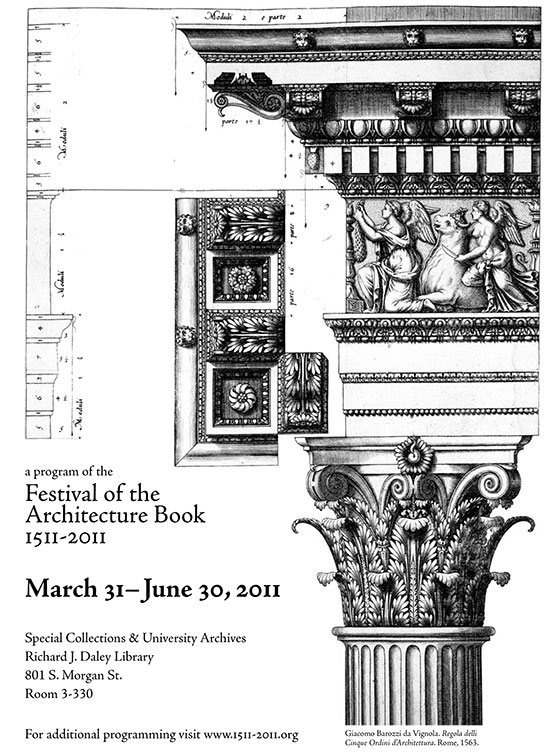
One of the great things about having friends is that they invite you to things you’d never get to, or even know about, otherwise—like, for instance, this wonderful exhibit of illustrated architecture books (dating from 1511), something I wouldn’t have gotten to but for my friend Bob Blythe.

Saturday, 6/11/11

What would Monday’s featured artist sound like if he’d come along a generation later?

Tyondai Braxton (Anthony’s son), “Dead Strings,” live, 2009

Part 1

Vodpod videos no longer available.

***

Part 2

Vodpod videos no longer available.

More? Here (with Battles, a group he’s since left).

**********

lagniappe

If you had to take five albums, books or DVDs on tour with you, which ones would they be, and why?

I picked 5 records and they are:

1. Bournemouth Symphony Orchestra & Marin Alsop: Takemitsu: The Flock Decsends Into The Pentagonal Garden
Honestly I always take this piece and the score with me on tour everywhere I go. It’s one of my favorite pieces.

2. Fela Kuti: Underground System
This record is a force. Infectious.

3. Black Dice: Miles Of Smiles
One of my favourites from this band. The mood it creates is wholly its own.

4. Chicago Symphony Orchestra & Pierre Boulez: Boulez Conducts Varèse
Varese is where my head has been for the past couple of months. Amériques is such a mind boggling piece.

5. The Bulgarian State Radio & Television Choir: Le Mystère Des Voix Bulgares 1&2
Another go-to old favorite. Stop what you’re doing and order this right now.

For DVDs, the complete Six Feet Under, The Wire and Entourage. Is any other network up to the challenge to even attempt to compete with an HBO series?

Books:

Donari Braxton: The Invisible Alphabet
New novel from my brother. It’s seriously amazing. He seems to have an inexhaustible amount of ideas and has such a great sense of control in his craft. I looked to him and his work when struggling to flesh out my own.

Alex Ross: The Rest Is Noise
Such an incredible book. Ross fed into my already glorified view of the 20th century composers and made them into the lead characters in one of the most compelling stories I’ve ever read.

John Adams: Hallelujah Junction
It’s great to hear a very down to earth narration of a composer who you respect.

Tyondai Braxton

*****

art beat

Lee Friedlander, Flowers and Trees (1981) (one of the most beautiful books I’ve ever seen), Tokyo 1977

More Lee Friedlander? Here. And here.

Monday, 6/6/11

sui generis, adj. A person or thing that is unique, in a class by itself. E.g., Anthony Braxton, composer, reed player, professor, MacArthur “genius” grant winner, one-time professional chess hustler.

Happy (Belated 66th) Birthday, Anthony!
(born June 4, 1945)

Anthony Braxton with his 12+1tet, Ghost Trance Music
New York (Iridium), 2008

Vodpod videos no longer available.

**********

lagniappe

musical thoughts

I wanted to live. I wanted to be alive. This experience goes by very quickly. Part of the radiance of a moment, in my opinion, involves that which we call music.

***

Suddenly, Coltrane solos become the “it” of music, when in fact, the records and the notated solos are the sonic footprints, the bone structure of what actually happened in the music.

***

I wanted a system that would be equal to the dynamics of curiosity. I wanted to have a music where I could have some fun.

***

There is the wonderful discipline of music and the ability of music to keep on opening up fresh prospects. I must say, what a discipline!

—Anthony Braxton

Saturday, 4/16/11

Billy Bang (AKA William Vincent Walker), violinist, 9/20/47-4/11/11

Billy Bang Quintet (BB, violin; Frank Lowe, tenor saxophone; Ahmed Abdullah, trumpet; William Parker, bass; Abbey Rader, drums), live, New York (Knitting Factory), 10/1/00

Vodpod videos no longer available.

*****

Billy Bang Quartet (BB, violin; Ngo Thanh Nahn, dan tranh; Todd Nicholson, bass; Shoji Hano, drums), live, New York (Vision Festival X), 6/18/05

Vodpod videos no longer available.

**********

lagniappe

As I lived in Harlem in the early Fifties as a kid, I heard music all around me from the jazz clubs and from the candy stores. They had speakers outside the candy stores that they would play music, music like Eddie Harris and once in a while, Brubeck’s “Take Five.” So I started hearing jazz very, very early, and when you lived in Harlem in those days, it was in the blood. It was in the people. It was in the clothing. It was prevalent. As a young man, I bought a pair of bongos and two of my friends and I used to play the bongos on the New York City subway system. We would take turns dancing and playing the bongos and earn some money. That was my professional debut in the music.

***

I bought the Delmark records and heard Leroy Jenkins. Then I started hearing all the Joseph Jarman and Roscoe Mitchell. I loved the AACM. I loved Delmark for putting them out, Muhal Richard Abrams. This music really turned me on. It seemed very political, very conscious for me at the time and also very free, but with structure. So when Leroy Jenkins came to New York, I tracked him down and I did a little study with him for about six months. It was enough to reshape my direction. I already had a direction, but it really straightened it. From that point on, I just kept trying to go for it. Nobody would hire me, but that didn’t stop me. I would hire myself and hire a band and we would play at places like lofts in New York. Eventually, loft jazz became very, very big in New York and that catapulted my name and my career. During that period, I did all sorts of things, sitting in with Sam Rivers at The Five Spot. I sat in with Jackie McLean. I just had to be around the music and the cats that I loved and respected. I was disappointed that John Coltrane passed away because I think I would have followed him day after day after day to try and get in his band.

***

[The loft scene] was a very big thing. I think that catapulted my name internationally along with the David Murrays, the Henry Threadgills, the Frank Lowes, the Lester Bowies, the Joe Bowies. A lot of us wrote our own compositions. We weren’t playing standards. The bebop guys had to play standards to be legitimate. We were able to create our own music, direction, and compositions that also helped to lend a more directional input into the music. The loft jazz’s impact of it came when the Newport Jazz Festival came to New York that year and they didn’t hire any of us, so we had our own loft jazz festival. There were meetings and I remember Archie Shepp was talking and Rashied Ali was talking. I was very, very happy to be in New York at that time and to be around such a powerful movement with powerful names in it, Braxton, a lot of cats, all the cats that I love. We started setting up concerts all over, all the places. Sam Rivers had Rivbea and Rashied Ali had Ali Alley, which is where I played most of the time. When I played there with my Survival group, Werner Uehlinger came from hatHUT and he signed me to do a solo record. We were very adamant and strong about what we were doing. We were committed in belief. The World Saxophone Quartet started. The String Trio of New York started. Air was here. There was a lot of power going on simultaneously. There was a movement going on. We actually saw it in the making. I find it extremely important. The only reason why it does not have as much importance as I see it is because a lot of the writers didn’t pick up on it. Francis Davis from Philadelphia, he did and Stanley Crouch to some degree. There were people that picked up on it, but it wasn’t enough of a movement. The next year, George Wein hired some of the loft guys to play at the jazz festival. I was even offered a gig there with the String Trio. I didn’t make it because I like to hold out. I will be very honest, Fred. After I did my tour in Vietnam, I felt above a lot of the everyday activities in this world. I faced death and I think I had died more than once, so after that, I was sort of an untouchable. Me with my music, I didn’t feel the threatening situation that others felt. I didn’t feel obligated to have to compromise or the necessity to have to kiss anybody’s ass. I was determined to be focused in a Billy Bang direction until today, I am the same way. I think that strength is what kept me going, that commitment of strength, that conviction. They didn’t like the things that I did in the beginning. In fact, I didn’t like a lot of it, but I was committed enough to keep trying and not be shot down by critics, writers, peers, whomever.

***

Cats [today] are trying to be technical. You can exercise all your technical prowess and you sound like what’s been out already. I hear more guys sound like Clifford Brown or Freddie Hubbard then I heard them do. That was not the thing. We were always going for individual voices and individual sound. That is the only thing that almost made me stop. I didn’t sound like anybody. I thought I sounded so horrible that one particular day, I was ready to smash up my violin and I remember James Jackson from the Sun Ra band came in and tried to recruit me and he had a long talk with me. He told me that I had my own sound and that I had a Billy Bang sound. I took that to heart and started working from that perspective and saying that I needed to keep working at it and developing my sound.

Billy Bang (2003)