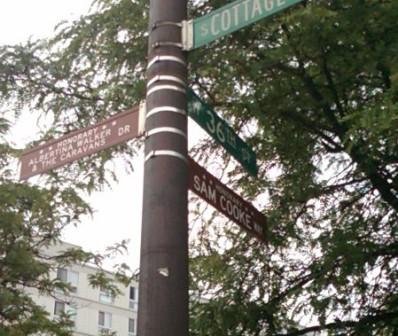
Chicago’s South Side, W. 36th St. (Honorary Sam Cooke Way, as of this month) and S. Cottage Grove Ave. (Honorary Albertina Walker & The Caravans Drive)
Few musicians, on any instrument, give me so much joy.
Ed Blackwell, October 10, 1929-October 7, 1992
Mal Waldron Quintet (Mal Waldron, piano, with Ed Blackwell, drums; Reggie Workman, bass; Charlie Rouse, saxophone; Woody Shaw, flugelhorn), “The Git-Go,” live, New York (Village Vanguard), 1986
I’ve been playing with Blackwell over 20 years. We used to play when I first went to Los Angeles. Blackwell plays the drums as if he’s playing a wind instrument. Actually, he sounds more like a talking drum. He’s speaking a certain language that I find is very valid in rhythm instruments.
Very seldom in rhythm instruments do you hear rhythm sounding like a language. I think that’s a very old tradition, because the drums, in the beginning, used to be like the telephone—to carry the message.
In one of my clearest memories of the drummer Ed Blackwell, he sat in an Indian restaurant drawing percussion notation on the tablecloth with a felt-tipped pen. The waiters looked on, aghast, as the splodgy black figures spread across their white linen, but Blackwell, rapt in concentration behind his dark glasses, remained oblivious. Music was all that mattered to him, the drums in particular, and there was a particular point he needed to make.
***
Blackwell was a deeply serious artist who, whatever his circumstances, put the music first and insisted his associates did likewise. In New York percussion circles he was seen as a teacher. He often quoted the Chinese adage, ‘Neglect your art for a day, and it will neglect you for two’, and would actively pursue other drummers whom he respected, should he feel they reneged on commitment.
I never saw him without a pair of drumsticks or homemade mallets in his hand; these he would employ constantly as much to accentuate a point as to strengthen his wrists. Some percussionists have made a cabaret act from beating out rhythms on any available surface; Blackwell would do it to fill in gaps in conversation. He played drums like that, too: the perfect listener, who could equally stimulate and inspire with his enviable grasp of polyrhythmic possibilities.
No jazz musician can claim greater authenticity than a New Orleans birth. It is the most African of US cities, where Yoruba religious practice continues and the Second Line that accompanies street-parades moves with an African strut. From the moment he could walk, Blackwell was part of that Second Line and as a child he danced in the street for pennies. That characteristic dancestep and the ‘double-clutching’ two-beat of the parade bass drum remained features of his playing, securely anchoring his adventurousness in an earlier memory.
This is the first project, in my 30-year career, that I have devoted to the music of someone else. It grew out of “Sitting by the Window,” a homage to Curtis Mayfield that I wrote for my band In Order To Survive. The current project develops this inspiration while trying to call upon the spirit in which Curtis Mayfield wrote his songs. We are trying to let that spirit find its voice today through musicians who not only know Mayfield’s songs, but more importantly, know themselves. They are familiar with the language of a music that includes Curtis Mayfield as well as Sun Ra.
I grew up listening to Smokey Robinson, The Temptations, Martha and The Vandellas, Gladys Knight and The Pips, and Curtis Mayfield and The Impressions. In my mind, their music was not separate from Marian Anderson, Count Basie, Coleman Hawkins, Ben Webster, Don Byas, Sarah Vaughn, Ornette Coleman, Don Cherry, Cecil Taylor, Bill Dixon, and Louis Armstrong. All this music is part of an African American tradition that comes out of the blues. The roots of the jazz known as avant-garde are also in the blues, the field holler, and the church. Avoiding artificial separations is the key to understanding the true nature of the music. All these artists ultimately speak using this reservoir of sounds and colors that we can use to paint our own music.
The music that passed through the life and work of Curtis Mayfield cannot be duplicated. The question becomes, how can it then continue? I also ask myself this question in connection to Duke Ellington or Thelonious Monk. It always seemed to me that when Ellington died, the music physically died with him. We were left orphaned, with just the recorded part of his work and all these notes on paper, but that is not the reality. Once you realize this truth, you can find a different way to proceed to re-create the songs. Paradoxically, you can only find a way to play the music by initially affirming that it cannot be done. Let us imagine the Creator: part of his voice was expressed through Duke Ellington, a part through Albert Ayler, another part through Curtis Mayfield. The method doesn’t consist in following or imitating anyone’s style; the method consists of plunging into the Tone World, which is the source of all music. You can’t counterfeit a music. One can only collect strands and begin to weave a new tapestry out of them.
Curtis Mayfield was a prophet, a preacher, a revolutionary, a humanist, and a griot. He took the music to its most essential level in the America of his day. If you had ears to hear, you knew that Curtis was a man with a positive message—a message that was going to help you to survive. He was in the foreground, always in the breach, both soft and powerful at the same time. For these reasons, his music still resounds in my heart.
Live (as I heard it Thursday night), this music hits like a tidal wave, washing over you, engulfing you.
Percy Gray, Jr. & the Chicago Mass Choir (joined by, among others, Joe Ligon [Mighty Clouds of Joy] at 7:00-8:05), “God Is My Everything,” Musical Tribute to the late Albertina Walker, live, Chicago (Apostolic Church of God, 63rd & Dorchester), 10/14/10
**********
lagniappe
technical stuff
In the stuff-you-may-already-know department, there are sites—like this—where you can convert YouTube clips to mp3s.
Albertina Walker, October 29, 1929-October 8, 2010
“I Can Go To God In Prayer” (joined, at the end, by Patti LaBelle), live, Chicago, 1991
*****
“Please Be Patient With Me” (with James Cleveland), live, Chicago, 1979
This track, which I first encountered 30 years ago, I never tire of hearing.
*****
“Lord Keep Me Day By Day,” live (James Cleveland’s funeral), Los Angeles, 1991
**********
lagniappe
Somebody gonna leave here feeling a little better than they did when they came in . . .
—Albertina Walker
**********
Happy Birthday, Monk!
In celebration of the birthday of Thelonious Monk (October 10, 1917-February 17 1982), WKCR-FM is playing his music all day—and we’re replaying some clips.
**********
Here is the onliest Thelonious.
Thelonious Monk, “Epistrophy,” live (TV broadcast), Paris, 1966
*****
Thelonoius Monk, “’Round Midnight,” live (TV broadcast)
*****
You can tell a lot about Monk’s music—about the centrality of dance, about the interplay between melody and rhythm, about the way a melody’s irregular accents override the pulse (making the dance melodic)—just by watching, in the second performance, the way his right foot moves.
**********
lagniappe
He played each note as though astonished by the previous one, as though every touch of his fingers on the keyboard was correcting an error and this touch in turn became an error to be corrected and so the tune never quite ended up the way it was meant to be.
***
You had to see Monk to hear his music properly. The most important instrument in the group—whatever the format—was his body.
—Geoff Dyer, But Beautiful: A Book About Jazz (1996)
(Originally posted 11/2/09.)
**********
Yeah, the format might seem a little strange: soprano saxophone, unaccompanied. But Monk’s musical language—its tangy mix of geometric elegance and off-kilter bluesiness—is rarely spoken this eloquently.
Sam Newsome, Thelonious Monk Medley, live, 2008
**********
lagniappe
The clarity and logic of his [Thelonious Monk’s] work might have been compared with the craft of an architect. Each phrase, each fragment, each plump chord had its exact place in his musicial structure.—Mimi Clar (in Robin D. G. Kelley, Thelonious Monk: The Life and Times of an American Original[2009])
*****
‘All jazz musicians are mathematicians unconsciously’ was a favorite theory of Monk’s.—Randy Weston (in Deborah Kapchan, Traveling Spirit Masters: Moroccan Gnawa Trance and Music in the Global Marketplace [2007])
(Originally posted 11/25/09.)
**********
genius at work
Thelonious Monk with saxophonist Charlie Rouse, working out a number, “Boo Boo’s Birthday,” during a recording session, 1967
*****
Thelonious Monk (with Charlie Rouse, tenor saxophone; Ben Riley, drums; Larry Gales, bass), “Boo Boo’s Birthday” (Underground [Columbia], 1968)
(Originally posted 12/28/09.)
**********
What did it sound like when Beethoven, seated at the piano, played Bach? For that we have to use our imagination. For this we don’t.
Thelonious Monk plays Duke Ellington, live, Berlin, 1969
[T]he only time I’ve ever seen Monk act like a little boy and looking up to somebody [was in the presence of Duke Ellington]. That was his idol.—Joe Termini (quoted in Robin D. G. Kelley, Thelonious Monk: The Life and Times of an American Original [2009])
 music clip of the day