I’ve tried listening to his recordings while doing something else, but that hasn’t worked. Whatever else I was doing, I just put aside. If it was nighttime, I turned off the light. Some music occupies every available inch of space—there isn’t room for anything else.
Alfred Cortot: Frederic Chopin, “Farewell” (Waltz in A-flat major, Op. 69, No. 1 [excerpt]); Robert Schumann, “Der Dichter Spricht” (Op. 15, No. 13 in G major [excerpt])
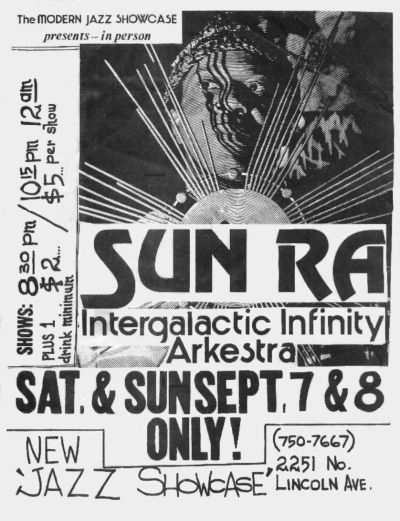
Here’s a big birthday shout-out to my wife Suzanne, who’s not nearly as crazy as I am about music—not nearly as crazy, period—but is crazy enough that she kept going out with me after I took her on our first date, in the summer of 1974, to Chicago’s Jazz Showcase (then on Lincoln Avenue) to see this guy, whose multimedia performance that night featured some of this footage—the stuff with the pyramids.
Sun Ra & His Arkestra in Egypt and Italy, 1971
**********
lagniappe
Even in the excesses of this era there were few audiences prepared for an ominous, ragtag group of musicians in Egyptian robes, Mongolian caps (Mongolian, as from the planet Mongo of Flash Gordon), and B-movie spacesuits who played on a variety of newly invented or strangely modified electronic instruments (the sun harp, the space organ, the cosmic side drum) and proclaimed the greatness of the most ancient of races (this, the Sun Ra of the Solar-Myth Arkestra); or, on yet another night, a merry band in jester’s motley, jerkins, and pointed caps (a la Robin Hood or perhaps the Archers of Arboria) who marched or crawled through the audience, chanting cheerful songs about travel to Venus. It was intensely dramatic music, moving from stasis to chaos and back, horn players leaping about, or rolling on the bandstand, sometimes with fire eaters, gilded muscle men, and midgets, an all-out assault on the senses. At the end of the evening the musicians and dancers moved among the audience, touching them, surrounding them, inviting them to join the Arkestra in marching off to Jupiter.
—John F. Szwed, Space Is The Place: The Lives And Times Of Sun Ra (1997)
*****
Sun Ra’s consistent statement, musically and spoken, is that this is a primitive world. Its practices, beliefs, religions, are uneducated, unenlightened, savage, destructive, already in the past. . . . That’s why Sun Ra returned only to say he left. Into the future. Into Space.
—Amiri Baraka (formerly known as LeRoi Jones)
*****
Silence is music. There are different kinds of silence, each silence is a world all of its own . . . silence is an integral part of all music . . .
***
When you meet a man
You meet a scheme of words
Patterns of concept
A concepted being
Whose very birth conception is called.
***
The earth cannot move without music. The earth moves in a certain rhythm, a certain sound, a certain note. When the music stops the earth will stop and everything upon it will die.
Thelonious Monk, “Epistrophy,” live (TV broadcast), Paris, 1966
*****
Thelonoius Monk, “’Round Midnight,” live (TV broadcast)
*****
You can tell a lot about Monk’s music—about the centrality of dance, about the interplay between melody and rhythm, about the way a melody’s irregular accents override the pulse (making the dance melodic)—just by watching, in the second performance, the way his right foot moves.
**********
lagniappe
He played each note as though astonished by the previous one, as though every touch of his fingers on the keyboard was correcting an error and this touch in turn became an error to be corrected and so the tune never quite ended up the way it was meant to be.
***
You had to see Monk to hear his music properly. The most important instrument in the group—whatever the format—was his body.
—Geoff Dyer, But Beautiful: A Book About Jazz (1996)
. . . I received five hundred thousand discrete bits of information today, of which maybe twenty-five are important. And how am I going to sort that out, you know?
—David Foster Wallace (in David Lipsky, Although of Course You End Up Becoming Yourself: A Road Trip with David Foster Wallace [2010])
*****
great minds at work
When you see your starting pitcher win a game, that means you’ve played a good baseball game.
—Lou Piniella, talking with Ron Santo on WGN Radio before last night’s Cubs game
Brave Combo played a wild set Sunday night (the 4th) at FitzGerald’s American Music Festival—everything from “Beer Barrel Polka” to a hard-rockin’ “Hokey Pokey” to a polka-inflected “Ode to Joy” (“Any Beethoven fans in the house?”) to a Tejano-style “America the Beautiful.” By the end of the 90-minute set, everybody’s IQ, it seemed, had gone up 15 points. Or was it down?
On Saturday night these guys played this, in overdrive, at FitzGerald’s American Music Festival, a wonderful 4-day event that just celebrated its 30th anniversary.
The funkiest, countriest quartet. As a church once rocked to guitarist William ‘Pee Wee’ Crawford’s vamps, the late Reuben Willingham quipped, ‘This may not be a Fish Fry, but it sure got soul.’ The Augusta-based Swanees maintained the same background—Charlie Barnwell, Rufus Washington and the good-humored falsetto James ‘Big Red’ Anderson—for over thirty years. Some of James Brown’s grooves were first set down by his friends the Swanees. Veteran leads included Willingham, Johnny Jones (the finest singer in the post Sam Cooke tradition, with a range from baritone to high falsetto, and a more vivid, sanctified persona than his idol Cooke) and Percy Griffin.
—Anthony Heilbut, The Gospel Sound: Good News and Bad Times (6th ed. 2002)
*****
Swanee Quintet, live
“What Are They Doing In Heaven” (featuring Johnny Jones), TV broadcast
*****
“Little Talk With Jesus” (featuring Johnny Jones), TV broadcast
*****
“New Walk” (featuring Reuben Willingham and Johnny Jones), TV broadcast
*****
“Doctor Jesus” (featuring Percy Griffin and Johnny Jones)