music clip of the day

jazz/blues/rock/classical/gospel/more

Saturday, 9/25/10

I’ll take some of whatever he’s having.

Hylton The Whistler Brown, Reggae Radio Show, 2007

**********

lagniappe

radio gems: sounds of Jamaica (reggae, rocksteady, ska)

Eastern Standard Time
WKCR-FM
New York (Columbia University)

Saturday, 6-10 a.m. (EST)
(archived shows)

Friday, 9/24/10

Career plan for the next life, if tap-dancer and rubboard player don’t pan out: reggae bassist.

Lee “Scratch” Perry, Junior Murvin, The Heptones, The Congos, The Upsetters, “Play On Mr. Music,” live, Jamaica (Roots Rock Reggae [1977]),

Thursday, 9/23/10

Happy Birthday, Trane!

John Coltrane, September 23, 1926-July 17, 1967

“Naima,” live (with McCoy Tyner, piano; Jimmy Garrison, bass, Elvin Jones, drums), Europe, 1965

#1 (7/27/1965, Antibes, France)

***

#2 (4/1/1965, Comblain-La-Tour, Belgium)

**********

lagniappe

[Coltrane’s sound is] [b]ig, resonant, and it begins at a very high level. He comes to the microphone and delivers a big block of sound rather than doing the normal sort of bell-shape that the best soloists tend to do, where they start out small, then they get big, then they get small and elegant.

Physical descriptions of his sound, especially from my own mouth, always sound meager, because the whole thing about his sound—and the reason I keep using that word in the book—has to do with the fact that if you follow his career, and if you look at what he was doing at the end of his life, you hear these tracks that seemed more and more similar from one to the next, so in the end the message of his work was not so much about composition or structure any more, it was about sound—both the sound coming out of his individual instrument, and the sound coming out of his band.

—Ben Ratliff

*****

thinking about time

The distance between today and 1965—the year of these performances (yesterday’s, too)—is like that between 1965 and 1920.

*****

radio

Today it’s all Trane all the time on WKCR-FM.

Wednesday, 9/22/10

Some performances are so full of energy and ideas and feeling—so full of life—you wish they’d never end.

Sonny Rollins (with Alan Dawson, drums; Niels-Henning Orsted Pedersen, bass); “Oleo” (excerpt), live, Denmark (Copenhagen), 1965

Often, as here, the heart of a jazz performance can be found in the interplay between horn and drums. Listen, for instance, to the way these two play off one another at :44-58.

**********

lagniappe

More from the same performance (featuring drummer Alan Dawson).

***

***

Where did Tony Williams come from?

He began taking lessons from Alan Dawson, in Boston, when he was eleven years old.

At seventeen, he was playing with Miles Davis.

*****

Want more of Sonny Rollins? Here. Here.

Tuesday, 9/21/10

No tenor player moves me more.

Von Freeman

“I Can’t Get Started” (excerpt), live, Belgium, 1992

*****

“Blues for Sunnyland,” live, Germany (Berlin), 2002

*****

Live, Chicago, 2009

**********

lagniappe

Being a local legend can be a mixed bag. Consider Von Freeman, the 72-year-old tenor saxophonist who reigns as Chicago’s preeminent local jazz legend. In the 40s, he performed with bop genius Charlie Parker. In the 60s, Miles Davis tried to hire him as a replacement for John Coltrane. In the 80s, he and his son Chico, a formidable saxophonist himself, shared an album with the first family of jazz: trumpeter Wynton Marsalis, his saxophonist brother Branford, and his pianist father Ellis (Fathers and Sons, Columbia). And in the 90s, he’s performed at New York’s most prestigious concert halls–Lincoln Center and Carnegie Hall.

But legendary status can have drawbacks. It’s opened a lot of doors for Freeman, making him a familiar figure at a variety of local clubs (including the Bop Shop, the Green Mill, Pops for Champagne, and Andy’s). But appearing so often at so many places can make a performer seem as unremarkable as a crooked alderman. And the tag “legendary,” which smacks of the sort of hushed reverence usually reserved for the dead, can make a performer seem less a vital artist–one who continues to take chances–than a bloodless icon.

But Freeman is neither unremarkable nor bloodless. Hearing him live is like taking a tour of a fun house: you never know what you’ll find behind the next door.

Upon entering, the first thing you notice is that the floor seems tilted–the result of Freeman’s distinctively oblique intonation. His sour off-center tone–which occasionally prompts charges that he plays out of tune–invests the best of his performances with a hard-edged emotional intensity. When he played Charlie Parker’s “Confirmation” on a recent weekend at the Jazz Showcase, where he led a fine quintet (Brad Goode on trumpet; Joan Hickey on piano; Mendai on bass; Robert Shy on drums one night and Michael Raynor on drums the other), he bristled with energy but also sounded wounded. And when he played the ballad “Lover Man,” he conjured up a world that was unremittingly bleak.

Freeman’s improvisations take you quickly from one room to the next. Some of them, like the meowing slurs during an unaccompanied solo on the ballad “Body and Soul,” are breathtakingly strange. Others, like the wild chorus at the top of his range on Duke Ellington’s “Caravan,” offer hair-raising adventure.

Not all of his ideas are equally striking. But jazz improvisation on the order of Freeman’s is necessarily a hit-or-miss affair. As Somerset Maugham put it, only the mediocre are always at their best.

Throughout the recent performance Freeman played the role of genial host. One moment he was encouraging the bassist: “Hit it, Mendai!” The next he was indulging in Von-speak, adding the ending “-ski” to proper nouns, turning himself into “Vonski” and the Duke Ellington piece into “Caravanski.” And in another he was explaining, in a tone half mocking and half serious, the unpredictable nature of jazz: “Sometimes this horn plays and sometimes it doesn’t. I have no control over it.”

At their best, Freeman’s performances dazzle in ways all too rarely encountered in jazz these days. While the well-mannered music of many of today’s most acclaimed performers (Wynton Marsalis, Marcus Roberts) may have its appeal, it generally lacks those undomesticated virtues that Freeman’s music celebrates: daring, originality, and unpredictability. Like the man himself, Freeman’s musical values are a product of this city. He began developing them while attending DuSable High School, where–like many other Chicago-bred jazz giants, including fellow tenor saxophonists Gene Ammons, Johnny Griffin, and John Gilmore–he studied under the fabled music teacher Captain Walter Dyett. As Freeman once explained in a New York Times interview, Dyett stressed originality, preaching a message both simple and elusive: “Try and find yourself.” Even when performing classic material (Ellington, Parker, Monk), Freeman’s music sounds brand-new. The difference between him and many younger musicians who have achieved greater renown is like that between a fun house and a museum.

—“Jazz Tilt-A-Whirl,” (review of Von Freeman, Jazz Showcase, 1/13-14/1995), Chicago Reader, 1/26/1995 (yeah, I’m cannibalizing myself here)
*****

. . . one of the most original and creative tenormen of the 1950s and, in light of other work I’ve heard by him, a great tenor player by any standards.

***

An exceptional artist, he belongs in jazz’s pantheon.

—Harvey Pekar, JazzTimes, 1-2/2001

Monday, 9/20/10

two takes

“Hard Times” (Curtis Mayfield)

John Legend & The Roots, live (recording studio), 2010

***

Baby Huey & the Babysitters, 1971 (The Baby Huey Story: The Living Legend, produced by Curtis Mayfield and released, posthumously [the singer died, at 26, in 1970], on Curtom Records)

I must have seen Baby Huey & the Babysitters at least a half-dozen times. In the late ’60s they played the Chicago area teen clubs. Tight rhythm section, punchy horns, soulful vocals—what could be, at 16, a finer date?

Sunday, 9/19/10

The Reverend Al Green

Memphis (Full Gospel Tabernacle Church), Sunday, 6/15/08

Want more? Here. Here.

**********

reading table

your rice field
my rice field
the same green

—Kobayashi Issa, 1815

*****

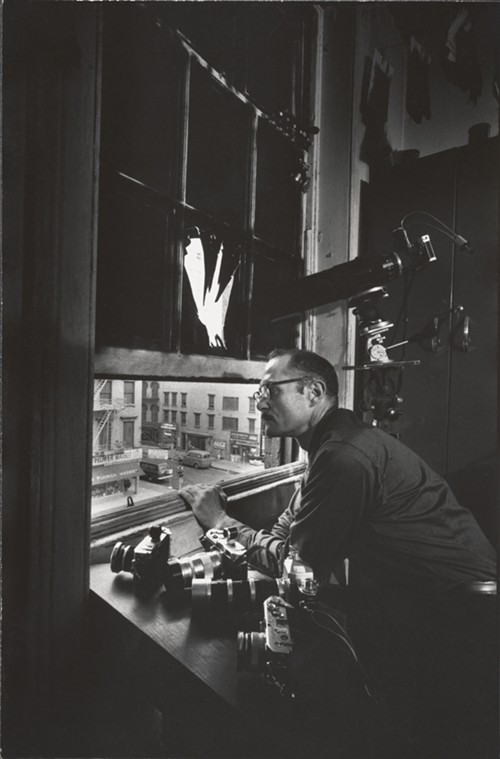
art beat: closing today

The Jazz Loft Project, W. Eugene Smith in NYC, 1957-1965 (Chicago Cultural Center)


Saturday, 9/18/10

replay: a clip too good for just one day

Here’s Arthur Russell, the “seminal avant-garde composer, singer-songwriter, cellist, and disco producer” who died in 1992 at the age of 40 (of AIDS-related complications)  and is the subject of both a recent documentary, Wild Combination, and a new book, Hold On To Your Dreams: Arthur Russell and the Downtown Music Scene, 1973-1992.

Arthur Russell

“Get Around To It”

*****

“You And Me Both”

*****

“This Is How We Walk on the Moon”

*****

“That’s Us/Wild Combination”

(Yeah, the fact that I’m posting four tracks by this guy shows how much his music, which I just encountered recently, has been getting under my skin.)

(Originally posted on 11/23/09.)

**********

lagniappe

[Russell’s] various distinctions—folkie, art-music songwriter and improviser, dance-club maven—seem incoherent until you hear several of his records. When musicians get angry about being categorized by critics, I usually feel frustrated: readers, after all, want to know what the record sounds like. With Russell, I take the musicians’ angle. Just listen to it and you’ll understand.

—Ben Ratliff, “The Many Faces, and Grooves, of Arthur Russell,” New York Times, 2/29/04

*****

For Arthur, there was no cachet to being eclectic. Rather, he played across genre because it would have required a colossal and entirely counterproductive effort on his part to stick to one sound. . . . Drifting into an ethereal, gravity-defying zone, Arthur had come to embody the interconnectivity of music.

—Tim Lawrence, Hold On To Your Dreams: Arthur Russell and the Downtown Music Scene, 1973-1992 (2009)

Friday, 9/17/10

Many years ago, when I was younger than my sons are now (22, 19), I listened to this album (Forever Changes) day after day after day.

Arthur Lee and Love, “Alone Again Or,” “A House Is Not A Motel,” England (London), 2003

Thursday, 9/16/10

What a joy it is to hear an improvising musician whose mind moves as fast as her fingers.

Geri Allen, live, Atlanta, 2009

**********

lagniappe

art beat

In 1932 I saw a photograph by Martin Munkacsi of three black children running into the sea, and I must say that it is that very photograph which was for me the spark that set fire to the fireworks . . . and made me suddenly realize that photography could reach eternity through the moment. It is only that one photograph which influenced me. There is in that image such intensity, spontaneity, such a joy of life, such a prodigy, that I am still dazzled by it even today.

—Henri Cartier-Bresson (the Cartier-Bresson exhibit continues at the Art Institute of Chicago through 10/3/10)

Martin Munkacsi, Three Boys at Lake Tanganyika, c. 1930

*****

radio: space is the place

Tonight, from 6-9 p.m. (EST), WKCR-FM (broadcasting from Columbia University) will be featuring recordings of live performances by Sun Ra & His Solar Arkestra at Soundscape, a New York loft space (West 52nd St. and 10th Ave.) that presented live music from 1979 to 1983.