Here, in MP3 format, is a track featuring a guy we listened to the other day: Cecil Taylor, with drummer Tony Williams (“Morgan’s Motion,” from Williams’ 1978 album The Joy of Flying).
Johnny Cash, “Ain’t No Grave,” 2003 (recorded), 2010 (released)
Vodpod videos no longer available.
**********
lagniappe
The Johnny Cash Project is a global collective art project, and we would love for you to participate. Through this website, we invite you to share your vision of Johnny Cash, as he lives on in your mind’s eye. Working with a single image as a template, and using a custom drawing tool, you’ll create a unique and personal portrait of Johnny. Your work will then be combined with art from participants around the world, and integrated into a collective whole: a music video for “Ain’t No Grave,” rising from a sea of one-of-a-kind portraits.
Strung together and played in sequence over the song, the portraits will create a moving, ever evolving homage to this beloved musical icon. What’s more, as new people discover and contribute to the project, this living portrait will continue to transform and grow, so it’s virtually never the same video twice.
Ain’t No Grave is Johnny’s final studio recording. The album and its title track deal heavily with themes of mortality, resurrection, and everlasting life. The Johnny Cash Project pays tribute to these themes. Through the love and contributions of the people around the world that Johnny has touched so deeply, he appears once again before us.
The Johnny Cash Project is a visual testament to how the Man in Black lives on—not just through his vast musical legacy, but in the hearts and minds of all of us around the world he has touched with his talent, his passion, and his indomitable spirit. It is this spirit that is the lifeblood of The Johnny Cash Project. Thank you for helping Johnny’s spirit soar once more. God bless.
—New Orleans restaurateur Provino Mosca, quoted in Calvin Trillin, U.S. Journal, “No Daily Specials,” New Yorker, 11/22/10
*****
radio
Happy Birthday, Hawk!
Today, Coleman Hawkins’ (106th) birthday, the folks at WKCR-FM (broadcasting from Columbia University) are celebrating in their usual way—playing his music all day (and then some [’til 9:30 a.m. tomorrow]).
If you have any doubts about the transformative powers of music, watch this. I’ve spent more hours than I could count in prisons, state and federal, in Illinois and Ohio and Wisconsin, meeting with clients. Never have I seen folks so relaxed.
Johnny Cash, live, San Quentin, 1969
“I Walk the Line”
***
“Folsom Prison Blues”
Vodpod videos no longer available.
***
“Orange Blossom Special”
***
“Jackson” (with June Carter Cash)
**********
lagniappe
reading table
There is nothing in our material world more beautiful than the book.
—Patti Smith (after winning this year’s National Book Award for nonfiction for her memoir Just Kids)
—Cecil Taylor (when asked what advice he would give to a young musician)
Cecil Taylor, live, 1981 (Imagine the Sound)
**********
lagniappe
art beat
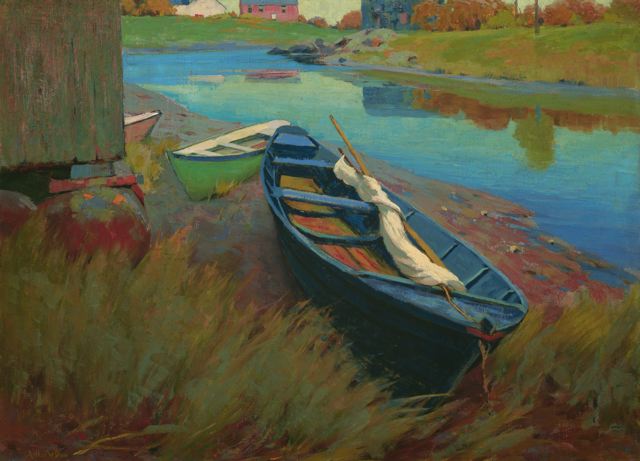
Going to an art museum you never know what you may encounter. This painting, for instance, I’d never laid eyes on—never even heard of the artist—until I happened upon it the other day at Chicago’s Art Institute.
Arthur Wesley Dow (American, 1857-1922), Boats at Rest
MCOTD’s alter ego has a letter in today’s New York Times Book Review.
To the Editor:
In connection with his review of Stephen Sondheim’s “Finishing the Hat” (“Isn’t It Rich?” Oct. 31), Paul Simon, in the Up Front, says that when he wrote the refrain to “Bridge Over Troubled Water” — “Like a bridge over troubled water, I will lay me down” — he had “no idea where those words and melody came from.” It takes nothing away from Mr. Simon to note that one apparent source of inspiration for this line was the Swan Silvertones’ gospel song “Oh Mary Don’t You Weep,” which was released in 1959. That recording, which features the wonderful Claude Jeter on lead vocals, includes the ad-libbed line “I’ll be a bridge over deep water if you trust in my name.” Mr. Simon has previously acknowledged this link.
RICHARD MCLEESE
Oak Park, Ill.
The Swan Silvertones, “Oh Mary Don’t You Weep” (1959): MP3
*****
replay: a clip too good for just one day
If influence were compensable, Claude Jeter of the Swan Silvertones—a huge influence on Sam Cooke, Curtis Mayfield, Eddie Kendricks (Temptations), Al Green, even Paul Simon (who took inspiration from a line in the Swans’ “hit” “Oh Mary Don’t You Weep” [“I’ll be a bridge over deep water if you trust in my name”] when he wrote “Bridge Over Troubled Water”)—would have, when he passed earlier this year at the age of 94, died a wealthy man.
Swan Silvertones, “Only Believe,” live
**********
lagniappe
When he leaves the house [in NYC], he whistles his favorite tune, ‘What A Friend We Have In Jesus,’ while greeting the assorted neighborhood junkies and prostitutes who knew him mainly as sometime manager of the [Hotel] Cecil. ‘What’s new, Jeter,’ they ask. ‘Nothing new, nothing good, just thank God for life up here with these heathens and muggers.’
—Anthony Heilbut, The Gospel Sound: Good News and Bad Times (1971)