Friday, 9/17/10
Many years ago, when I was younger than my sons are now (22, 19), I listened to this album (Forever Changes) day after day after day.
Arthur Lee and Love, “Alone Again Or,” “A House Is Not A Motel,” England (London), 2003
Many years ago, when I was younger than my sons are now (22, 19), I listened to this album (Forever Changes) day after day after day.
Arthur Lee and Love, “Alone Again Or,” “A House Is Not A Motel,” England (London), 2003
To these ears, this is just inches shy of insufferable—too cute, too precious, too fey. But those inches make all the difference. As it is, I find it beguiling.
Clare and the Reasons, “Wake Up (You Sleepyhead),” 2009
For those who’re interested in such genealogical details (and are old enough to remember), Clare is the daughter of Geoff Muldaur.
**********
lagniappe
reading table
Utterly unbelievable, incontrovertibly real: his poems, at their best, have the associative logic of a dream.
Russell Edson, “Let Us Consider”
two takes
This just in from my older (22-year-old) son Alex:
Have you heard the new Arcade Fire? It’s incredibly good, totally different from their older stuff—poppy and catchy.
Arcade Fire, “The Suburbs”
The Suburbs (8/10)
***
live, New York (Madison Square Garden), 8/5/10
More? Here.
Sheer beauty—sometimes it seems like more than enough.
Ingram Marshall, Fog Tropes II (String Quartet and Tape)/Kronos Quartet
*****
what a world
Until yesterday morning, I’d never heard of this guy. I happened upon him while looking up someone else (in Kyle Gann’s American Music in the Twentieth Century). Intrigued by what I read, I did a search on YouTube, which led to this piece. Mesmerized by what I heard, I listened to it several times over the course of the day. Today I’m posting it here. So the last 24 hours, in relation to this music, have gone like this: utter ignorance —> chance encounter —> first listen —> sharing with others.
You could listen to his music, and nothing else, every day for the rest of your life and never touch bottom.
Bach, Chaconne in D minor for solo violin (Partita for Violin No. 2 [BWV 1004])/Gidon Kremer (violin), live
Another take? Here.
Wealthiest state in the nation?
If music were money, it might be this.
Nathan Abshire (accordion), “Ma Negresse” (AKA “Pine Grove Blues”)
Take 1
With The Balfa Brothers (Dewey Balfa, fiddle), live, Louisiana (Dedans le Sud de la Louisiane [1974])
*****
Take 2
Live, Louisiana (Mamou [Fred’s Lounge]), 1976
**********
lagniappe
Thanks, Richard, for another tremendous clip. Art Pepper [6/21/10] left us way too soon. Along with his music, I loved his autobiography. Keep up the great work.
*****
Thanks so much!
—L. [Laurie Pepper, Art’s wife, in response to an email letting her know that Art’s music was being featured here [6/21/10]]
In embracing music from another continent, this guy—a Gypsy born in Belgium who grew up near Paris—was way ahead of his time.
Django Reinhardt, January 23, 1910-May 16, 1953
Quintette du Hot Club de France
Live, “J’attendrai Swing,” 1939
*****
Live, “Echoes of France,” 1945
It’s something of a miracle that Django was able, physically, to make music at all. When he was eighteen, his left hand was badly injured in a fire, leaving his fourth and fifth fingers permanently curled toward the palm.
**********
lagniappe
Jazz attracted me because in it I found a formal perfection and instrumental precision that I admire in classical music, but which popular music doesn’t have.—Django Reinhardt
*****
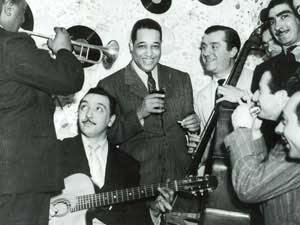
With Duke Ellington (1939)
I was about 16 when I had an experience that I recollect in nearly Proustian detail, listening for the first time to the String Quartet in C-sharp Minor, op. 131. I was sitting in a friend’s living room when her father put a recording of it on the hi-fi. I remember everything about those three-quarters of an hour back in 1961 or ’62: the room in which I was sitting and the direction in which I was facing; the single, exposed Bozak speaker vibrating like an exotic organism in the unfinished wooden box that Mr. L. had built to contain it; the quickly dawning realization that the first movement was the most overwhelming piece of music I had ever heard—a feeling that comes back to me whenever I listen to it, in real sound or mentally, as at this moment; and I remember (but this memory comes also from countless later listenings) the mysterious, throbbing sound of the first violin’s statement of the opening subject in that recording, made by the Budapest Quartet in the early 1950s.
***
I am now several years older than Beethoven lived to be. I still think of him as my alpha and omega, but in a different sense: as the author of music that transformed my existence at the onset of adulthood and that continues to enrich it more than any other music as I approach what are often referred to as life’s declining years. His music still gives me as much sensual and emotional pleasure as it gave me 50 years ago, and far more intellectual stimulation than it did then. It adds to the fullness when life feels good, and it lengthens and deepens the perspective when life seems barely tolerable. It is with me and in me. A thousand or 5,000 or 10,000 years from now, Beethoven and our civilization’s other outstanding mouthpieces may still have much to communicate to human beings—if any of our descendants are still around—or they may seem remote, cold, obscure. But what matters most in Beethoven’s case is his belief that we are all part of an endless continuum, whatever our individual level of awareness may be. In the Ninth Symphony, he used Schiller’s words to tell us explicitly what many of his other works, especially his late works, tell us implicitly: that the “divine spark” of joy and the “kiss for the whole world,” which originate “above the canopy of stars,” must touch and unite us all. The spark is there, he said, and so is the kiss; we need only feel and accept their presence.—Harvey Sachs
*****
Beethoven, String Quartet No. 14 in C-sharp minor, op. 131/1st Movement
Budapest Quartet, 1943
*****
Busch Quartet, 1936
Happy (111th) Birthday, Duke!
At least one day out of the year all musicans should just put their instruments down, and give thanks to Duke Ellington.
—Miles Davis
Duke Ellington and His Orchestra
“C Jam Blues,” 1942
*****
“Mood Indigo,” “Sophisticated Lady,” “It Don’t Mean a Thing (If It Ain’t Got That Swing),” “Don’t Get Around Much Anymore,” 1943
lagniappe
It is becoming increasingly difficult to decide where jazz starts or where it stops, where Tin Pan Alley begins and jazz ends, or even where the borderline lies between between classical music and jazz. I feel there is no boundary line.
—Duke Ellington
*****
Radio Ellington: All Duke, All Day
WKCR-FM (broadcasting from Columbia University)
Originally, Morton Feldman was commissioned to compose the score for the film [Something Wild], but when the director heard the music, he promptly withdrew his commission, opting to enlist Aaron Copland instead. The reaction of the baffled director [Jack Garfein] was said to be, ‘My wife is being raped and you write celesta music?’
Morton Feldman, “Something Wild in the City: Mary Ann’s Theme,” 1960
 music clip of the day
