Thursday, July 24th
Why not listen to something new?
Iva Bittova (voice, violin), Don Byron (clarinet), Hamid Drake (drums), live, Paris, 2008
Why not listen to something new?
Iva Bittova (voice, violin), Don Byron (clarinet), Hamid Drake (drums), live, Paris, 2008
This piece had its world premiere in 1941; the venue wasn’t fancy—a Nazi prisoner-of-war camp.
Olivier Messiaen (1908-1992), Quatuor pour la fin du temps (Quartet for the End of Time), live, ChamberFest Cleveland (Franklin Cohen, clarinet; Yura Lee, violin; Gabriel Cabezas, cello; Orion Weiss, piano), 2013
beyond category
John Zorn, Book of Angels (excerpts); Uri Caine, piano; Masada String Trio (Mark Feldman, violin; Erik Friedlander, cello;* Greg Cohen, bass); live, France (Marciac), 2008
**********
lagniappe
reading table
There’s a line in Tarkovsky’s Solaris: we never know when we’re going to die and because of that we are, at any given moment, immortal.
—Geoff Dyer, “Diary,” London Review of Books, 4/3/14
***
*It’s all related: Erik’s the son of photographer Lee Friedlander, whose work is often featured here.
sounds of Surry County, North Carolina
Tommy Jarrell (fiddle, vocals), Chester McMillan (guitar), Frank Bodie (guitar), Ray Chatfield (banjo), “Let Me Fall,” live, Mt. Airy, North Carolina, 1983
never enough
Three more takes on what we heard Thursday.
Johann Sebastian Bach (1685-1750), Violin Sonata No. 1 in G minor (2nd Movt.)
Henryk Szeryng (1918-1988), live
***
Arthur Grumiaux (1921-1986), recording
***
Yoojin Jang (1990-), live
**********
lagniappe
reading table
[A] mad person not helped out of his trouble by anything real begins to trust what is not real because it helps him and he needs it because real things continue not to help him.
—Lydia Davis, “Liminal: The Little Man” (The Collected Stories of Lydia Davis)
sounds of New York
William Parker (bass), Christian McBride (bass), Cooper-Moore (drums), Charles Gayle (tenor saxophone), Hamiett Bluiett (baritone saxophone), Jason Kao Hwang (violin), live (benefit concert), New York, 2012
**********
lagniappe
musical thoughts
Q: What would you do if you were not a composer?
Augusta Read Thomas (1964-): . . . I would spend all day listening. I could listen all day long until the day I die to music I’ve never heard and only begin to scratch the surface. There’s so much new. . . .
sleepless in Chicago
Some folks sleep all night, or so I’ve heard. Maybe you’re one of them. If not, here’s a mix you might try—a sonic tonic.
1. Play this on repeat.
John Luther Adams (1953-), “The Farthest Place” (2001); piano (Clint Davis), vibraphone (Brian Archinal & Andy Bliss), bass (Satoru Tagawa), violin (Lydia Kabalen); University of Kentucky (Lexington), 2008
2. Ditto.
Waterfall Sounds, Cow Creek
3. Adjust volume levels to taste.
**********
lagniappe
reading table
For you fleas too
the nights must be long,
they must be lonely.—Kobayashi Issa (1763-1827; translated from Japanese by Robert Hass)
never enough
One-word review: riveting.
Johann Sebastian Bach, Chaconne in D minor for solo violin (Partita for Violin No. 2); Ivry Gitlis (violin), live, Japan (Tokyo), 1990
**********
lagniappe
art beat
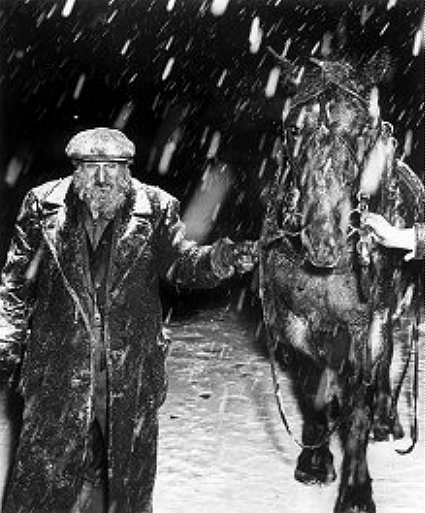
Weegee (AKA Arthur Fellig, 1899-1968)
 music clip of the day