Thursday, January 29th
string quartet festival (day four)
Dmitri Shostakovich (1906-1975), String Quartet No. 8 in C minor (1960); Borodin Quartet, live
string quartet festival (day four)
Dmitri Shostakovich (1906-1975), String Quartet No. 8 in C minor (1960); Borodin Quartet, live
string quartet festival (day two)
Back to the beginning—the “father” of the string quartet.
Josef Haydn (1732-1808), String Quartet in C-major, Op. 76, No. 3 (“Emperor”), c. 1796; St. Lawrence String Quartet, live, Houston, 2014
string quartet festival (day one)
Ludwig van Beethoven (1770-1827), String Quartet No. 14 (Op. 131, C-sharp minor), 1826
Alban Berg Quartet, live, Vienna, 1989
***
Végh Quartet, recording, 1952
***
Budapest String Quartet, recording, 1951
**********
lagniappe
musical thoughts
Opus 131 . . . is routinely described as Beethoven’s greatest achievement, even as the greatest work ever written. Stravinsky called it ‘perfect, inevitable, inalterable.’ It is a cosmic stream of consciousness in seven sharply contrasted movements, its free-associating structure giving the impression, in the best performances, of a collective improvisation. At the same time, it is underpinned by a developmental logic that surpasses in obsessiveness anything that came before. The first four notes of the otherworldly fugue with which the piece begins undergo continual permutations, some obvious and some subtle to the point of being conspiratorial. Whereas the Fifth Symphony hammers at its four-note motto in ways that any child can perceive, Opus 131 requires a lifetime of contemplation. (Schubert asked to hear it a few days before he died.)
—Alex Ross, “Deus Ex Musica,” New Yorker, 10/20/14
If your appetite for new music is insatiable, what better time to be alive?
Tyshawn Sorey (1980-), Quartet for Butch Morris (2012); International Contemporary Ensemble (ICE), featuring Erik Carlson (violin); Joshua Rubin (bass clarinet), Eric Lamb (flute), Cory Smythe (piano); live, New York, 2012
Six decades of listening and, until yesterday, I’d never heard this particular combination of instruments. You?
**********
lagniappe
art beat: yesterday at the Art Institute of Chicago
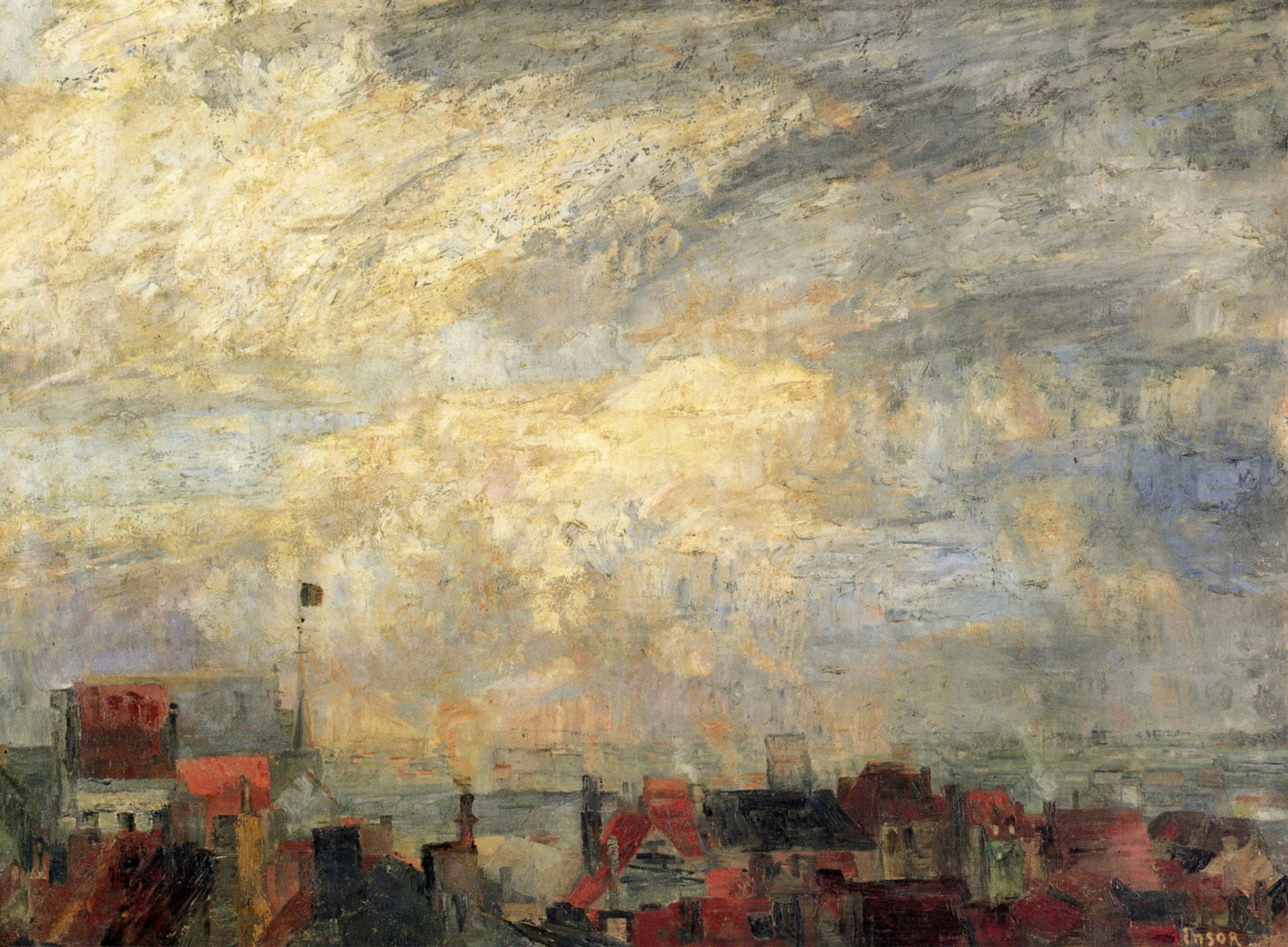
James Ensor (1860-1949), Rooftops of Ostend, 1884 (Temptation: The Demons of James Ensor, through January 25th)
*****
reading table
Nature, the sky above us, is conducting no mean politics when it presents beauty to all, without discrimination, and nothing old and defective, but fresh and most tasty.
—Robert Walser (1878-1956), “Snowdrops,” excerpt (translated from German by Tom Whalen and Trudi Anderegg)
sounds of Chicago (day two)
Sometimes encountering a new piece of music can turn your whole day around, which is what happened to me the other day when I bumped into this.
Georg Friedrich Haas (1953-), In Vain (2000)
Ensemble Dal Niente, live, Chicago, 2013
**********
lagniappe
art beat: yesterday at the Art Institute of Chicago
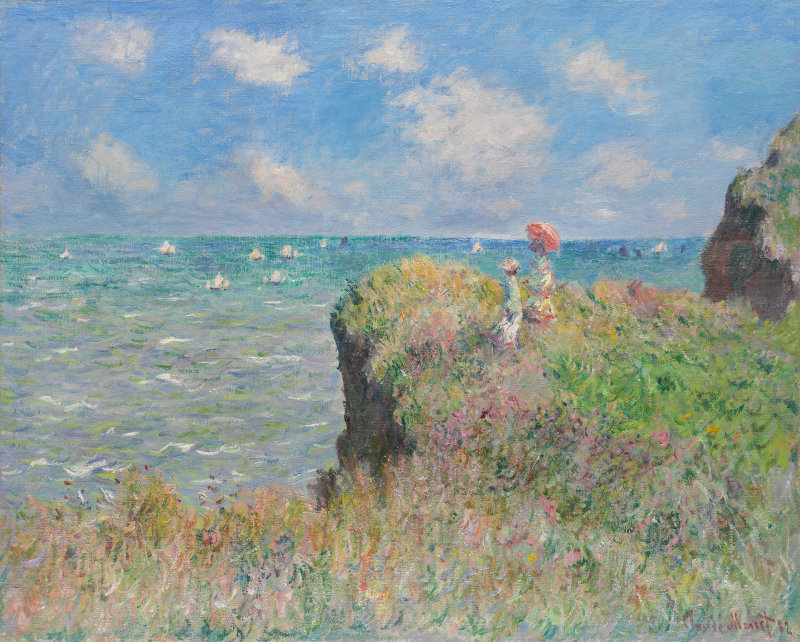
Claude Monet (1840-1926), Cliff Walk at Pourville (1882)
***
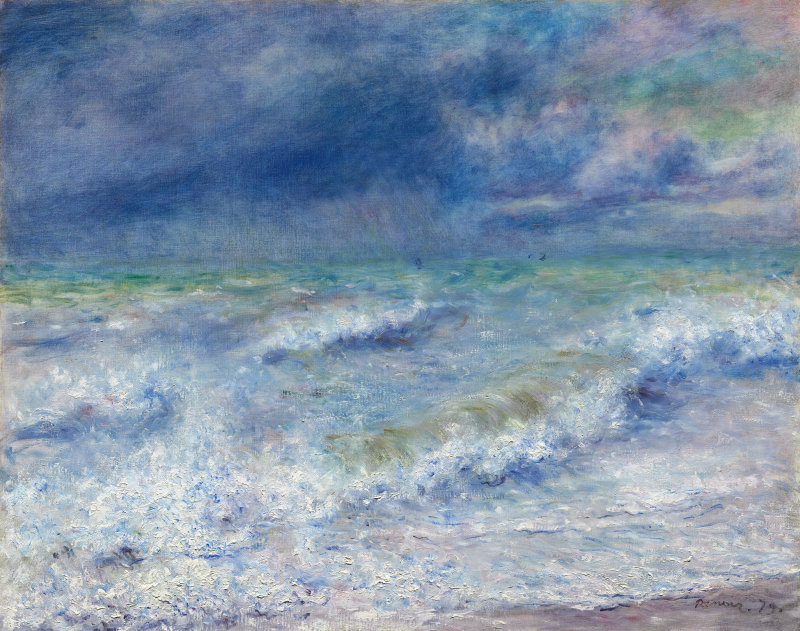
Pierre-Auguste Renoir (1841-1919), Seascape (1879)
*****
random thoughts
Eyes taste paintings no less than mouths taste food.
two takes
“I Don’t Claim To Be An Angel”
Laura Cantrell, live (studio performance), New York, 2011
***
Kitty Wells (1919-2012), live (TV show), c. 1953
What better way to start the year than with the music of Sly Stone?
Steven Bernstein’s Millennial Territory Orchestra (Steven Bernstein, trumpet; John Medeski, organ, et al.), live, Paris, 2011
“Stand” (feat. Sandra St. Victor, vocals)
***
“Everyday People” (feat. Eric Mingus, vocals)
*****
Still, after four decades, this album remains on my desert-island list.
Sly and the Family Stone, Fresh, 1973
1. In Time (0:00)
2. If You Want Me To Stay (5:48)
3. Let Me Have It All (8:48)
4. Frisky (11:43)
5. Thankful ‘N’ Thoughtful (14:54)
6. Skin I’m In (19:36)
7. I Don’t Know (Satisfaction) (22:29)
8. Keep On Dancin’ (26:23)
9. Que Sera, Sera (Whatever Will Be, Will Be) (28:45)
10. If It Were Left Up To Me (34:07)
11. Babies Makin’ Babies (36:07)
**********
lagniappe
random thoughts: New Year’s resolution #5
Each day: begin, again.
two takes
Need a lift?
Charles Ives (1874-1954), Ragtime Dance No. 4 (1904)
Alarm Will Sound, live, New York, 2013
***
Orchestra New England, recording, 1990
**********
lagniappe
musical thoughts
As I remember some of the dances as a boy, and also from father’s description of some of the old dancing and fiddle playing, there was more variety of tempo than in the present-day dances. In some parts of the hall a group would be dancing in polka, while in another, a waltz. Some of the players in the band would, in an impromptu way, pick up with the polka, and some with the waltz, and some with a march. Often the piccolo or cornet would throw in asides. Sometimes a change in tempo, or a mixed rhythm would be caused by a fiddler who, after playing three or four hours steadily, was getting a little sleepy. Or maybe another player was seated too near the hard cider barrel. Whatever the reason for these changes and simultaneous playing of things, I remember distinctly catching a kind of music that was natural and interesting and which was decidedly missed when everybody came down ‘blimp’ on the same beat again.
—Charles Ives
sounds of New York (day three)
If this life of ours isn’t easy, why should our music be?
Alex Mincek (1975-), String Quartet No. 3; Mivos Quartet, live, New York, 2013
**********
lagniappe
reading table
By Emily Dickinson (1830-1886; Franklin 384)
It dont sound so terrible—quite—as it did—
I run it over—”Dead”, Brain—”Dead”.
Put it in Latin—left of my school—
Seems it don’t shriek so—under rule.Turn it, a little—full in the face
A Trouble looks bitterest—
Shift it—just—
Say “When Tomorrow comes this way—
I shall have waded down one Day” .I suppose it will interrupt me some
Till I get accustomed—but then the Tomb
Like other new Things—shows largest—then—
And smaller, by Habit—It’s shrewder then
Put the Thought in advance—a Year—
How like “a fit”—then—
Murder—wear!
 music clip of the day