music clip of the day

jazz/blues/rock/classical/gospel/more

Category: viola

Saturday, March 1, 2014

If you wanted to conjure a world of mystery, what better instrument to lead the way than one that possesses neither the brightness of the violin nor the darkness of the cello?

Morton Feldman, Rothko Chapel (1971), live, Houston (Rothko Chapel), 2011; Kim Kashkashian (viola), Brian Del Signore (percussion), Sarah Rothenberg (celeste), Maureen Broy Papovich (soprano), Houston Chamber Choir (Robert Simpson, cond.)

#1

***

#2

***

#3

Another take? Here.

**********

lagniappe

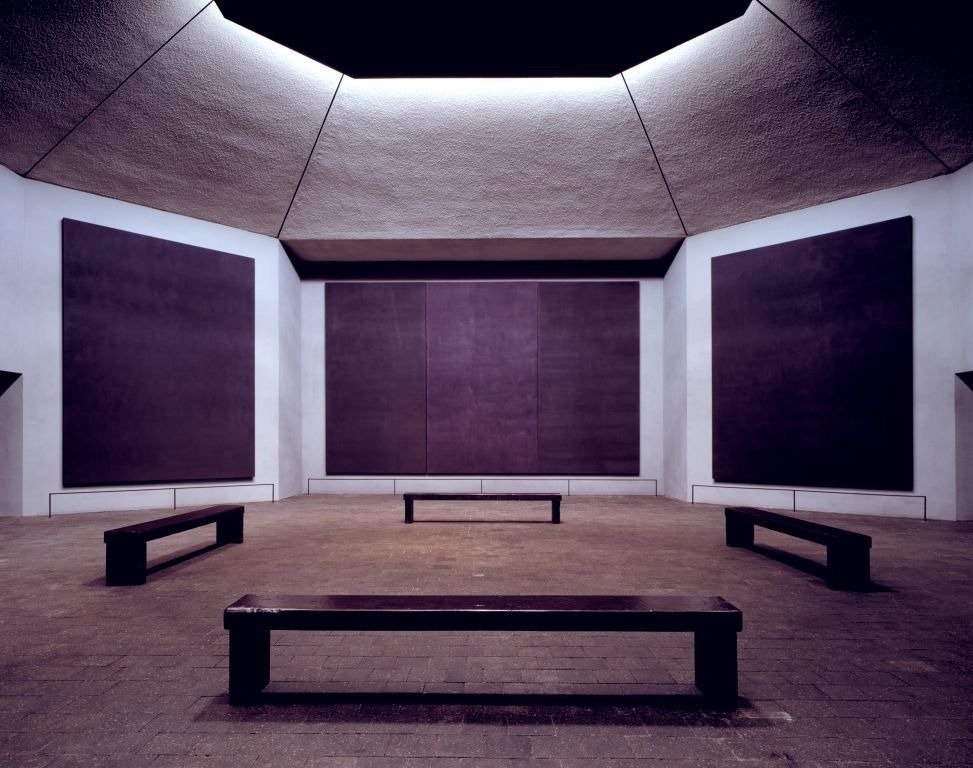
Rothko Chapel

***

The Rothko Chapel is an interfaith sanctuary, a center for human rights — and a one-man art museum devoted to 14 monumental paintings by abstract expressionist Mark Rothko. The Houston landmark, commissioned by John and Dominique de Menil, opened its doors 40 years ago, in February 1971.

For the past four decades, the chapel has encouraged cooperation between people of all faiths — or of no faith at all. While the chapel itself has become an art landmark and a center for human-rights action, the sanctuary’s creator never lived to see it finished. Rothko committed suicide in 1970.

Approaching the chapel from the south, visitors first see a steel sculpture called Broken Obelisk by Barnett Newman in the middle of a pool — it appears to be floating on the surface of the water. The chapel itself is a windowless, octagonal brick building. Solid black doors open on a tiny glass-walled foyer. (The foyer was walled off from the rest of the interior when the Gulf Coast’s notorious humidity began to affect the paintings.)

The main room is a hushed octagonal space with gray stucco walls, each filled by massive paintings. Some walls feature one canvas, while on others, three canvases hang side by side to form a triptych. A baffled skylight subdues the bright Houston sun, and the surfaces of the paintings change dramatically as unseen clouds pass outside. There are eight austere wooden benches informally arranged, and today, a few meditation mats. A young woman brings the meditation hour to a close by striking a small bowl with a mallet, creating a soft peal of three bells in the intense silence of the room.

Concerts, conferences, lectures, weddings and memorial services all take place in the chapel throughout the year, but on most days you will find visitors — about 55,000 annually come to see, to meditate, to write in the large comment book in the foyer, to read the variety of well-thumbed religious texts available on benches at the entrance.

***

These paintings do not feature the luminous color fields that made Rothko famous. The paintings in the chapel are dark, in purplish or black hues. And there’s a reason for that, says [chapel historian Suna] Umari.

“They’re sort of a window to beyond,” she explains. “He said the bright colors sort of stop your vision at the canvas, where dark colors go beyond. And definitely you’re looking at the beyond. You’re looking at the infinite.”

***

At first glance, the paintings appear to be made up of solid, dark colors. But look closely, and it becomes evident that the paintings are composed of many uneven washes of pigment that create variations in every inch. Stepping back, waves of subtle color difference appear across the broad surfaces — leading to an unmistakable impression of physical depth.

***

Though Mark Rothko didn’t live to see the sanctuary he created, Christopher Rothko says his father knew what it should be.

“It took me a while to realize it, but that’s really my father’s gift, in a sense, to somebody who comes to the chapel. It’s a place that will really not just invite, but also demand a kind of journey.”

—Pat Dowell, “Meditation and Modern Art Meet In Rothko Chapel,” NPR, 3/1/11
*****

reading table

Our lives are Swiss –
So still – so Cool –
Till some odd afternoon
The Alps neglect their Curtains
And we look farther on!

Italy stands the other side!
While like a guard between –
The solemn Alps –
The siren Alps
Forever intervene!

—Emily Dickinson

Thursday, December 5th

soundtrack to a dream

Witold Lutoslawski (1913-1994), String Quartet (1964); Tetris Quartet, live, Thailand (Bangkok), 2012


**********

lagniappe

art beat

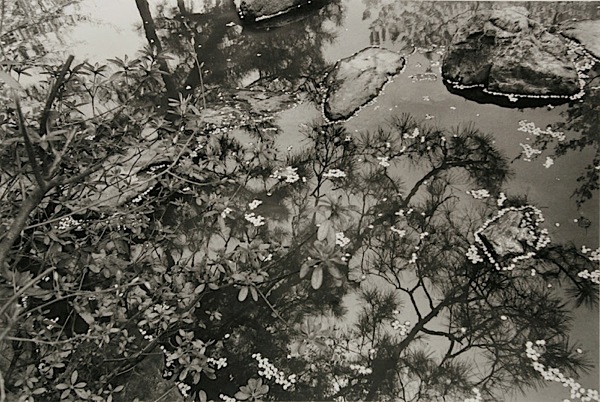
Lee Friedlander (1934-), Japan (Kyoto), 1981

MG_7620

Tuesday, December 3rd

career plans for the next life

If none of those other things pan out (tap dancer, rubboard playerreggae bassist, guitarist in a Malian band), I might give cellist-in-a-string-quartet a shot.

Keller String Quartet, Johann Sebastian Bach (1685-1750), The Art of the Fugue (excerpts); György Kurtág (1926-), Officium Breve (excerpts)

Thursday, November 14th

Georg Friedrich Haas (1953-), String Quartet No. 5; Crash Ensemble, live, Ireland (Dublin), 2013


**********

lagniappe

musical thoughts

All theater is musical and all music theatrical.

Monday, November 11th

People talk about getting enough of this or that in their daily diet. But what about beauty? There’s an epidemic, unreported by TV, radio, newspapers, of beauty malnutrition.

Lou Harrison (1917-2003), Threnody for Carlos Chavez (1978); William Winant Percussion Group with David Abel (viola), live, Berkeley, Calif., 2010

**********

lagniappe

art beat: Friday at the Art Institute of Chicago (while waiting for the jury to return a verdict in a trial involving an alleged conspiracy to steal millions of dollars of diamonds)

Paul Cezanne, The Bay of Marseilles, Seen From L’Estaque, c. 1885

ambrvoll_02

Wednesday, October 16th

mesmerizing

Benjamin Britten (1913-1976), Lachrymae (1950; arranged for viola and string orchestra, 1976); A Far Cry with Roger Tapping (viola), live, Cambridge, Mass., 2008

#1


#2

Saturday, October 12th


This I could listen to forever.

Morton Feldman (1926-1987), Piano and String Quartet (1985)
Aki Takahashi (piano) and Kronos Quartet


**********

lagniappe

musical thoughts

Earlier in my life there seemed to be unlimited possibilities, but my mind was closed. Now, years later and with an open mind, possibilities no longer interest me. I seem content to be continually rearranging the same furniture in the same room. My concern at times is nothing more than establishing a series of practical conditions that will enable me to work. For years I said if I could only find a comfortable chair I would rival Mozart.

***

If a man teaches composition in a university, how can he not be a composer? He has worked hard, learned his craft. Ergo, he is a composer. A professional. Like a doctor. But there is that doctor who opens you up, does exactly the right thing, closes you up—and you die. He failed to take the chance that might have saved you. Art is a crucial, dangerous operation we perform on ourselves. Unless we take a chance, we die in art.

Morton Feldman

Wednesday, October 2nd

love it or hate it

Anthony Braxton 12+1tet, Composition 355, live, Italy (Venice), 2012


*****

Anthony, a MacArthur “genius” award winner (1994) and professor at Wesleyan University, talks about this and that:


**********

lagniappe

musical thoughts

Music can take us places we’ve never been before, if we’re willing to listen to sounds we’ve never heard before.

Tuesday, September 24th

Some folks are intimidated by this stuff. Part of the problem is the label: “classical” music. That sounds like something for graduate students. Nonsense. You don’t need to know anything—anything at all—to connect with this. All you need are two ears, a mind, and a heart.

Maurice Ravel (1875-1937), String Quartet in F major (1903), first movement; Chiara String Quartet, live, University of Nebraska, 2013

Saturday, August 17th

MCOTD mailbag

Dear MCOTD,

I need your advice. I’ve developed this mad crush on a musical instrument—the viola. It’s so dark, so mysterious. I’m obsessed! What should I do?

Sincerely,

Desperate in Denver

***

Dear Desperate,

There’s only one thing you can do—give in.

Yours,

MCOTD

***

Benjamin Britten (1913-1976), Lachrymae (1950; arranged for viola and string orchestra, 1976); New York Classical Players (Dongmin Kim, cond.) with Kim Kashkashian (viola), live, New York (Church of the Heavenly Rest), 2011

**********

lagniappe

musical thoughts

Four things are needed to survive: air to breathe; water to drink; food to eat; music to hear.