Thursday, March 5th
No matter what, music remains.
Gyorgy Ligeti (1923-2006), String Quartet No. 1 (1953-54), live (Erica Kiesewetter and Yinbin Qian, violins; Marie Daniels, viola; Jake Hanegan, cello), Texas (Round Top), 2011
Twenty-four hours ago I’d never heard of this piece, nor this composer. Now I’ve listened to it, hungrily, twice. What a world.
Sulkhan Tsintsadze (1925-1991), String Quartet No. 6 (1968)
sounds of Mali (day two)
Trio Da Kali and Kronos Quartet, “Diaraby,” live, University of Maryland, 2014
string quartet festival (day five)
Maurice Ravel (1875-1937), String Quartet in F major (1903); Hagen Quartet, live, Austria (Salzburg), 2000
1st movt.
2nd movt.
3rd movt.
4th movt.
string quartet festival (day four)
Dmitri Shostakovich (1906-1975), String Quartet No. 8 in C minor (1960); Borodin Quartet, live
string quartet festival (day two)
Back to the beginning—the “father” of the string quartet.
Josef Haydn (1732-1808), String Quartet in C-major, Op. 76, No. 3 (“Emperor”), c. 1796; St. Lawrence String Quartet, live, Houston, 2014
string quartet festival (day one)
Ludwig van Beethoven (1770-1827), String Quartet No. 14 (Op. 131, C-sharp minor), 1826
Alban Berg Quartet, live, Vienna, 1989
***
Végh Quartet, recording, 1952
***
Budapest String Quartet, recording, 1951
**********
lagniappe
musical thoughts
Opus 131 . . . is routinely described as Beethoven’s greatest achievement, even as the greatest work ever written. Stravinsky called it ‘perfect, inevitable, inalterable.’ It is a cosmic stream of consciousness in seven sharply contrasted movements, its free-associating structure giving the impression, in the best performances, of a collective improvisation. At the same time, it is underpinned by a developmental logic that surpasses in obsessiveness anything that came before. The first four notes of the otherworldly fugue with which the piece begins undergo continual permutations, some obvious and some subtle to the point of being conspiratorial. Whereas the Fifth Symphony hammers at its four-note motto in ways that any child can perceive, Opus 131 requires a lifetime of contemplation. (Schubert asked to hear it a few days before he died.)
—Alex Ross, “Deus Ex Musica,” New Yorker, 10/20/14
sounds of Chicago (day two)
Sometimes encountering a new piece of music can turn your whole day around, which is what happened to me the other day when I bumped into this.
Georg Friedrich Haas (1953-), In Vain (2000)
Ensemble Dal Niente, live, Chicago, 2013
**********
lagniappe
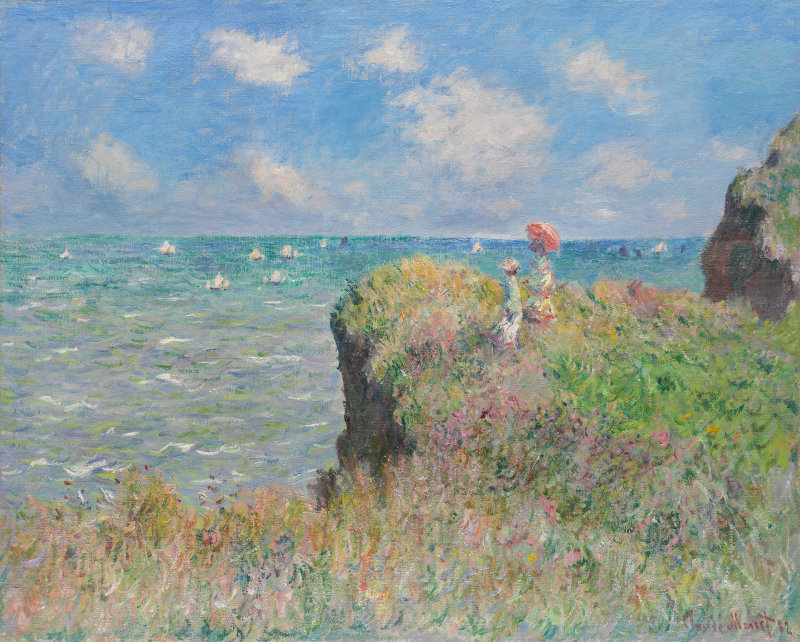
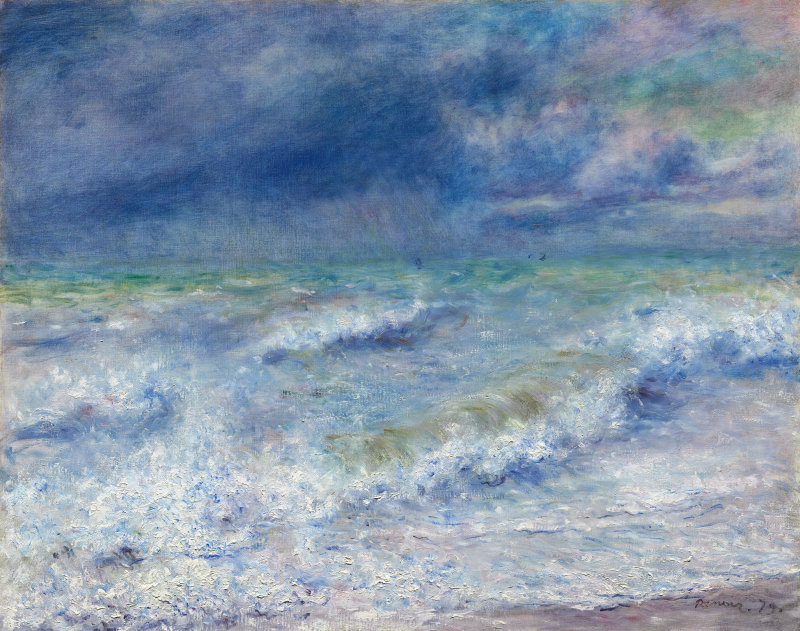
art beat: yesterday at the Art Institute of Chicago
Claude Monet (1840-1926), Cliff Walk at Pourville (1882)
***
Pierre-Auguste Renoir (1841-1919), Seascape (1879)
*****
random thoughts
Eyes taste paintings no less than mouths taste food.
what’s new
Dirty Beaches, “Time Washes Everything Away,” 12/14 (video)
**********
lagniappe
random thoughts: New Year’s resolution #3
Give up the wish to live in a world where making New Year’s resolutions would be something more than a reminder of how laughably little is within our control.

