Friday, 2/4/11
fringe dress festival (cont’d)
Wanda Jackson, live (TV broadcast [Town Hall Party]), 1958
Vodpod videos no longer available.fringe dress festival (cont’d)
Wanda Jackson, live (TV broadcast [Town Hall Party]), 1958
Vodpod videos no longer available.Roy Eldridge, January 30, 1911-February 26, 1989
No you, no me.
“I Can’t Get Started,” live (TV broadcast), 1958
Vodpod videos no longer available.***
“After You’ve Gone,” 1937
Vodpod videos no longer available.***
“Wabash Stomp,” 1937
Vodpod videos no longer available.***
“Let Me Off Uptown” (Gene Krupa Orchestra with Anita O’Day), 1942
Vodpod videos no longer available.**********
lagniappe
radio Roy Eldridge
WKCR-FM’s centennial birthday celebration, mentioned yesterday, continues until midnight.
They don’t just sing about—they take you on—a journey.
“Heavenly Home (Got to Take a Journey),” live, Langrun Branch Baptist Church, York, South Carolina
**********
lagniappe
Happy (100th) Birthday, Roy!
For two full days—all day today and tomorrow—WCKR-FM (broadcasting from Columbia University) celebrates the birthday of trumpeter Roy Eldridge. (I’m listening as I type this—delicious!)
Today MCOTD celebrates its 500th post. When this started, I thought I might eventually run out of material. But what I’ve found is the opposite: the more you hear, the more there is to hear.
Percy Sledge, “When A Man Loves A Woman,” live (TV broadcast), c. 1966
Vodpod videos no longer available.
**********
lagniappe
reading table
Haiku
That was fast.
I mean life.—Ron Padgett
three takes
Is this—the new cover—great?
Maybe, maybe not.
No matter—I, uh (to dip into the aging hipster’s lexicon), dig it.
“Is This Love” (Bob Marley)
Corinne Bailey Rae
Take 1: recording, 2010
Vodpod videos no longer available.***
Take 2: live, Los Angeles, 2010
Vodpod videos no longer available.***
Bob Marley
Take 3: live, Santa Barbara, 1979
Vodpod videos no longer available.More Bob Marley? Here.
Does anyone play Mozart with more verve?
Mozart, Piano Concerto No. 20 in D minor, KV. 466, first movement;
Friedrich Gulda (piano and conducting), Munich Philharmonic Orchestra, live, Germany (Munich), 1986
Part 1
***
Part 2
Vodpod videos no longer available.More? Here.
**********
lagniappe
Friedrich Gulda has refused to succumb to the increasing specialization of our age, refused to limit his horizons to one small portion of the musical spectrum. A prodigious talent, whom Harold Schonberg once hailed in The New York Times as “a continuation of the great German traditions of piano playing exemplified by Schnabel and Backhaus,” he chose to reject the cloistered life of a virtuoso in favor of a career that paid equal attention to jazz and classical music, to performance, composition and improvisation.
“There can be no guarantee that I will become a great jazz musician, but at least I shall know that I am doing the right thing,” he once said. “I don’t want to fall into the routine of the modern concert pianist’s life, nor do I want to ride the cheap triumphs of the Baroque bandwagon.” His insistence on shaping his career in his own image has been costly: once a household name among piano aficionados, he has not toured America in nearly two decades. Yet a spate of recent releases – both jazz and classical – suggest that it may be time for him to reclaim the fame once so deservedly his.
Born in Vienna in 1930, Mr. Gulda began piano studies at the age of 7, entered the Vienna Music Academy at 12 and won a major competition at 16 – first prize in the Geneva International Music Festival. His career catapulted with meteoric speed: he toured Europe and South America in 1949, and made his much-heralded Carnegie Hall debut in 1950. Mr. Gulda’s playing, however, always shunned excessive showmanship, favoring an intellectual, objective stance. His concentration on Bach, Mozart and Beethoven reflected these innate tendencies.
Mr. Gulda’s life changed in 1951: after an appearance with the Chicago Symphony, he joined Dizzy Gillespie in jazz improvisations – his first taste of freedom, so it would seem. Jazz offered “the rhythmic drive, the risk, the absolute contrast to the pale, academic approach I had been taught.” By 1956 Mr. Gulda had made his American jazz debut at New York’s Birdland, subsequently participating in the Newport Jazz Festival. Later he founded a jazz combo and in 1964 a big band grandly titled the Eurojazz Orchestra. Refusing to be limited to the piano, Mr. Gulda quickly mastered both flute and baritone sax.
What happened to his career as a classical pianist? By the late 1950’s he had rejected the traditional recital format, instead combining classical music and jazz on the same programs. By the 1970’s he had begun to irritate concert promoters by refusing to announce the content of his programs in advance and by fearlessly juxtaposing Bach, Debussy, his own jazz and freely improvised new music. Not surprisingly, many ridiculed him, claiming he had thrown away a promising career, had succumbed to egotistical eccentricity.
A sudden burst of new releases proves how wrong his critics were. “The Meeting: Chick Corea and Friedrich Gulda” (Philips CD 410 397-2), recorded at a live performance in Munich in 1982, consists exclusively of two-piano improvisations. Chick Corea is hardly a novice at either improvisations – readers may recall his 1978 two-record set with Herbie Hancock (CBS PC2 35663) – or at a crossover stance that melds both classical and jazz approaches. The result is a disk that consists of three gigantic essays, each beginning in a rhapsodic manner and only gradually coalescing into a structured commentary on familiar tunes – “Someday My Prince Will Come,” Miles Davis’s “Put Your Little Foot Out,” Brahms’s Lullaby. Most remarkable are the completely free sections in which the players must rely entirely on listening, responding, sensing each other’s every whim. Ironically enough, the music is often angular and dissonant – occasionally approaching the intricacies of atonal modernism – yet always possessing a tightly disciplined structure. Both Mr. Corea and Mr. Gulda display dazzling technique together with fertile imaginations that dart unfettered from classical to jazz idioms.
“Gulda Plays Gulda” (Philips CD 412 115-2) consists almost entirely of his own piano compositions. The finest are those in which he adopts the conventions of both jazz and classical music to traditional forms – a virtuosic set of Variations, a Prelude and Fugue, a three-movement Sonatina. If Mr. Gulda is not an innovator, he shows remarkable ability at absorbing, integrating, synthesizing diverse idioms. Even at his most derivative – the spirits of Count Basie and Miles Davis haunt these works – the pieces are never less than formally skilled and overflowing with vitality. Only “For Paul” and “For Rico,” bathed in pop-rock cliches, sound both dated and embarrassingly trivial.
Mr. Gulda’s “Winter Meditation”, paired with Beethoven’s Sonata in C minor, Op. 111 (Philips 412 114-1), provides the link from his own compositions to the realm of classical music. There are no references to jazz here: instead “Winter Meditation” conjures up images of a barren, ominous, frozen landscape. Dissonant and fragmented, it explores extremes of register and dynamic range; it deliberately eschews traditional form or melodic content. Ultimately, though, it reaches for profundity, it appears far less successful than his jazz, remaining shapeless and self-indulgent. The Beethoven, however, is a revelation: rarely have I heard such a riveting performance of the composer’s last Sonata. Mr. Gulda’s Beethoven is driving, lean, hard-edged, its propulsive power more than matched by a probing, intellectual musicianship that penetrates to the core of this most complex work.
Schumann’s “Fantasiestukce”, Op. 12 and “Liederkreis”, Op. 39 (Philips CD 412 113-2) find Mr. Gulda in similarly evocative form. It takes him no more than a few moments to capture the essence of these moody, impassioned, sometimes haunted texts. Mr. Gulda is joined in the “Liederkreis” by the soprano Ursula Anders, who opts for a childlike purity of tone, performing these songs almost entirely without vibrato. Such a vocal timbre can be appealing but here seems a bit excessive in its application; though she may have been reaching for naturalistic, folklike simplicity the result severely limits her expressive range.
In all of Mr. Gulda’s recent releases he favors a percussive, hammered attack in forte passages, eliciting a clangorous, metallic sound from his beloved Bosendorfer. His own jazz benefits from such an approach, and to a certain extent even the Beethoven Sonata – with its explosive sforzandos and ensuing pianos – is not harmed. In the Schumann, however, Mr. Gulda’s pianistic touch can seem needlessly brutal. Yet his manner provides the hidden benefit of creating chiseled, transparent textures; even in massive passages, all lines stand out in relief.
Mr. Gulda’s approach fits perfectly with the conductor Nikolaus Harnoncourt’s, and the result in their new recording of Mozart’s Concertos Nos. 23 and 26 (Telarc CD 8. 42970 ZK) is nothing less than a radical rethinking of these familiar works. Mr. Harnoncourt stamps his imprint on the Concertgebouw Orchestra: he has it imitate the manner of an original-instrument ensemble, with biting articulations, crisp bow strokes and transparent textures in which brass and tympani stand out with startling clarity. To further enhance textural lucidity, Mr. Harnoncourt occasionally reduces the strings to a small concertino group during solo piano passages. Mr. Gulda plays throughout, even during orchestral tuttis, sometimes adding arpeggiated figuration or bass reinforcement in full instrumental sections.
Mr. Harnoncourt and Mr. Gulda possess no less a unity of vision than do Mr. Corea and Mr. Gulda in ”The Meeting.” Mr. Gulda’s playing is rhythmically precise, keenly articulated, objective and unsentimentalized, yet never insensitive to phrasing or mood. The result is the ultimate vindication of this enigmatic, fiercely independent musician, a man whose wide-ranging efforts have – to judge from recent recordings – succeeded far more often than they have failed.
—K. Robert Schwartz, New York Times, 9/29/85
*****
reading table
The John Cage of status updates?
The Led Zeppelin of sensitive screenwriters?
The Willie Nelson of pin-up girls?
All these, and more, can be found at The Rosa Parks of Blogs.
Talking with a Jamaican-born client, I mention Gregory Isaacs’ passing.
He responds, “He died too?”
Sugar Minott, May 25, 1956-July 10, 2010
1983:”Rough Ole Life (Babylon),” Reggae Sunsplash, Jamaica
Vodpod videos no longer available.*****
2009: Rehearsal, Lovers Rock Gala Awards, England
“Lovers Rock”
Vodpod videos no longer available.***
“Good Thing Going”
Vodpod videos no longer available.[D]ance first and think afterwards . . . . It’s the natural order.
—Samuel Beckett, Waiting for Godot (English-language premiere, 1955)
Al Minns & Leon James, New York (Savoy Ballroom, Harlem), 1950s
Vodpod videos no longer available.**********
lagniappe
art beat
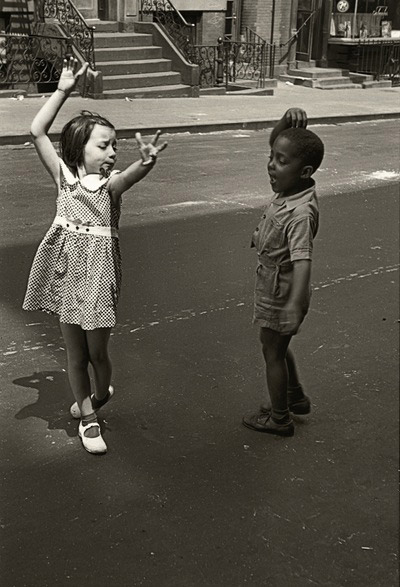
Helen Levitt, New York, c. 1940
Happy Birthday, Max!
No drummer is more clear, more precise, more melodic.
Max Roach, January 10, 1924-August 16, 2007
“The Third Eye,” live
Vodpod videos no longer available.***
“The Drum Also Waltzes” (Drums Unlimited), 1966
Vodpod videos no longer available.***
With Sonny Rollins (saxophone), “St. Thomas” (Saxophone Colossus), 1956
Vodpod videos no longer available.***
With Clifford Brown (trumpet), “Sweet Clifford” (Brown and Roach Incorporated), 1955
Vodpod videos no longer available.***
With Dizzy Gillespie (trumpet), Charlie Parker (saxophone), Bud Powell (piano), Charles Mingus (bass), “Salt Peanuts,” live, 1953
Vodpod videos no longer available.**********
lagniappe
musical thoughts
In this music, you have to find out who you are, what you feel, what you want to say. That’s one of the reasons that it’s so American. You have to be yourself.
That’s also one way jazz is different from classical music. In classical music, you learn to study and come up with the finest interpretation of a work that you can. That’s a different way of expressing your personality. You have to learn to use what’s written already to express yourself. In jazz, you have to learn to be who you are, and create the music from that.
—Max Roach (in Gene Santoro, Highway 61 Revisited [2004])
*****
radio
Today it’s all Max all day at WKCR-FM (broadcasting from Columbia University).
This would be riveting even with the sound off.
James Brown, “I Got You (I Feel Good),” live (TV broadcast), c. 1965
Vodpod videos no longer available.Like Lester Young and Charlie Parker and John Coltrane, James Brown floats over the bar lines, defying, as he dances, the gravitational pull of the downbeat.
Want more? Here.
 music clip of the day