Friday, February 27th
sounds of Chicago
Goofiness is a much underrated virtue.
Mucca Pazza, live, Washington, D.C., 2015
sounds of Chicago
Goofiness is a much underrated virtue.
Mucca Pazza, live, Washington, D.C., 2015
Soundtrack for your day?
Peter Brotzmann Tentet,* live, Atlanta, 2002
*PB, reeds; Ken Vandermark, reeds; Mats Gustafsson, reeds; Mars Williams, reeds; Joe McPhee, trumpet; Jeb Bishop, trombone; Fred Longberg-Holm, cello; Kent Kessler, bass; Hamid Drake, drums; Michael Zerang, drums.
sounds of Chicago (day one)
Art Ensemble of Chicago (Roscoe Mitchell, reeds; MCOTD Hall-of-Famer Lester Bowie [1941-1999], trumpet; Malachi Favors [1927-2004], bass; Don Moye, drums), live, Hungary (Budapest), 1995
two takes
Rebirth Brass Band, “A. P. Tureaud,” live, New Orleans
Treme Sidewalk Steppers Second Line, 2011
***
Revolution Social Aid and Pleasure Club Second Line Parade, 2012
**********
lagniappe
art beat
Lee Friedlander (1934-), Second Liners at Mardi Gras, New Orleans, 1957

voices I miss
Lester Bowie’s From the Root to the Source (MCOTD Hall-of-Famer Lester Bowie [1941-1999], trumpet; Fontella Bass, vocals, piano; Martha Bass, vocals; Malachi Favors, bass, et al.), live, 1983
**********
lagniappe
reading table
I walked through the mountains today. The weather was damp, and the entire region was grey. But the road was soft and in places very clean. At first I had my coat on; soon, however, I pulled it off, folded it together, and laid it upon my arm. The walk on the wonderful road gave me more and even more pleasure; first it went up and then descended again. The mountainous world appeared to me like an enormous theatre. The road snuggled up splendidly to the mountainsides. Then I came down into a deep ravine, a river roared at my feet, a train rushed past me with magnificent white smoke. The road went through the ravine like a smooth white stream, and as I walked on, to me it was as if the narrow valley were bending and winding around itself. Grey clouds lay on the mountains as though that were their resting place. I met a young traveller with a rucksack on his back, who asked if I had seen two other young fellows. No, I said. Had I come here from very far? Yes, I said, and went farther on my way. Not a long time, and I saw and heard the two young wanderers pass by with music. A village was especially beautiful with humble dwellings set thickly under the white cliffs. I encountered a few carts, otherwise nothing, and I had seen some children on the highway. We don’t need to see anything out of the ordinary. We already see so much.
—Robert Walser (1878-1956), “A Little Ramble” (translated from German by Tom Whalen)
What better way to start the year than with the music of Sly Stone?
Steven Bernstein’s Millennial Territory Orchestra (Steven Bernstein, trumpet; John Medeski, organ, et al.), live, Paris, 2011
“Stand” (feat. Sandra St. Victor, vocals)
***
“Everyday People” (feat. Eric Mingus, vocals)
*****
Still, after four decades, this album remains on my desert-island list.
Sly and the Family Stone, Fresh, 1973
1. In Time (0:00)
2. If You Want Me To Stay (5:48)
3. Let Me Have It All (8:48)
4. Frisky (11:43)
5. Thankful ‘N’ Thoughtful (14:54)
6. Skin I’m In (19:36)
7. I Don’t Know (Satisfaction) (22:29)
8. Keep On Dancin’ (26:23)
9. Que Sera, Sera (Whatever Will Be, Will Be) (28:45)
10. If It Were Left Up To Me (34:07)
11. Babies Makin’ Babies (36:07)
**********
lagniappe
random thoughts: New Year’s resolution #5
Each day: begin, again.
sounds of New Orleans
Henry Butler (piano, vocals), Steven Bernstein (trumpet), Herlin Riley (drums), et al., “Some Iko,” recording session (Viper’s Drag, 2014)
**********
lagniappe
reading table
One must always fight back, not in the hope of winning but just to delay the moment of losing.
—Samantha Harvey, The Wilderness
two takes
Need a lift?
Charles Ives (1874-1954), Ragtime Dance No. 4 (1904)
Alarm Will Sound, live, New York, 2013
***
Orchestra New England, recording, 1990
**********
lagniappe
musical thoughts
As I remember some of the dances as a boy, and also from father’s description of some of the old dancing and fiddle playing, there was more variety of tempo than in the present-day dances. In some parts of the hall a group would be dancing in polka, while in another, a waltz. Some of the players in the band would, in an impromptu way, pick up with the polka, and some with the waltz, and some with a march. Often the piccolo or cornet would throw in asides. Sometimes a change in tempo, or a mixed rhythm would be caused by a fiddler who, after playing three or four hours steadily, was getting a little sleepy. Or maybe another player was seated too near the hard cider barrel. Whatever the reason for these changes and simultaneous playing of things, I remember distinctly catching a kind of music that was natural and interesting and which was decidedly missed when everybody came down ‘blimp’ on the same beat again.
—Charles Ives
passings
Bunny Briggs, tap dancer, February 26, 1922-November 15, 2014
Duke Ellington Orchestra with Bunny Briggs (dance) and Jon Hendricks (vocal), “David Danced Before the Lord with All His Might,” live (A Concert of Sacred Music), San Francisco (Grace Cathedral), 1965
*****
And David danced before the Lord with all his might . . .
—2 Samuel 6:14 (King James)
**********
lagniappe
art beat
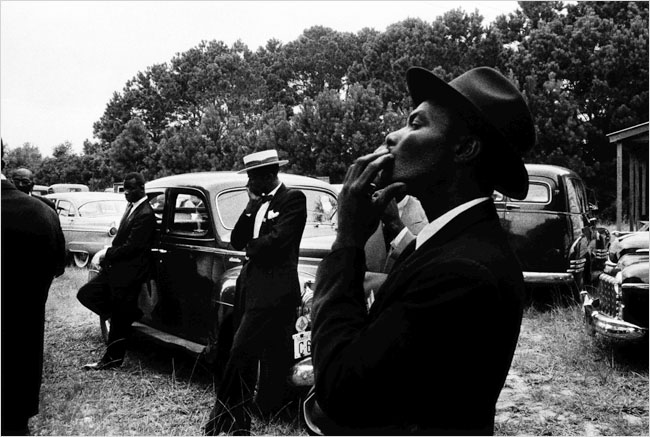
Robert Frank (1924-), Funeral—St. Helena, South Carolina, 1955
Why not start the week with a parade?
Divine Ladies Social Aid and Pleasure Club Parade (with Stooges Brass Band), New Orleans, 2009
**********
lagniappe
art beat
Lee Friedlander (1934-), Second Liners, New Orleans, 1961


