music clip of the day

jazz/blues/rock/classical/gospel/more

Category: saxophone

Saturday, 4/16/11

Billy Bang (AKA William Vincent Walker), violinist, 9/20/47-4/11/11

Billy Bang Quintet (BB, violin; Frank Lowe, tenor saxophone; Ahmed Abdullah, trumpet; William Parker, bass; Abbey Rader, drums), live, New York (Knitting Factory), 10/1/00

Vodpod videos no longer available.

*****

Billy Bang Quartet (BB, violin; Ngo Thanh Nahn, dan tranh; Todd Nicholson, bass; Shoji Hano, drums), live, New York (Vision Festival X), 6/18/05

Vodpod videos no longer available.

**********

lagniappe

As I lived in Harlem in the early Fifties as a kid, I heard music all around me from the jazz clubs and from the candy stores. They had speakers outside the candy stores that they would play music, music like Eddie Harris and once in a while, Brubeck’s “Take Five.” So I started hearing jazz very, very early, and when you lived in Harlem in those days, it was in the blood. It was in the people. It was in the clothing. It was prevalent. As a young man, I bought a pair of bongos and two of my friends and I used to play the bongos on the New York City subway system. We would take turns dancing and playing the bongos and earn some money. That was my professional debut in the music.

***

I bought the Delmark records and heard Leroy Jenkins. Then I started hearing all the Joseph Jarman and Roscoe Mitchell. I loved the AACM. I loved Delmark for putting them out, Muhal Richard Abrams. This music really turned me on. It seemed very political, very conscious for me at the time and also very free, but with structure. So when Leroy Jenkins came to New York, I tracked him down and I did a little study with him for about six months. It was enough to reshape my direction. I already had a direction, but it really straightened it. From that point on, I just kept trying to go for it. Nobody would hire me, but that didn’t stop me. I would hire myself and hire a band and we would play at places like lofts in New York. Eventually, loft jazz became very, very big in New York and that catapulted my name and my career. During that period, I did all sorts of things, sitting in with Sam Rivers at The Five Spot. I sat in with Jackie McLean. I just had to be around the music and the cats that I loved and respected. I was disappointed that John Coltrane passed away because I think I would have followed him day after day after day to try and get in his band.

***

[The loft scene] was a very big thing. I think that catapulted my name internationally along with the David Murrays, the Henry Threadgills, the Frank Lowes, the Lester Bowies, the Joe Bowies. A lot of us wrote our own compositions. We weren’t playing standards. The bebop guys had to play standards to be legitimate. We were able to create our own music, direction, and compositions that also helped to lend a more directional input into the music. The loft jazz’s impact of it came when the Newport Jazz Festival came to New York that year and they didn’t hire any of us, so we had our own loft jazz festival. There were meetings and I remember Archie Shepp was talking and Rashied Ali was talking. I was very, very happy to be in New York at that time and to be around such a powerful movement with powerful names in it, Braxton, a lot of cats, all the cats that I love. We started setting up concerts all over, all the places. Sam Rivers had Rivbea and Rashied Ali had Ali Alley, which is where I played most of the time. When I played there with my Survival group, Werner Uehlinger came from hatHUT and he signed me to do a solo record. We were very adamant and strong about what we were doing. We were committed in belief. The World Saxophone Quartet started. The String Trio of New York started. Air was here. There was a lot of power going on simultaneously. There was a movement going on. We actually saw it in the making. I find it extremely important. The only reason why it does not have as much importance as I see it is because a lot of the writers didn’t pick up on it. Francis Davis from Philadelphia, he did and Stanley Crouch to some degree. There were people that picked up on it, but it wasn’t enough of a movement. The next year, George Wein hired some of the loft guys to play at the jazz festival. I was even offered a gig there with the String Trio. I didn’t make it because I like to hold out. I will be very honest, Fred. After I did my tour in Vietnam, I felt above a lot of the everyday activities in this world. I faced death and I think I had died more than once, so after that, I was sort of an untouchable. Me with my music, I didn’t feel the threatening situation that others felt. I didn’t feel obligated to have to compromise or the necessity to have to kiss anybody’s ass. I was determined to be focused in a Billy Bang direction until today, I am the same way. I think that strength is what kept me going, that commitment of strength, that conviction. They didn’t like the things that I did in the beginning. In fact, I didn’t like a lot of it, but I was committed enough to keep trying and not be shot down by critics, writers, peers, whomever.

***

Cats [today] are trying to be technical. You can exercise all your technical prowess and you sound like what’s been out already. I hear more guys sound like Clifford Brown or Freddie Hubbard then I heard them do. That was not the thing. We were always going for individual voices and individual sound. That is the only thing that almost made me stop. I didn’t sound like anybody. I thought I sounded so horrible that one particular day, I was ready to smash up my violin and I remember James Jackson from the Sun Ra band came in and tried to recruit me and he had a long talk with me. He told me that I had my own sound and that I had a Billy Bang sound. I took that to heart and started working from that perspective and saying that I needed to keep working at it and developing my sound.
Billy Bang (2003)

Thursday, 4/7/11

Happy (96th) Birthday, Billie!

Tune in to WKCR-FM (broadcasting from Columbia University) and you’ll swear you must’ve died and gone to heaven—it’s all Billie, all day.

Billie Holiday, “The Blues Are Brewin'” (with Louis Armstrong, trumpet), New Orleans (1947)

Vodpod videos no longer available.

More? Here. And here. And here.

**********

lagniappe

art beat

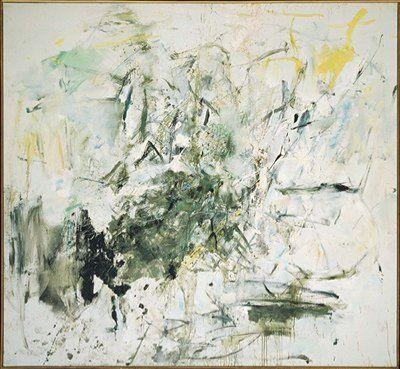
Joan Mitchell, Chamonix (c. 1962), Museum of Fine Arts, Boston


Wednesday, 4/6/11

I’m surprised that I got this old and know so little.

—Terry Riley

Terry Riley, talking and playing, California, 2010

Vodpod videos no longer available.

*****

In C (excerpt), Terry Riley, 1964

Take 1

Terry Riley, Center of Creative and Performing Arts (SUNY-Buffalo), 1968

Vodpod videos no longer available.

***

Take 2

Ars Nova, Percurama Percussion Ensemble, Paul Hillier (cond.), 2007

Vodpod videos no longer available.

**********

lagniappe

art beat: yesterday at Boston’s Museum of Fine Arts

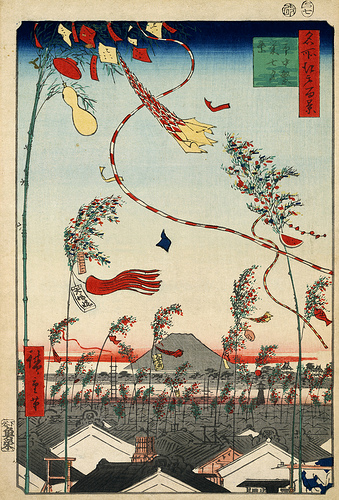
Hiroshige, The City Flourishing, Tanabata Festival (1857)


Wednesday, 3/9/11

Happy (81st) Birthday, Ornette!

His sound—his whole approach (simple melodies, vocal phrasing, off-center intonation)—is drenched in the blues.

Ornette Coleman (alto saxophone) with The Roots
Live, London (Meltdown Festival), 2009

#1

Vodpod videos no longer available.

***

#2

Vodpod videos no longer available.

The tenor player at the end—that’s David Murray.

More Ornette? Here.

**********

lagniappe

radio

What am I listening to today?

That’s easy—WKCR-FM (broadcasting from Columbia University), where it’s all Ornette all day.

Tuesday, 3/8/11

Today, in celebration of Fat Tuesday, let’s go to New Orleans.

Rebirth Brass Band, Treme Sidewalk Steppers Parade
Live, New Orleans, 2/6/11

Vodpod videos no longer available.

More? Here. And here. And here.

*****

TBC Brass Band, Krewe de Vieux Parade
Live, New Orleans, 2/19/11

Vodpod videos no longer available.

*****

A great brass band and a great mix have something in common. You can tell a great mix—as we used to say at Alligator Records—even from the next room. And you can tell a great brass band even from the next block.

Sunday, 3/6/11

I wouldn’t mind dying if I knew my funeral would sound like this.

Vernard Johnson (alto saxophone), “Goin’ Up Yonder,” “Amazing Grace,” live (service for alto saxophonist Philip Slack [begins at 2:50]), 1/09 (from the forthcoming documentary Walk With Me)

Vodpod videos no longer available.

More? Here.

**********

lagniappe

radio

Greatest radio station on the planet? WFMU-FM, home of the wonderful Sinner’s Crossroads (“[s]cratchy vanity 45s, pilfered field recordings, muddy off-the-radio sounds, homemade congregational tapes and vintage commercial gospel throw-downs; a little preachin’, a little salvation, a little audio tomfoolery”), is a contender. They’re currently in the midst of their annual fundraiser, offering great DJ-crafted premiums. What better way to get rid of that extra dough that’s just taking up space?

*****

art beat

American Modern: Abbott, Evans, Bourke-White
Art Institute of Chicago (through 5/15/11)

Berenice Abbott, Church of God, New York (Harlem), 1936

Tuesday, 3/1/11

More Von

The other night, during a performance and interview at the University of Chicago, he seemed, at times, a bit frail. He’s nearing 90 and was recently in the hospital. But what I said a while back still holds true: no tenor player moves me more.

Von Freeman (tenor saxophone, with Mike Allemena, guitar; Matt Ferguson, bass; Michael Raynor, drums), “Bewitched, Bothered and Bewildered,” live, Chicago (Mandel Hall, University of Chicago), 2/24/11

Vodpod videos no longer available.

More? Here. And here. And here.

**********

lagniappe

better late, etc.

The University of Chicago recently awarded Von the Rosenberger Medal, which “was established in 1917 . . . [and recognizes] achievement through research, in authorship, in invention, for discovery, for unusual public service, or for anything deemed of great benefit to humanity.” Past recipients include Toni Morrison, Pierre Boulez, and Frederick Wiseman.

*****

musical thoughts

It takes years to explain those vibrational things in verbal language. And it still might not work. One time I asked Von Freeman about his voice-leading in harmony, he’s the master of that shit. I asked him, “How did you learn that shit? You’re so fluent at it.” And he said, “Well, you know, I sat down one day and I said, let me look at this thing.” He said, “I began with one tone. I studied one tone. And I studied all that I could study about one tone.” When these old guys talk, you don’t ask too many questions. You pretty much just listen to what they say. And so, I didn’t know what he meant, but I just listened. And he said, “I worked on that for a long time, you know, for months. Just seeing what could be done with one tone. When I felt pretty good about that, I moved on to two tones. That was a bit harder. I worked a lot longer, but I worked and saw all that I could do with two tones. Then I moved to three tones, and so on. After I went on for a while I realized that you can pretty much do everything that you need to do with two tones.” That’s what he told me. I spent years thinking about this shit. Years. I’m still thinking about it, you know. I feel like I have a better handle on knowing what he meant now than then, although it is not a simple thing to explain. And when I tell the story to somebody playing in my group or something, and they ask me, “What did he mean?” it takes me literally years to explain what I think he means. And I’m sure I only have part of what he means. What it means to me. Some things, you have to explain them with a million examples over a period of time. The meaning dawns on a person and when they have to explain it it’s funny. We live in this McDonald’s type society where everybody thinks everything is just quick. It’s not like that. You have to actually build the understanding, slowly over time. So this thing that Von Freeman explained to me, it sounds like a very simple thing, but it really doesn’t make any sense at all without the experience. It’s maybe fifteen years ago that he told me, and I found it to be absolutely true. I could never explain it in one day, or in a lecture over an hour.

Steve Coleman (whose latest album was named one of the year’s ten best in the 2010 Village Voice Jazz Critics’ Poll)

*****

my back pages

No other musician, in any genre, has meant so much to me in so many ways for so many years. I first heard Von in the mid-70s, when I was in my twenties (and working for Alligator Records) and he was in his fifties. The setting, coincidentally, was the University of Chicago; he opened for Cecil Taylor. I got to know him and booked a few shows for him. In 1977, when I got married, he and pianist John Young played at our wedding ceremony. Later, when I was reviewing live jazz, I wrote a piece about him for the Chicago Reader. Over the last three decades, I’ve listened, avidly, to his growing catalog of albums and seen him live more times than I could count. He is now an old man. And I am getting there.

Friday, 2/25/11

Our music is a Secret Order.

—Louis Armstrong, 1954 (John F. Zwed, Space Is The Place: The Lives And Times Of Sun Ra [1997], epigraph)

Von Freeman (tenor saxophone, with Ed Petersen, tenor saxophone; Willie Pickens, piano; Brian Sandstrom, bass; Robert Shy, drums), live, Chicago (Green Mill Lounge), 12/31/10

Vodpod videos no longer available.

More? Here. And here.

Monday, 2/21/11

Whatever I’d say would be an understatement. I can only say my life was made much better by knowing him. He was one of the greatest people I’ve ever known, as a man, a friend, and a musician.

—John Coltrane

Eric Dolphy (alto saxophone, bass clarinet, flute)
June 20, 1928-June 29, 1964

John Coltrane Quintet (JC, tenor saxophone; Eric Dolphy, alto saxophone; McCoy Tyner, piano; Reggie Workman, bass; Elvin Jones, drums), “Impressions,” live, Germany (Baden-Baden), 1961

Vodpod videos no longer available.

(For whatever reason, this clip sometimes seems to play better, on my Mac, with Safari than Firefox.)

More Eric Dolphy? Here. And here.

More John Coltrane? Here.

**********

lagniappe

reading table

Leviathan

Truth also is the pursuit of it:
Like happiness, and it will not stand.

Even the verse begins to eat away
In the acid. Pursuit, pursuit;

A wind moves a little,
Moving in a circle, very cold.

How shall we say?
In ordinary discourse—

We must talk now. I am no longer sure of the words,
The clockwork of the world. What is inexplicable

Is the ‘preponderance of objects.’ The sky lights
Daily with that predominance

And we have become the present.

We must talk now. Fear
Is fear. But we abandon one another.

George Oppen

Wednesday, 2/16/11

Comedy, like jazz, is an art of syncopation.

Lenny Bruce, 1959 (with Cannonball Adderly, saxophone; Bill Evans, piano; Teddy Kotick, bass; Philly Joe Jones, drums)

Vodpod videos no longer available.

(Yeah, I could do without all the extra blah-blah-blah, too.)

More Lenny? Here.

**********

lagniappe

radio

Today WKCR-FM (broadcasting from Columbia University) is remembering George Shearing, who passed away Monday at the age of 91, with a memorial broadcast that runs until 9 p.m. (EST).