music clip of the day

jazz/blues/rock/classical/gospel/more

Category: rock/pop

Saturday, 3/20/10

What a nasty one-two punch for Memphis: first Jim Dickinson, then—seven months later—Alex Chilton.

Alex Chilton, December 28, 1950-March 17, 2010

Big Star, “Thirteen” (1972)

*****

Big Star, “September Gurls” (1974)

*****

Alex Chilton, “Bangkok” (1978)

*****

The Replacements, “Alex Chilton” (1987)

*****

Alex Chilton, “There Will Never Be Another You” (1985?)

**********

lagniappe

Alex Chilton, the pop hitmaker, cult icon and Memphis rock iconoclast best known as a member of 1960s pop-soul act the Box Tops and the 1970s power-pop act Big Star, died Wednesday at a hospital in New Orleans.

The singer, songwriter and guitarist was 59.

“I’m crushed. We’re all just crushed,” said John Fry, owner of Memphis’ Ardent Studios and a longtime friend of Chilton’s. “This sudden death experience is never something that you’re prepared for. And yet it occurs.”

***

The Memphis-born Chilton rose to prominence at age 16 when his gruff vocals powered the massive Box Tops hit “The Letter,” as well as “Cry Like a Baby” and “Neon Rainbow.”

After the Box Tops broke up in 1970, Chilton had a brief solo run in New York before returning to Memphis. He soon joined forces with a group of Anglo-pop-obsessed musicians — fellow songwriter/guitarist Chris Bell, bassist Andy Hummel and drummer Jody Stephens — to form Big Star.

The group became the flagship act for Ardent’s Stax-distributed label. Big Star’s 1972 debut album, #1 Record, met with critical acclaim but poor sales.

The group briefly disbanded, but reunited without Bell to record the album Radio City. Released in 1974, the second album suffered a similar fate, plagued by Stax’s distribution woes.

The group made one more album, Third/Sister Lovers, with just Chilton and Stephens — and it, too, was a minor masterpiece. Darker and more complex than the band’s previous pop-oriented material, it remained unreleased for several years.

In 2003, Rolling Stone magazine named all three Big Star albums to its list of the 500 Greatest Albums of All Time.

“It’s a fork in the road that a lot of different bands stemmed from,” said Jeff Powell, a respected local producer who worked on some of Chilton’s records. “If you’re drawing a family tree of American music, they’re definitely a branch.”

***

“When some people pass, you say it was the end of an era. In this case, it’s really true,” said Van Duren, a fellow Memphis musician who knew Chilton for decades. “It puts an end to the Big Star thing, and that’s a very sad thing.”—Jody Callahan, Bob Mehr, Memphis Commericial Appeal (3/17/10)

*****

A day after the death of Memphis music legend Alex Chilton, shock and sadness slowly gave way to fond remembrance by friends, fans and fellow musicians.

Over the course of a remarkably varied 40-plus-year career with the Box Tops, Big Star and as a solo artist, Chilton was a creative chameleon. A teen pop hitmaker, a reluctant cult hero, a champion of Southern roots music, a visionary producer, a punk-rock provocateur and a much underrated guitarist, Chilton had carved his place as one of the most singular figures — both as an artist and as a personality — that Memphis music has ever produced.

***

The news of Chilton’s death sent shockwaves through the annual South by Southwest music conference in Austin, Texas. The massive industry gathering kicked off Wednesday night just as word of his passing began to spread.

Chilton had been scheduled to perform with Big Star on Saturday night, part of a headlining set at Antone’s nightclub, and the group was also set to be the subject of a historical panel earlier in the day.

After consulting with Chilton’s wife and festival organizers, surviving Big Star members Jody Stephens, Jon Auer and Ken Stringfellow confirmed that the panel and performance would go on as scheduled, effectively serving as memorials for Chilton.

“It felt like we had to pay tribute in some form,” said Auer. “In a strange way, it’s amazing that it happened around something like South by Southwest. So many people there are hyper-aware of Chilton and understand what he means musically, so it seems like the perfect place to do something like this.”

The Saturday night Big Star set is shaping up to be an all-star tribute. Though the lineup is still coming together, a variety of artists including X’s John Doe, R.E.M.’s Mike Mills, indie-folk singer M. Ward, the dB’s Chris Stamey, Green on Red veteran Chuck Prophet and Chilton’s longtime New Orleans collaborators Doug Garrison and René Coman are among those expected to appear.

For Coman, the sheer breadth of Chilton’s artistry and the scope of his career remain the true measure of the man. “Alex had such a long career, and all kinds of different stages to it.” said Coman. “The people that stay in it for a really long time and still enjoy it, it seems like they wind up finding different things to keep them interested as the years go by.

“Alex, being the free spirit that he was, always followed his own muse.”—Bob Mehr, Memphis Commercial Appeal (3/18/10)

*****

Congressman Steve Cohen (3/18/10)

Saturday, 3/6/10

For some people, going their own way seems to be the only way they could possibly go.

Captain Beefheart (AKA Don Van Vliet)

The Artist Formerly Known As Captain Beefheart (BBC Documentary, 1997)

Part 1

*****

Part 2

*****

Part 3

*****

Part 4

*****

Part 5

*****

Part 6

**********

lagniappe

Don’t you think that somebody like Stravinsky, for instance . . . that it would annoy him if somebody bent a note the wrong way?—Captain Beefheart

*****

About the seventh or eighth time [I listened to Trout Mask Replica], I thought it was the greatest album ever made—and I still do.—Matt Groening

*****

art beat

Paintings by Don Van Vliet

**********

**********

Friday, 3/5/10

Elvis!

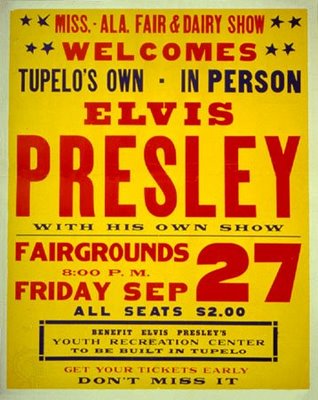
Elvis Presley, live, Tupelo, Mississippi (Mississippi-Alabama Fair & Dairy Show), 1956

“Heartbreak Hotel”

*****

“Long Tall Sally”

**********

lagniappe

Wednesday, 3/3/10

What other pop star has made such stunning contributions as a guest artist?

Sinead O’Connor

With Willie Nelson, “Don’t Give Up”

*****

With the Chieftains, “The Foggy Dew”

*****

With Shane MacGowan, “Haunted”

Friday, 2/26/10

something you cannot do

Watch this guy and not feel better about, well, pretty much everything.

*****

Jackie Wilson, “You Better Know It,” 1959

Take 1: TV broadcast

*****

Take 2: Movie (Go, Johnny, Go!)

Want more? Here (“Lonely Teardrops” [11/20/09]).

Tuesday, 2/16/10

Delmar Allen “Dale” Hawkins, a rockabilly pioneer who gave the music world the hit “Oh! Suzy-Q,” died Saturday in Little Rock of colon cancer. He was 73.

Hawkins, originally from Goldmine, in Richland Parish, recorded his first hit in the KWKH Radio studios in downtown Shreveport in 1956 with then-15-year-old guitarist James Burton, who later went on to perform and record with Elvis Presley, Ricky Nelson, John Denver and Jerry Lee Lewis, among others.

***

[Burton] recalled the guitar lick that became the hook for “Oh! Suzy-Q.”

“I wrote that little guitar lick when I was 14,” Burton recalled. “It got to be so pop in the club that Dale decided to write some lyrics to it and that became ‘Suzy-Q.’ It became a good record for him and (me) both.

“I was probably his first fan. He was a good guy, a good friend, and I think he lived life to the fullest, right up to the end.”

***

Bassist Joe Osborn, whose career on hundreds of No. 1 and Top 10 hits includes work with Ricky Nelson, Johnny Rivers, the Carpenters, the Fifth Dimension and Bob Dylan, credits Hawkins with starting his career and transitioning him from the guitar to the electric bass.

“In 1956, I was working at Sears in the hardware department and Dale came in,” Osborn said. “‘Suzy-Q’ was already out and a hit, and he wanted me to play with his brother Jerry and his band at the Skyway Club. That’s how me and Dale started. If he hadn’t come in that day I’d still be at Sears, selling hardware.”

***

In addition to his classic “Suzy-Q,” Hawkins recorded more than 40 songs on the “Chess” label. According to an obituary, he was the third entertainer to appear on Dick Clark’s American Bandstand and was the first white artist to perform at the “Apollo Theatre” in Harlem and the “Regal” in Chicago.

***

In the mid-1980s, after moving to Arkansas and entering into a second career as a social worker and counselor, Hawkins returned to live performances in a comeback concert at then-Cowboys nightclub in Bossier City, an event put together by Oil City producer Tom Ayres.

Hawkins, a Navy veteran of the Korean War, is in the Rockabilly Hall of Fame and the Louisiana Music Hall of Fame.

Shreveport Times

Dale Hawkins (August 22, 1936-February, 13, 2010)

“Susie Q” (1956 [variously spelled over the years])

*****

“Little Pig” (1957)

*****

With James Burton (guitar), “Who Do You Love?”, live, Louisiana (Shreveport), 2008

Monday, 2/15/10

Listen to “Sunny Day” by Akon and Wyclef.—Luke (my 18-year-old son, on the phone the other night)

Akon with Wyclef Jean, “Sunny Day” (2008)

***

One of the things I find intriguing about contemporary popular music is the widespread practice (particularly in hip-hop) of featuring guest artists, usually, it seems, people whose style and approach are very different from one’s own. Implicit in this is the notion that hearing two different musical personalities can make for a more interesting and rewarding experience than hearing just one. And including another artist opens a song up, making it less a fixed, static thing and more a vehicle for improvisation and variation, something subject to different takes, whose content and texture ultimately depend to a large extent on the identity and contributions of the featured guest.

**********

lagniappe

mail

My son called from Minnesota the other day to tell me that the weather was terrible, his car had been towed, he didn’t like his job, and he had a cold and a sore throat. Is it bad that the only motherly advice I could think to give him was to listen to Fats Waller [2/9/10]?

*****

The drummer’s comments were great [Brian Blade, 2/13/10]. You layin’ down a pretty good groove your own self, Richard.

Saturday, 2/13/10

Great drummers are like great basketball players—they lift everybody’s game.

Trixie Whitley with Brian Blade (drums) and Daniel Lanois, “I’d Rather Go Blind,” recording session, 2008

*****

Herbie Hancock (piano), Wayne Shorter (saxophone), Dave Holland (bass), Brian Blade (drums); live, Germany (Salzau), 2004

Part 1

(It may simply be a coincidence [or my imagination], but a four-note pattern that Herbie keeps repeating, with variations, reminds me, particularly at around 2:27 and following, of the beginning of Alfred Schnittke’s Piano Concerto [featured on 1/14/10].)

Part 2

**********

lagniappe

Johnny [Vidacovich, featured on 9/30/09], man . . . what an inspiration. His playing is so liquid but at the same time just the street of it is so intoxicating. Studying with him, the drumming aspect was never about fundamental things. It was never about the drums as much as it was about the music and playing with this melodic sensibility. That sticks with me even more than the thickness or the groove, which he never spoke about, really. That was like a given. If you have it inside of you, that groove, you need to lay it down. But also need to be able to sing through the drums.—Brian Blade

Friday, 2/5/10

Who needs electricity?

Jimi Hendrix, “Hound Dog,” live, 1960s

Friday, 1/29/10

William Zinsser, author of On Writing Well:

Short words are better than long words.

Little Richard:

I’m gonna rip it up . . .

Little Richard, “Rip It Up,” live (TV broadcast), c. 1956