“Oh, Lady Be Good,” “Memories of You,” live (TV broadcast [Soupy’s On, Detroit]), 1955
*****
Clifford Brown/Max Roach Quintet (Clifford Brown, trumpet; Max Roach, drums; Sonny Rollins, tenor saxophone; Richie Powell, piano; George Morrow, bass)
Live, “Get Happy”
*****
Live, Virginia (Norfolk, Continental Restaurant), 6/18/1956 (Last Concert)
“You Go To My Head”
***
“What’s New”
**********
lagniappe
Don’t take a trumpet player, man. You won’t need one after you hear this young cat, Clifford Brown.
—Charlie Parker (to Art Blakey, when he was going to work in Philadelphia in the early 1950s)
***
Out in California, we had a house, and we had a piano and vibes as well as trumpet and drums. Brownie could play all these instruments, you know. I would go out of the house and come back, and he would be practicing on anything, drums, vibes, anything. He loved music.
He was so well-rounded in all music. He liked Miles, Trane—who was very young then—and Louis Armstrong, and Lee Morgan, who spent alot of time with Clifford in Philly. Eric Dolphy was another good friend of ours. Music was his first love; I was his second, and math was his third. He was a wizard with figures and numbers; he used to play all kinds of mathematical games. . . .
There was only one time I didn’t travel with him. Our child, Clifford Jr., had been born, and I hadn’t taken him home yet to see the family. So Clifford said okay, and he put us on the plane; and of course that was when he was in the car accident and was killed. It was our second wedding anniversary and my 22nd birthday.
Today, at WKCR-FM (broadcasting from Columbia University), it’s all Brownie, (almost) all day. (This birthday celebration will be interrupted in the middle of the day for coverage of the Columbia/Yale football game.)
Albertina Walker, October 29, 1929-October 8, 2010
“I Can Go To God In Prayer” (joined, at the end, by Patti LaBelle), live, Chicago, 1991
*****
“Please Be Patient With Me” (with James Cleveland), live, Chicago, 1979
This track, which I first encountered 30 years ago, I never tire of hearing.
*****
“Lord Keep Me Day By Day,” live (James Cleveland’s funeral), Los Angeles, 1991
**********
lagniappe
Somebody gonna leave here feeling a little better than they did when they came in . . .
—Albertina Walker
**********
Happy Birthday, Monk!
In celebration of the birthday of Thelonious Monk (October 10, 1917-February 17 1982), WKCR-FM is playing his music all day—and we’re replaying some clips.
**********
Here is the onliest Thelonious.
Thelonious Monk, “Epistrophy,” live (TV broadcast), Paris, 1966
*****
Thelonoius Monk, “’Round Midnight,” live (TV broadcast)
*****
You can tell a lot about Monk’s music—about the centrality of dance, about the interplay between melody and rhythm, about the way a melody’s irregular accents override the pulse (making the dance melodic)—just by watching, in the second performance, the way his right foot moves.
**********
lagniappe
He played each note as though astonished by the previous one, as though every touch of his fingers on the keyboard was correcting an error and this touch in turn became an error to be corrected and so the tune never quite ended up the way it was meant to be.
***
You had to see Monk to hear his music properly. The most important instrument in the group—whatever the format—was his body.
—Geoff Dyer, But Beautiful: A Book About Jazz (1996)
(Originally posted 11/2/09.)
**********
Yeah, the format might seem a little strange: soprano saxophone, unaccompanied. But Monk’s musical language—its tangy mix of geometric elegance and off-kilter bluesiness—is rarely spoken this eloquently.
Sam Newsome, Thelonious Monk Medley, live, 2008
**********
lagniappe
The clarity and logic of his [Thelonious Monk’s] work might have been compared with the craft of an architect. Each phrase, each fragment, each plump chord had its exact place in his musicial structure.—Mimi Clar (in Robin D. G. Kelley, Thelonious Monk: The Life and Times of an American Original[2009])
*****
‘All jazz musicians are mathematicians unconsciously’ was a favorite theory of Monk’s.—Randy Weston (in Deborah Kapchan, Traveling Spirit Masters: Moroccan Gnawa Trance and Music in the Global Marketplace [2007])
(Originally posted 11/25/09.)
**********
genius at work
Thelonious Monk with saxophonist Charlie Rouse, working out a number, “Boo Boo’s Birthday,” during a recording session, 1967
*****
Thelonious Monk (with Charlie Rouse, tenor saxophone; Ben Riley, drums; Larry Gales, bass), “Boo Boo’s Birthday” (Underground [Columbia], 1968)
(Originally posted 12/28/09.)
**********
What did it sound like when Beethoven, seated at the piano, played Bach? For that we have to use our imagination. For this we don’t.
Thelonious Monk plays Duke Ellington, live, Berlin, 1969
[T]he only time I’ve ever seen Monk act like a little boy and looking up to somebody [was in the presence of Duke Ellington]. That was his idol.—Joe Termini (quoted in Robin D. G. Kelley, Thelonious Monk: The Life and Times of an American Original [2009])
Tadd Dameron wrote and arranged this while serving time for a federal drug crime.
Blue Mitchell Orchestra (Blue Mitchell, trumpet, with [among others] Clark Terry, trumpet; Tommy Flanagan, piano; Willie Ruff, French horn; Philly Joe Jones, drums), “Smooth as the Wind” (1961)
***
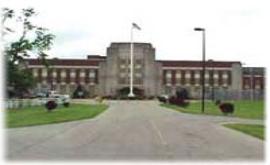
Federal Bureau of Prisons
Federal Medical Center (as it’s now called)
Lexington, Kentucky
***
Tadd Dameron
**********
lagniappe
Sarah Vaughan, live, “If You Could See Me Now” (Tadd Dameron)
*****
radio gems: jazz
Bird Flight WKCR-FM New York (Columbia University)
Monday-Friday, 8:20-9:30 a.m. (EST)
I know of nothing, in radio or anywhere else, like Phil Schaap’s daily meditations on the music of Charlie Parker, which he’s been offering now, five days a week, for over twenty-five years. At its best, his show enthralls. At its worst, well, sometimes you wish Phil would play a little more music and talk a little less. But even when he goes on longer than perhaps he should, your tendency, as with a charmingly eccentric uncle, is to excuse his excesses.
Shelby had been fooled about Florida, but that was okay. She wasn’t the first. She’d imagined a place that was warm and inviting and she’d gotten a place that was without seasons and sickeningly hot. She’d wanted palm trees and she’d gotten grizzly, low oaks. She’d wanted surfers instead of rednecks. She’d thought Florida would make her feel glamorous or something, and there was a region of Florida that might’ve done just that, but it wasn’t this part. It was okay, though. It was something different. It wasn’t the Midwest. It wasn’t a place where you could look around and plainly see, for miles, that nothing worthwhile was going on.
***
“Everybody calls this the real Florida . . . . I don’t understand an expression like that. Is part of the state imaginary?”
What a joy it is to hear an improvising musician whose mind moves as fast as her fingers.
Geri Allen, live, Atlanta, 2009
**********
lagniappe
art beat
In 1932 I saw a photograph by Martin Munkacsi of three black children running into the sea, and I must say that it is that very photograph which was for me the spark that set fire to the fireworks . . . and made me suddenly realize that photography could reach eternity through the moment. It is only that one photograph which influenced me. There is in that image such intensity, spontaneity, such a joy of life, such a prodigy, that I am still dazzled by it even today.
Martin Munkacsi, Three Boys at Lake Tanganyika, c. 1930
*****
radio: space is the place
Tonight, from 6-9 p.m. (EST), WKCR-FM(broadcasting from Columbia University) will be featuring recordings of live performances by Sun Ra & His Solar Arkestra at Soundscape, a New York loft space (West 52nd St. and 10th Ave.) that presented live music from 1979 to 1983.
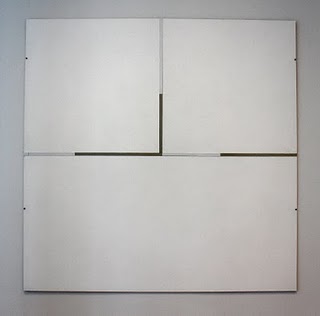
While at the Art Institute the other day, I wandered into a small room of paintings by this guy—who, in his early 20s (in the 1950s), moved to New York to study music with Lennie Tristano.
Robert Ryman, from The Elliot Room (Charter Series), 1985-87


 music clip of the day