music clip of the day

jazz/blues/rock/classical/gospel/more

Category: radio

Thursday, 12/22/11

John Coltrane, Dorothy Love Coates, this guy: the genre makes no difference; some folks play like (as Buddhists put it) their hair is on fire.

Bach, Partita No. 4 in D Major, BMV 828
Glenn Gould, live, Canada, 1981

1: Ouverture

***

2: Allemande

***

3: Courante

***

4: Aria

***

5: Sarabande

***

6: Menuet

***

7: Gigue

**********

lagniappe

heaven, n. a condition or place of great happiness, delight, or pleasure. E.g., WKCR-FM’s annual Bach Festival, which begins today, at 3 p.m., and runs until midnight New Year’s Eve.

Friday, 12/16/11

only rock ’n roll

Happy Refugees, “What’s Your Appeal”
Live, New York (Cake Shop), 12/10/11

More? These guys recently did a live studio performance at WFMU-FM (The Cherry Blossom Clinic with Terre T), which can be heard here.

**********

lagniappe

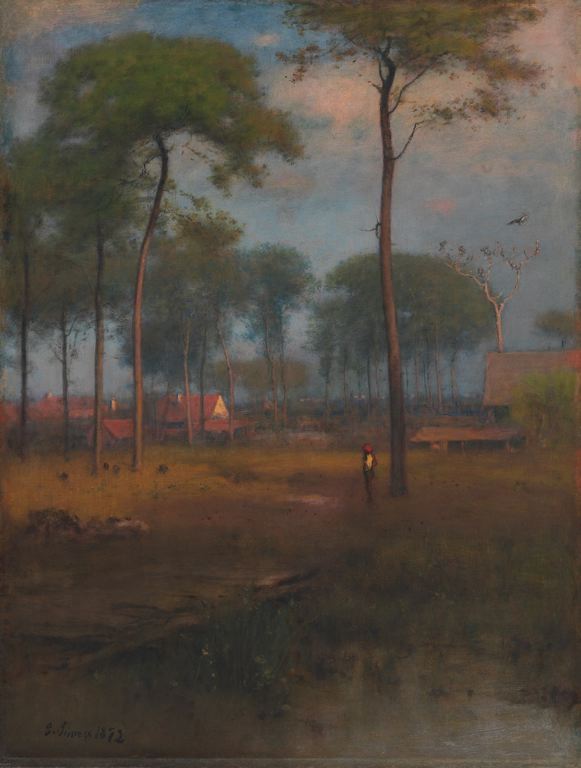
art beat: Tuesday at the Art Institute of Chicago (after a hearing at the nearby federal court building)

George Inness (1825-1894), Early Morning, Tarpon Springs (1892)

Wednesday, 11/23/11

 passings

Is any drummer more lyrical?

Paul Motian, drummer, composer, collaborator, bandleader
March 25, 1931-November 22, 2011

Paul Motian Trio (PM, drums; Joe Lovano, saxophone; Bill Frisell, guitar), “It Should’ve Happened a Long Time Ago” (P. Motian), live, New York (Village Vanguard), 2005

More? Here.

**********

lagniappe

Stephen Paul Motian (he pronounced his surname, which was Armenian, like the word “motion”) was born in Philadelphia on March 25, 1931, and reared in Providence, R.I. In 1950 he entered the Navy. After briefly attending its music school in Washington, he sailed around the Mediterranean until 1953, when he was stationed in Brooklyn. He was discharged a year later.

He met Evans in 1955, and by the end of the decade he was working in a trio with him and the bassist Scott LaFaro. That group, in which the bass and drums interacted with the piano as equals, continues to serve as an important source of modern piano-trio jazz.

In the late 1950s and early 1960s Mr. Motian played with many other bandleaders, including Lee Konitz, Warne Marsh, Mose Allison, Tony Scott, Stan Getz, Johnny Griffin and, for a week, [Thelonious] Monk. After leaving his partnership with Evans, he worked steadily with the pianist Paul Bley, whom he often credited with opening him up to greater possibilities.

“All of a sudden there was no restrictions, not even any form,” he told the writer and drummer Chuck Braman in 1996. “It was completely free, almost chaotic.”

In an interview on Tuesday, Mr. Bley recalled: “We shared the same philosophy, musically. He knew that what he was doing in the past was not his answer. What he lived for was growth and change.”

Then, and even more with Mr. Jarrett’s quartet in the 1970s, Mr. Motian moved away from swing-based rhythm; he improvised freely, or played off melodic form. Eager to grow beyond percussion, he studied and composed on a piano he had bought from Mr. Jarrett, and in 1973 he made a record of his own compositions for ECM, “Conception Vessel,” with Mr. Jarrett and others. One of the last records he made with Mr. Jarrett’s quartet, “Byablue” (1977), consisted mostly of Motian originals.

But the old sense of swing never left, and it later became abundantly clear again, whether he was playing an original sketch built on uneven phrasing with gaps of silence or a root text of jazz like “Body and Soul.” Sometimes he would strip a beat to absolute basics, the sound of brushes on a dark-toned ride cymbal and the abrupt thump of his low-tuned kick drum. Generally, a listener could locate the form, even when Mr. Motian didn’t state it explicitly.

“With Paul, there was always that ground rhythm, that ancient jazz beat lurking in the background,” said the pianist Ethan Iverson, one of the younger bandleaders who played with and learned from him toward the end.

Mr. Motian’s final week at the Vanguard was with Mr. Osby and Mr. Kikuchi, in September. “He was an economist: every note and phrase and utterance counted,” Mr. Osby said on Tuesday. “There was nothing disposable.”

—Ben Ratliff, New York Times11/22/11

*****

radio

Where will my ears be today?

WKCR-FM (broadcasting from Columbia University): they’re celebrating his life and music all day, playing his stuff—and nothing but—until midnight.

*****

reading table

One in my hand

One in the air

And one in you.

—Bill Knott, “The Juggler to His Audience”

Thursday, 11/10/11

serendipity

These tracks brightened a recent Saturday afternoon, thanks to
WFMU-FM (Terre T’s Cherry Blossom ClinicSat., 3-6 p.m. [EST]).

The Equals, “I Can See But You Don’t Know” (1970)

*****

The Eyes, “I’m Rowed Out” (1965)

*****

The Shades of Night, “Fluctuation” (1967)

*****

The Kinks, “She’s Got Everything” (1968)

**********

lagniappe

reading table

[S]itting on the stone wall of the pump house overlooking the reservoir eating my old tuna, jalapeno and “hot” hummus sandwich I had a peaceful sense of NOTHINGNESS and that was what I was going to come to. DEATH is NOTHING. It’s not death that’s sad, it’s life. There is nothing sad about nothing. I had a very strong feeling that I am nothing visiting something. Yes, I am nothing visiting something and returning to nothing.

—Spalding Gray, The Journals of Spalding Gray (2011)
Monday, 10/24/11

Wild Flag, live, SXSW (Austin, Texas), 3/11

“Romance” (Mellow Johnny’s Bike Shop)

***

“Future Crimes” (IFC Crossroads House)

Someday an all-female band will seem no more remarkable than an
all-male one.

**********

lagniappe

radio

A live studio performance,* which I caught part of Saturday afternoon, can be heard here.

*The Cherry Blossom Clinic with Terre T (Sat., 3-6 p.m. [EST]), WFMU-FM

Saturday, 10/15/11

serendipity

Want to feel no better than you do right now?

If so, don’t bother with this stuff.

Last night, while I was listening to the radio,* these tracks came on back to back to back to back, brightening my mood considerably.

Valorie Keys, “Listen Here” (Double Shot 1966)

***

Arthur Alexander, “You Better Move On” (Dot 1961; London [UK] 1962))

***

Bessie Banks, “Go Now” (Blue Cat 1964; Soul City re-release 1966)

***

Dee Dee Warwick, “You’re No Good” (Jubilee 1963)

***

*WFMU-FM (Betsy Nichols, subbing for Mr. Fine Wine)

Monday, 10/10/11

Happy Birthday, Thelonious!

Thelonious Monk, composer, pianist, bandleader
October 10, 1917-February 17, 1982 

Monk’s music—its exquisite mix of logic and lyricism—sometimes makes me think of Mozart.

“’Round Midnight” (AKA “’Round About Midnight”) (T. Monk)

Take 1: Bill Evans Trio (BE, piano; Eddie Gomez, bass; Marty Morrell, drums), live, Sweden, 1970

Vodpod videos no longer available.

***

Take 2: Don Pullen (piano), rec. 1984 (Don Pullen Plays Monk)

Vodpod videos no longer available.

***

Take 3: Milt Jackson (vibes), live, Japan, 1990

Vodpod videos no longer available.

More Monk? Here. And here. And here. And here.

**********

lagniappe

musical thoughts

If it wasn’t for music, man, life wouldn’t be nothing—it’s all about music.

—Thelonious Monk

*****

Sonny Rollins talks about Monk:

Vodpod videos no longer available.

*****

radio

All Monk, all day: WKCR-FM (broadcasting from Columbia University).

Friday, 10/7/11

It’s easy to forget, sometimes, just how great somebody could be.

B.B. King, “How Blue Can You Get?”
Live, Sing Sing Prison (Ossining, New York), 1972

Vodpod videos no longer available.

**********

lagniappe

last night

W. S. Merwin, who just finished a term as U.S. Poet Laureate, gave a reading at Chicago’s downtown library, where he talked about this and that:

The English language is a great dump. Everything that has come into it has stayed there.

***

Poetry begins . . . with listening.

***

I wanted to be open . . . to anything that sounded like poetry.

***

To animals the meaning is the sound—and that’s pretty close to poetry.

***

Time is one of the great human fictions.

***

Many of the most important things we do are not calculated. They take us by surprise.

***

What the arts are made of is nothing but pure attention.

*****

radio

Happy (100th) Birthday, Papa Jo! WCKR-FMs Centennial Festival, mentioned Monday, continues until noon tomorrow.

Thursday, 10/6/11

only rock ’n roll

The Ex, “Waiting,” live (studio performance), WFMU-FM, 2007

Vodpod videos no longer available.

Wednesday, 10/5/11

serendipity

The other day, while I was listening to the radio,* this popped out.

Derek Bailey (guitar) & Tony Oxley (percussion, electronics)
“Sheffield Phantoms,” The Advocate, Tzadik, 2007 (rec. 1975)

Vodpod videos no longer available.

Rarely do you hear something that’s both this “out” and this intimate.

*Afternoon New Music, WKCR-FM (broadcasting from Columbia University), Mon.-Wed., 3-6 p.m. (EST)