Children’s Corner was written for Debussy’s three-year-old daughter, Claude-Emma (nicknamed ‘Chou-Chou’ [AKA Chouchou]) and bears the following dedication: ‘to my dear Chou-Chou, with the tender apologies of her father for what is to follow.’
—All Music Guide to Classical Music (2005)
*****
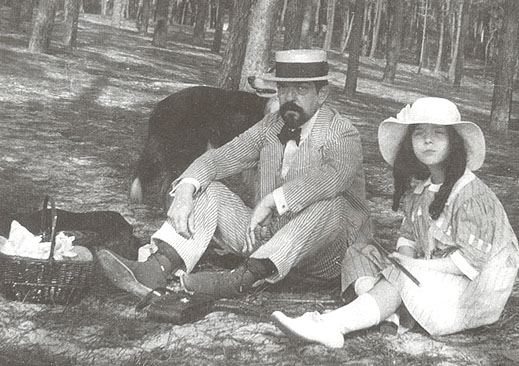
Claude & Chouchou
picnicking in a pine forest near Archachon, 1915
As the date of his appearance in Besançon approached, Lipatti was becoming more and more ill [Hodgkin’s lymphoma]; nevertheless, in the days before the recital he wrote to his teacher Florica Musicescu and also to Paul Sacher that his health was fine. The morning of his performance, he practiced on the Gaveau piano in the Salle du Parliament without any problems. That afternoon, however, he developed a strong fever, and his doctor begged him to cancel; Lipatti did not want to consider this but admitted that he didn’t think he could perform. The organizer of the recital was contacted by telephone, and when he stated that the hall was already full, Lipatti made the decision to play. After some injections, he walked robot-like to the car that transported him to the hall. He took each step deliberately, with such difficulty that he decided that he would not leave the stage between pieces. The Radiodiffusion Française cancelled the live transmission of the recital, fearing the worst, but recorded the performance for future broadcast.
The hall was packed, with additional seating behind the piano . . . The concentration of both the artist and the audience members is palpable in both the photographs and the recording of the recital, with enthusiastic applause greeting each work.
***
Despite other planned concerts later in September and in October, Lipatti did not give another public performance.
“Spring Can Really Hang You Up The Most” (T. Wolf & F. Landesman)
Bob Dorough, vocals & piano (Right On My Way Home, 1997)
*****
Betty Carter, vocals (Inside Betty Carter, 1964)
**********
lagniappe
reading table
Alcove
by John Ashbery
(Planisphere, 2009)
Is it possible that spring could be
once more approaching? We forget each time
what a mindless business it is, porous like sleep,
adrift on the horizon, refusing to take sides, “mugwump
of the final hour,” lest an agenda—horrors!—be imputed to it,
and the whole point of its being spring collapse
like a hole dug in sand. It’s breathy, though,
you have to say that for it.
And should further seasons coagulate
into years, like spilled, dried paint, why,
who’s to say we weren’t provident? We indeed
looked out for others as though they mattered, and they,
catching the spirit, came home with us, spent the night
in an alcove from which their breathing could be heard clearly.
But it’s not over yet. Terrible incidents happen
daily. That’s how we get around obstacles.
Von Freeman,* tenor saxophone; Clifford Jordan, tenor saxophone (first solo); Willie Pickens, piano; Dan Shapera, bass; Robert Shy, drums; “Oleo” (S. Rollins), live, Chicago (Chicago Jazz Festival), 1988
Not even with all the fingers on all the hands of all the people in the city of Chicago could you count the possibilities offered by just three instruments.
Gyorgy Ligeti, Trio for Violin, Horn, and Piano (1982); Tomas Major (violin), Zora Sloka (horn), Denes Varjon (piano), 2009
Levon Helm, drummer, singer, songwriter, actor, etc.
May 26, 1940-April 19, 2012
Live, 2/12, Woodstock, NY (Levon’s home)
“Ophelia”
***
“The Weight”
*****
“When I Go Away,” recording (Electric Dirt, 2009)
**********
lagniappe
Levon Helm will always hold a special place in my heart. He was as great of an actor as a musician. For me watching him play the role of my daddy in Coal Miner’s Daughter is a memory I will always treasure.
When I heard The Band’s Music from Big Pink, their music changed my life. And Levon was a big part of that band. Nigel Olson, my drummer, will tell you that every drummer that heard him was influenced by him. He was the greatest drummer and a wonderful singer and just a part of my life that was magical. They once flew down to see me in Philadelphia and I couldn’t believe it. They were one of the greatest bands of all time. They really changed the face of music when their records came out. I had no idea he was sick so I’m very dismayed and shocked that he died so quickly. But now my son [Zachary Jackson Levon Furnish-John] has his name.
He was my bosom buddy friend to the end, one of the last true great spirits of my or any other generation. This is just so sad to talk about. I still can remember the first day I met him and the last day I saw him. We go back pretty far and had been through some trials together. I’m going to miss him, as I’m sure a whole lot of others will too.
This guy’s a rare bird. Long a respected concert pianist, he’s also become a notable writer, appearing recently in the New Yorker and the New York Times Sunday Book Review.
Jeremy Denk, piano
Charles Ives, Concord Sonata (excerpt [“The Alcotts”])
Live, New York, 2012
**********
lagniappe
reading table
My Ives addiction started one summer at music camp, at Mount Holyoke College. I was twenty and learning his Piano Trio. There’s an astounding moment in the Trio where the pianist goes off into a blur of sweet and sour notes around a B-flat-major chord. I knew the moment was important, but I wondered, was my sound too vague or too clear? (A recurring interpretative problem in Ives is discovering the ideal amount of muddle.) I was also puzzled about where this phrase was going. I’d been taught that phrases were supposed to go somewhere, yet this musical moment seemed serenely determined to wander nowhere.
After posting the Peter Brötzmann clip and the AOL headlines, I drove a hundred miles to see a client serving a life sentence at the Pontiac Correctional Center, then stopped at a nearby restaurant for a mid-afternoon lunch, where I overheard the cook ask a patron: “Did you see where that guy was killed by a swan?”
Han Bennink, drummer, percussionist, visual artist, etc.
Han Bennink (drums) & Guus Janssen (piano), “One Bar”
Live, Japan (Chiba), 2010
**********
lagniappe
You’ve got to hand it to WKCR-FM. There are a few stations, here and there, that might spin a track or two in honor of the Dutch drummer’s 70th birthday. Somebody might even give him an hour or two. But who, other than a station deeply in tune with Bennink’s own inspired lunacy, would stage a five-day marathon?
The keyboard is the stage on which the fingers dance.
Sviatoslav Richter, piano
TV performance (CBC, Toronto),* 1964
**********
lagniappe
reading table
even grass and vines
don’t part willingly . . .
lantern for the dead
—Kobayashi Issa, 1822 (translated from Japanese by David G. Lanoue)
*****
*Johannes Brahms, Intermezzo in E Minor, Op. 116, No. 5
Sergei Prokofiev, Sonata No. 2 in D Minor, Op. 14
Maurice Ravel, Jeux d’eau, Alborada del gracioso

 music clip of the day