Saturday, August 10th
alone
Soundtrack to a dream I wish I’d had last night.
Tristan Murail (1947-), “Comme un oeil suspendu et poli par le songe . . .”; Mireia Vendrell, piano, live
alone
Soundtrack to a dream I wish I’d had last night.
Tristan Murail (1947-), “Comme un oeil suspendu et poli par le songe . . .”; Mireia Vendrell, piano, live
alone
John Cage (1912-1992), Sonatas and Interludes for Prepared Piano (1946-1948); Louis Goldstein, piano, live, Winston-Salem, N.C. (Reynolda House Museum of American Art), 1982
What I love about this performance is its directness. He doesn’t treat these pieces as arty exotica. He plays them as simply and naturally, as musically, as one might play Bach, or Mozart, or Chopin.
**********
lagniappe
musical thoughts
I remember loving sound before I ever took a music lesson. And so we make our lives by what we love.
***
A sound does not view itself as thought, as ought, as needing another sound for its elucidation, as etc.; it has not time for any consideration–it is occupied with the performance of its characteristics: before it has died away it must have made perfectly exact its frequency, its loudness, its length, its overtone structure, the precise morphology of these and of itself.
***
They say, “you mean it’s just sounds?” thinking that for something to just be a sound is to be useless, whereas I love sounds just as they are, and I have no need for them to be anything more than what they are. I don’t want them to be psychological. I don’t want a sound to pretend that it’s a bucket or that it’s president or that it’s in love with another sound. I just want it to be a sound.
alone
Ran Blake (1935-), “Over the Rainbow” (H. Arlen & E. Harburg), live, Portugal (Lisbon), 2010
**********
lagniappe
reading table
Even in Kyoto—
hearing the cuckoo’s cry—
I long for Kyoto.—Matsuo Basho (1644-1694; translated from Japanese by Robert Hass)
making a joyful noise
Evangelist Rosie Haynes (alto saxophone, vocals), “Because He Lives,” live, Milwaukee, 2005
#1
#2
*****
taking a break
I’m taking some time off—back in a while.
alone
The world seems, sometimes, like an uncatalogued collection of miracles.
Johann Sebastian Bach (1685-1750), Partita No. 6 in E minor; Glenn Gould (1932-1982), piano
baseball and boogie–woogie
In advance of tonight’s All-Star game, here’s the answer to a baseball trivia question: Who’s the finest musician ever to work between the foul lines? This guy, “the progenitor of boogie-woogie piano,” played for the Chicago All-Americans, a Negro league team, during World War I, then worked for twenty-five years as a groundskeeper for the Chicago White Sox.
Jimmy Yancey (1894 [or 1898]-1951), piano, “Yancey Stomp,” 1939
3n
Matthew Shipp Trio (MS, piano; Michael Bisio, bass; Whit Dickey, drums), live, Cold Spring, N.Y., 2011
#1
#2
#3
**********
lagniappe
reading table
Don’t be too eager to ask
What the gods have in mind for us . . .—Horace (65 BC-25 BC), Ode I.11 (excerpt; translated from Latin by David Ferry)
They play each note as if, at that particular moment, nothing in the world is more important.
György Kurtág (1926-) and Márta Kurtág, live, Kurtág (Játékok [Games]) and Bach (miscellaneous transcriptions), Paris, 2012
**********
lagniappe
musical (and other) thoughts
Q. One last question—are you a believer?
A [G. Kurtág]. I do not know. I toy with the idea. Consciously, I am certainly an atheist, but I do not say it out loud, because if I look at Bach, I cannot be an atheist. Then I have to accept the way he believed. His music never stops praying. And how can I get closer if I look at him from the outside? I do not believe in the Gospels in a literal fashion, but a Bach fugue has the Crucifixion in it—as the nails are being driven in. In music, I am always looking for the hammering of the nails. . . . That is a dual vision. My brain rejects it all. But my brain isn’t worth much.
—Alex Ross, New Yorker blog, quoting György Kurtág: Three Interviews and Ligeti Homages (2009)
In a world this fast what you need, sometimes, is something this slow.
Shirley Horn (1934-2005), “Summer (Estate)” (B. Martino & B. Brighetti), live, Switzerland (Bern), 1990
**********
lagniappe
musical thoughts
Space is a valuable commodity in music. Too many musicians rush through everything with too many notes. I need time to take the picture. A ballad should be a ballad. It’s important to understand what the song is saying, and learn how to tell the story. It takes time. I can’t rush it. I really can’t rush it.
*****
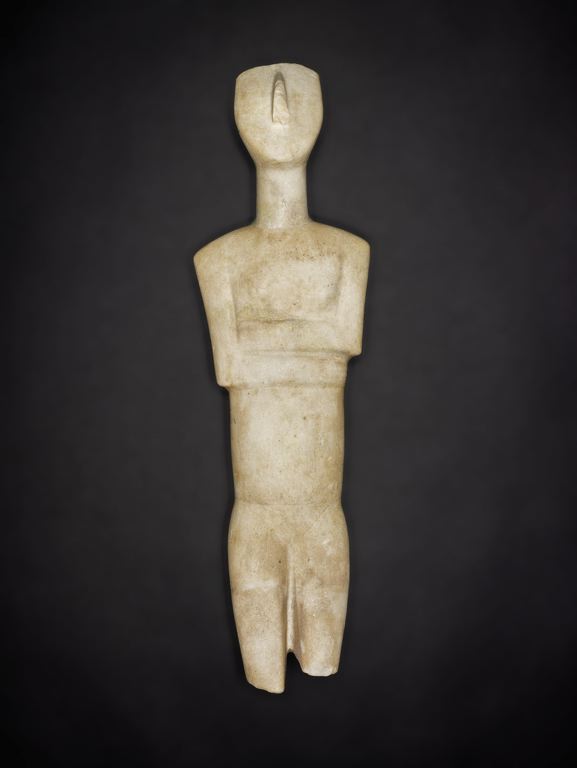
art beat: more from the other day at the Art Institute of Chicago
Statuette of a Female Figure
Cycladic, probably from the island of Keros
Early Bronze Age, 2600/2400 B.C.
 music clip of the day