I used to write these gigantic pieces that were very complex and took a long time to compose, if not to play. I am now much more impatient and couldn’t stand working for so long on the same thing. But also those pieces were me working out certain ideas about music. Those ideas are now part of my life, so I don’t have to think about them in quite the same way. But some things never change, in that you are still glad to finish a piece and still wonder whether it is as good as you hoped it might be when you started out.
***
The Two Diversions were an idea of Ursula Oppens. Oppens decided that Carnegie Hall should commission composers to write what they considered easy pieces, and to make an album for piano students, and so I wrote two pieces for this album. I don’t think they’re as easy as they’d hoped, but there are some people with even harder ones.
—Elliott Carter (first quote’s from here, second here)
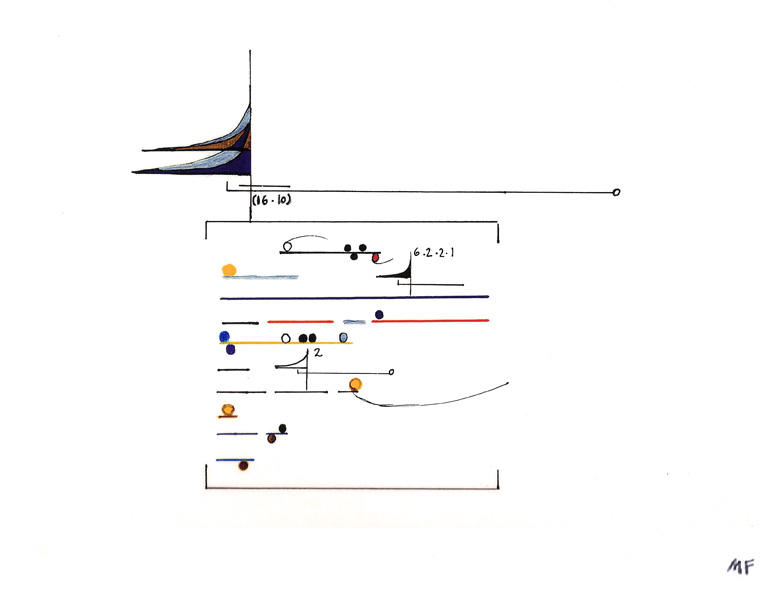
Trying to capture jazz in standard notation can be like trying to translate poetry into another language—what you wind up with is everything but the poetry. So composer/trumpeter Wadada Leo Smith (who, like many of his peers, eschews “jazz” as a label for his music) invented his own system of graphic notation.
***************
Wadada Leo Smith (trumpet) with his Golden Quartet (Vijay Iyer [piano], John Lindberg [bass], Ronald Shannon Jackson [drums]); Eclipse, 2005
Part 1
*****
Part 2
*****
Part 3
*****
Part 4
*****
Part 5
*****
Part 6
*****
Part 7
*****
Part 8
**********
lagniappe
art beat
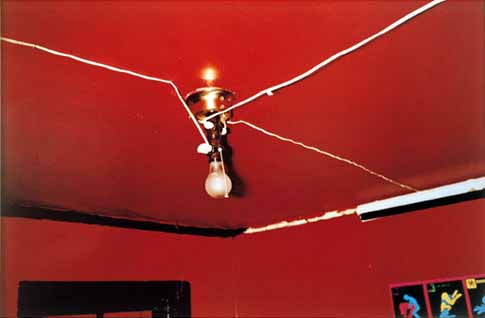
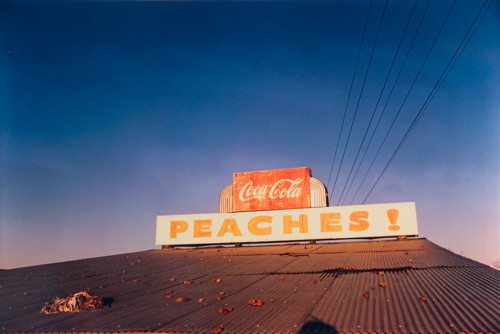
Earlier this month, when I mentioned the exhibit of William Eggleston’s photographs that’s currently at the Art Institute—posting an album cover that you’ll find in a display case there—I didn’t expect that Big Star would appear here again before the month’s end. But then I didn’t expect that Alex Chilton would pass away, either.Alex had more than simply an artistic interest in Eggleston and his work. He’d known the photographer, who was a good friend of his parents, since he was a little boy. Here, again, is the image Alex chose for that album cover, followed by a couple more from this exhibit.
Excerpt, recording (Grand Valley State University New Music Ensemble)
*****
Part 3
Excerpt (ending), live, Tokyo, 2008
*****
I first encountered Steve Reich’s music in 1971, while in college and living for a few months in New York. At a concert at New York University, I heard Reich and his ensemble perform his then-new piece “Drumming.” Stunning, mesmerizing, it was unlike anything my 19-year-old ears had ever heard.
**********
lagniappe
The other day, I watched as Steve Reich walked away from Carnegie Hall, where celebrations of his seventieth birthday were under way, and out into his native city. Trim and brisk, he darted into West Fifty-seventh Street, fell back before oncoming traffic, bopped impatiently in place, then darted forth again. He soon disappeared into the mass of people, his signature black cap floating above the crowd. Perhaps I should have lamented the fact that one of the greatest living composers was moving around New York unnoticed, but lamentation is not a Reichian state of mind, and I thought instead about how his work has blended into the cultural landscape, its repeating patterns and chiming timbres detectable all over modern music. Brian Eno, David Bowie, David Byrne, and a thousand d.j.s have paid him heed. On Fifty-seventh Street, Reich-inflected sounds may have been coursing through the headphones of a few oblivious passersby.
Three decades ago, New York’s leading institutions would have nothing to do with Reich. A riot broke out when Michael Tilson Thomas presented “Four Organs” at Carnegie in 1973: one woman tried to stop the concert by banging on the edge of the stage with her shoe. Now uptown is lionizing the longtime renegade.
***
Reich changed music, and he also changed how music relates to society. In the face of early incomprehension, he took a do-it-yourself approach to getting his work before the public. Nonclassical musicians were among his models: he saw John Coltrane some fifty times, and marvelled at how the great man would unleash mind-bending sounds, pack up his sax, and disappear into the night. With his namesake ensemble, Reich performed in galleries, clubs, and wherever else he felt welcome. The effects of this paradigm shift can be seen on any day of the week in New York, as composer-led ensembles proliferate.
***
The Reich ensemble retains most of its original members, and they remain an awesome force, even as shaggy hairdos have given way to dignified shocks of white. At Zankel Hall, they played Part I of “Drumming,” a phase-shifting tour de force in which bongos are struck with sticks. I was curious to see how they would compare with two sharp young ensembles who had performed the same stretch of music in recent weeks—So Percussion, at Symphony Space, and four Juilliard percussionists, at Carnegie. The youngsters drummed with effortless grace, as if the score were written into their genetic code. But the veterans more than held their own, bringing to bear a kind of disciplined wildness, in the spirit of the Ghanaian drummers with whom Reich studied before he wrote the piece. The energy that blazed up at climactic moments could have powered the hall in a blackout.
The Loose Marbles is a sort of Amalgamated Jazz Corporation that creates subsidiaries around the city, to maximize tips and minimize boredom. The fifteen musicians play clarinet, trumpet, banjo, washboard, accordion, trombone, guitars, sousaphone, standup bass, and guitars, but you’re likely to see only seven or eight performers at any given gig. And since you rarely see the same configuration of instruments twice in a row, you rarely hear the same kind of jazz. If Patrick McPeck is there with the accordion, you’ll hear the Marbles’ repertoire of spooky, minor-keyed, Gypsy-influenced songs. If Alynda Segarra is there, with her banjo or washboard, and Jason Jurzek is on string bass instead of tuba, they’ll be playing songs that sound as if they were first performed in a hobo jungle during the Hoover Administration. In Washington Square, in New York, they split into two groups, one anchored by the tuba and the other anchored by the bass, and they play on opposite sides of the park. Halfway through the day, they’ll mix up the configurations to give both the musicians and the crowd a change of pace. At the end of the day, they pool all the tips and divide them equally. I’ve seen days here in New Orleans where they have a stack of bills that’s so thick it can’t be held in one hand, and that contains a lot of portraits of Hamilton and Jackson.
***
The Loose Marbles look like street urchins, and at least a few of them are. The goat-bearded guitar and tuba player, Barnabus Jones; Ruth’s boy, Kiowa Wells; and the banjo and washboard player Alynda all come from a subculture of rail-riding, outdoor-living hobos that was beautifully documented a couple of years ago by the photographer James Heil in Time. . . . But the trumpeter Ben Polcer is a University of Michigan music-school graduate, and the clarinetist Mike Magro, from suburban Philadelphia, is a virtuoso who can hold forth at length about the rare and antiquated Albert fingering of his clarinet.
In addition to their song selection and their remarkably tight and vibrant musicianship, two things particularly excite me about the Loose Marbles. One is how carefully thought out their act is; their inter-war, Mitteleuropean flavor is somehow more than accidental and less than shtick. The other is how much, and how obviously, they all love each other.
***
I asked Ben why he and his friends aren’t playing rock and roll like proper twenty-somethings. What is the attraction, I wanted to know, of music his grandparents listened to?
“I’ve played in a lot of rock bands,” he said. “I like rock and roll. We all like rock and roll. But jazz is special. To play it well, you really have to listen to each other.”—Dan Baum
With John Coltrane (saxophone), Wynton Kelly (piano), Paul Chambers (bass), Jimmy Cobb (drums), Gil Evans Orchestra; live (TV Broadcast), 1959
*****
Take 2
With Wayne Shorter (saxophone), Herbie Hancock (piano), Ron Carter (bass), Tony Williams (drums); live (TV broadcast), 1964
**********
lagniappe
[Many admirers of Kind of Blue] are forced to reach back before the modern era to find its measure. Drummer Elvin Jones hears the same timeless sublimity and depth of feeling ‘in some of the movements of Beethoven’s Ninth Symphony, or when I hear Pablo Casals play unaccompanied cello.’ ‘It’s like listening to Tosca, says pianist/singer Shirley Horn. ‘ You know, you always cry, or at least I do.’
***
Quincy Jones: ‘That will always be my music, man. I play Kind of Blue every day—it’s my orange juice. It still sounds like it was made yesterday.’
***
Chick Corea: ‘It’s one thing to just play a tune, or play a program of music, but it’s another thing to practically create a new language of music, which is what Kind of Blue did.’
—Ashley Kahn, Kind of Blue: The Making of the Miles Davis Masterpiece (2000)
Both Chicago blues artists. Both guitar players. Both influenced by other kinds of music.
Musical personalities? They could hardly be more different.
Buddy Guy, “Let Me Love You Baby,” live
*****
Fenton Robinson, “Somebody Loan Me A Dime,” live, 1977
***
Back in the 1970s, when I was at Alligator Records, I had the pleasure of working with Fenton, co-producing his album I Hear Some Blues Downstairs (a Grammy nominee). He didn’t fit the stereotype of a bluesman. Gentle, soft-spoken, serious, introspective: he was all these things. He died in 1997.
God the poet, the master of metaphor, wanting to comment on what a big, open, unruly country this is, put the birthdays of Ornette Coleman, born in 1930 in Fort Worth, Texas, and Bix Beiderbecke, born in 1903 in Davenport, Iowa, back to back.
Bix Beiderbecke, cornet, with Frankie Trumbauer and His Orchestra, 1927
“I’m Coming, Virginia”
*****
“Singin’ the Blues”
*****
“Riverboat Shuffle”
lagniappe
Speaking of Bix’s playing, Louis Armstrong said:
Those pretty notes went right through me.
*****
Radio Bix: all Bix, all the time
As they did with Ornette’s birthday yesterday, WKCR-FM is celebrating Bix’s birthday by playing his music all day.
It used to be that music came from a particular place. No more. Whether it’s Sohrab Saadat Ladjevardi (the Iranian saxophonist who’s lived in Germany, in Japan, and now in New York City [2/18/10]), or Burkina Electric (whose members come from Burkina Faso, from Germany, and from New York City [by way of Austria] [2/22/10]), or this singer, who’s lived (and has homes) in Nigeria and in Germany, much of today’s most intriguing music has its ears and heart and feet on more than one continent.