When it comes to saying a lot with a little, Chopin’s 24 Preludes for solo piano—most of which last no more than a minute or two—have few equals. This one was played at his funeral.
Earlier this week the last surviving member of the Chicago-based Gay Sisters passed away. She was a piano wizard—sometimes referred to as the “Erroll Garner of gospel piano.” A musical tribute is scheduled for Friday evening, April 16th, at the Prayer Center Church of God in Christ, which is located at 526 E. 67th St. in Chicago.
Geraldine Gay, 1931-April 6, 2010
Gay Sisters, Savoy Records, 1951
“I’m A Soldier In The Army Of The Lord”
That’s Geraldine on the right.
*****
“I’m Goin’ To Walk Out In His Name”
*****
“God Will Take Care Of You”
**********
lagniappe
‘God Will Take Care Of You’ . . . sold an easy 100,000 units (an astounding amount of records for any genre to sell at the time), which in today’s sales would be equal to the popularity of a platinum album.—Bill Carpenter, Uncloudy Days: The Gospel Music Encyclopedia (2005)
*****
Chicago is known the world over as the birthplace of gospel music. So it comes as no surprise that city officials can barely contain their excitement over the possibility of a gospel museum opening on the city’s south side. How excited are they? Well, an official with the Chicago Board of Tourism recently made this commitment: the gospel museum “is exactly the kind of thing,” she said, that they “would put up” on their Web site. Yes, you heard that right: a city official announced, publicly, that they would include it on their Web site. Take that, Nashville!
This guy’s one of the most lyrical players and composers around.
(He also happens to have paranoid schizophrenia.)
Tom Harrell, flugelhorn/Tom Harrell Quintet
“Rhythm-A-Ning,” live, France (Paris), 2008
*****
“In the Infinite” (by TH), live, Italy (Sorrento), 2008
*****
“Dancin’ Around” (by TH), live, Brazil (Sao Paulo), 2003
**********
lagniappe
I’m posting this next piece with mixed feelings. Talking about Harrell’s psychiatric condition can distract from what’s most important—his music. On the other hand, what he’s been able to accomplish says a lot not only about him but also about the power of music.
If I could listen to only one singer for the rest of my life, she’d be the one.
No one gives you more of life.
Inessentials? No one offers fewer.
Moment by moment, no one is more enthralling.
***
Billie Holiday
“The Blues Are Brewin’,” with Louis Armstrong (New Orleans, 1947)
*****
“Fine and Mellow,” with Ben Webster (ts), Lester Young (ts), Vic Dickenson (trbn), Gerry Mulligan (bs), Coleman Hawkins (ts), Roy Eldridge (trmpt), live (TV broadcast), 1957
*****
“What A Little Moonlight Can Do,” with Mal Waldron (p), live (TV broadcast), 1958
BILLIE HOLIDAY BIRTHDAY BROADCAST : APRIL 7th, 2010
Ninety-five years after her birth, on April 7th, 2010, WKCR will dedicate all programming to Billie Holiday. Born Elinore Fagan in Baltimore, Holiday learned songs by Louis Armstrong and Bessie Smith despite the instability and tragedy of her childhood. In 1929, she teamed up with tenor sax player Kenneth Hollan, slowly building her reputation as a vocalist. She replaced Monette Moore at a club called “Covan’s” on West 132 Street in 1932. When producer John Hammond came to see Moore, he was instead captivated by Holiday. He secured a record deal for her, and she recorded two tracks with Benny Goodman. She soon began to record under her own name, collaborating with the greatest artists of the swing era. With pianist Teddy Wilson, she manipulated the melody of dull pop songs for jukeboxes, transforming them into jazz standards, and she courageously recorded “Strange Fruit” with Commodore records when Columbia rejected the sensitive subject matter. Though her career was strained by substance abuse and heartbreak, her voice did not deteriorate. As she inscribed the catastrophes of her life on the texture of her voice, it became only more powerful, more haunting. On April 7th, we will examine the life of this great, mysterious artist, but most importantly, we will listen to her voice.—WKCR-FM
I used to write these gigantic pieces that were very complex and took a long time to compose, if not to play. I am now much more impatient and couldn’t stand working for so long on the same thing. But also those pieces were me working out certain ideas about music. Those ideas are now part of my life, so I don’t have to think about them in quite the same way. But some things never change, in that you are still glad to finish a piece and still wonder whether it is as good as you hoped it might be when you started out.
***
The Two Diversions were an idea of Ursula Oppens. Oppens decided that Carnegie Hall should commission composers to write what they considered easy pieces, and to make an album for piano students, and so I wrote two pieces for this album. I don’t think they’re as easy as they’d hoped, but there are some people with even harder ones.
—Elliott Carter (first quote’s from here, second here)
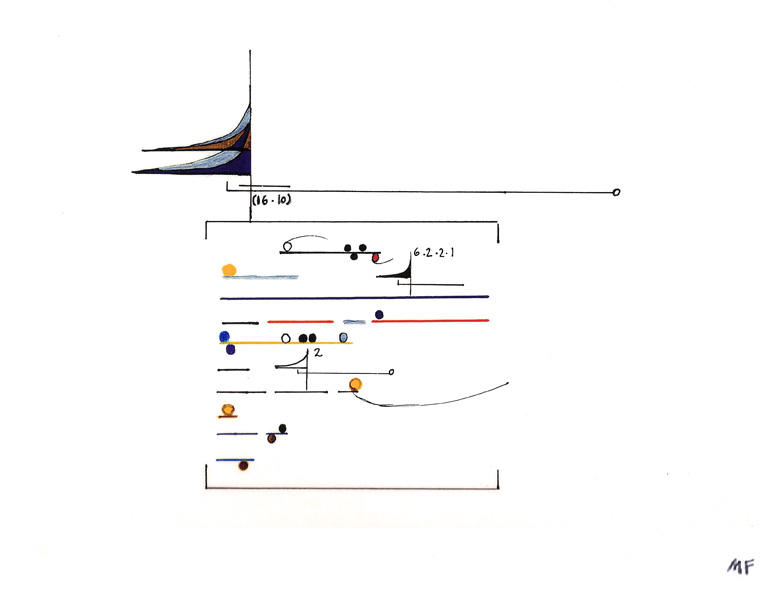
Trying to capture jazz in standard notation can be like trying to translate poetry into another language—what you wind up with is everything but the poetry. So composer/trumpeter Wadada Leo Smith (who, like many of his peers, eschews “jazz” as a label for his music) invented his own system of graphic notation.
***************
Wadada Leo Smith (trumpet) with his Golden Quartet (Vijay Iyer [piano], John Lindberg [bass], Ronald Shannon Jackson [drums]); Eclipse, 2005
Part 1
*****
Part 2
*****
Part 3
*****
Part 4
*****
Part 5
*****
Part 6
*****
Part 7
*****
Part 8
**********
lagniappe
art beat
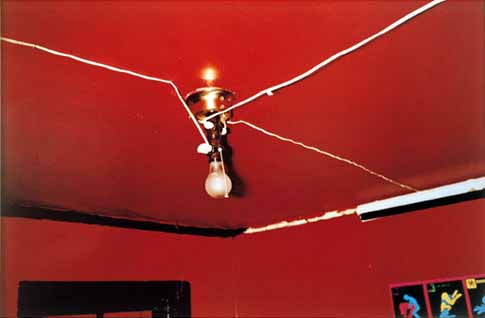
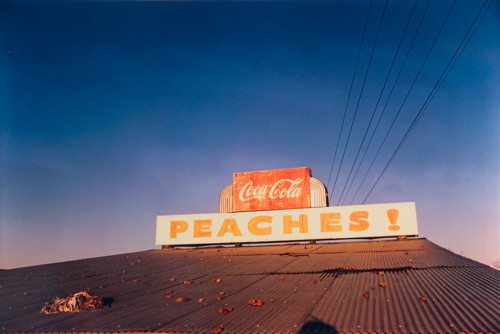
Earlier this month, when I mentioned the exhibit of William Eggleston’s photographs that’s currently at the Art Institute—posting an album cover that you’ll find in a display case there—I didn’t expect that Big Star would appear here again before the month’s end. But then I didn’t expect that Alex Chilton would pass away, either.Alex had more than simply an artistic interest in Eggleston and his work. He’d known the photographer, who was a good friend of his parents, since he was a little boy. Here, again, is the image Alex chose for that album cover, followed by a couple more from this exhibit.
Excerpt, recording (Grand Valley State University New Music Ensemble)
*****
Part 3
Excerpt (ending), live, Tokyo, 2008
*****
I first encountered Steve Reich’s music in 1971, while in college and living for a few months in New York. At a concert at New York University, I heard Reich and his ensemble perform his then-new piece “Drumming.” Stunning, mesmerizing, it was unlike anything my 19-year-old ears had ever heard.
**********
lagniappe
The other day, I watched as Steve Reich walked away from Carnegie Hall, where celebrations of his seventieth birthday were under way, and out into his native city. Trim and brisk, he darted into West Fifty-seventh Street, fell back before oncoming traffic, bopped impatiently in place, then darted forth again. He soon disappeared into the mass of people, his signature black cap floating above the crowd. Perhaps I should have lamented the fact that one of the greatest living composers was moving around New York unnoticed, but lamentation is not a Reichian state of mind, and I thought instead about how his work has blended into the cultural landscape, its repeating patterns and chiming timbres detectable all over modern music. Brian Eno, David Bowie, David Byrne, and a thousand d.j.s have paid him heed. On Fifty-seventh Street, Reich-inflected sounds may have been coursing through the headphones of a few oblivious passersby.
Three decades ago, New York’s leading institutions would have nothing to do with Reich. A riot broke out when Michael Tilson Thomas presented “Four Organs” at Carnegie in 1973: one woman tried to stop the concert by banging on the edge of the stage with her shoe. Now uptown is lionizing the longtime renegade.
***
Reich changed music, and he also changed how music relates to society. In the face of early incomprehension, he took a do-it-yourself approach to getting his work before the public. Nonclassical musicians were among his models: he saw John Coltrane some fifty times, and marvelled at how the great man would unleash mind-bending sounds, pack up his sax, and disappear into the night. With his namesake ensemble, Reich performed in galleries, clubs, and wherever else he felt welcome. The effects of this paradigm shift can be seen on any day of the week in New York, as composer-led ensembles proliferate.
***
The Reich ensemble retains most of its original members, and they remain an awesome force, even as shaggy hairdos have given way to dignified shocks of white. At Zankel Hall, they played Part I of “Drumming,” a phase-shifting tour de force in which bongos are struck with sticks. I was curious to see how they would compare with two sharp young ensembles who had performed the same stretch of music in recent weeks—So Percussion, at Symphony Space, and four Juilliard percussionists, at Carnegie. The youngsters drummed with effortless grace, as if the score were written into their genetic code. But the veterans more than held their own, bringing to bear a kind of disciplined wildness, in the spirit of the Ghanaian drummers with whom Reich studied before he wrote the piece. The energy that blazed up at climactic moments could have powered the hall in a blackout.



 music clip of the day