music clip of the day
jazz/blues/rock/classical/gospel/more
Category: piano
2010
Monday, 7/5/10
How many songs are so 4th-of-July perfect?
The Blasters, “American Music”
Take 1
Live, Illinois (Champaign), 1985
*****
Take 2
Live, Los Angeles, 2010
On Saturday night these guys played this, in overdrive, at FitzGerald’s American Music Festival, a wonderful 4-day event that just celebrated its 30th anniversary.
2010
Thursday, 7/1/10
looking back
Today, celebrating our 300th post, we revisit a few favorites.
**********
3/12/10
Both Chicago blues artists. Both guitar players. Both influenced by other kinds of music.
Musical personalities? They could hardly be more different.
Buddy Guy, “Let Me Love You Baby,” live
*****
Fenton Robinson, “Somebody Loan Me A Dime,” live, 1977
***
Back in the 1970s, when I was at Alligator Records, I had the pleasure of working with Fenton, co-producing his album I Hear Some Blues Downstairs (a Grammy nominee). He didn’t fit the stereotype of a bluesman. Gentle, soft-spoken, serious, introspective: he was all these things. He died in 1997.
**********
3/3/10
What other pop star has made such stunning contributions as a guest artist?
Sinead O’Connor
With Willie Nelson, “Don’t Give Up”
*****
With the Chieftains, “The Foggy Dew”
*****
With Shane MacGowan, “Haunted”
**********
5/28/2010
two takes
“La-La Means I Love You”
The Delfonics, live, 2008 (originally recorded 1968)
*****
Bill Frisell, live, New York (Rochester), 2007
**********
lagniappe
musical thoughts
Music . . . carr[ies] us smoothly across the tumult of experience, like water over rocks.
—Vijay Iyer, liner notes, Historicity (2009)
2010
Wednesday, 6/30/10
The other night, after falling asleep, my older son Alex (now 22) had an unexpected visitor—this guy showed up and began to play.
Vijay Iyer Trio (VI, piano; Marcus Gilmore, drums; Stephan Crump, bass)
“Galang,” recording session (Historicity), New York (Systems Two Studios), 2009
*****
“Questions of Agency,” live, New York (The Stone), 2007
*****
Playing and Talking about Historicity, 2009
**********
lagniappe
Presto! Here is the great new jazz piano trio.
—Ben Ratliff, New York Times (9/9/09)
2010
Friday, 6/25/10
The other day, as I waited for a train at an underground station in downtown Chicago, an older black guy started singing this song, accompanying himself on acoustic guitar, and at that moment everything—this song, this singer, this place—seemed all of a piece and I was no longer waiting.
Curtis Mayfield (with David Sanborn, alto saxophone; Hiram Bullock, guitar; David Lindley, steel guitar; George Duke, piano; Phillipe Saisse, keyboard; Tom Barney, bass; Omar Hakim, drums), “It’s All Right,” live (TV broadcast [Sunday Night]), 1989
2010
Thursday, 6/24/10
Greatest prison band of all time?
No contest.
Who could beat the one that Art Pepper and this guy—both followed Charlie Parker down the path of heroin addiction—led in the 1960s at San Quentin?
Frank Morgan (alto saxophone, with Claude Black, piano; Clifford Murphy, bass; Sean Dobbins, drums), “Well You Needn’t,” live, Ohio (Toledo), 2006
lagniappe
The greatest big band I ever played with was in San Quentin. Art Pepper and I were proud of that band. We had Jimmy Bunn and Frank Butler [whom Jo Jones called “the greatest drummer in the world”], and some other musicians who were known and some who weren’t, but they could play. We played every Saturday night for what they called a Warden’s Tour, which showed paying visitors only the cleanest cell blocks and exercise yards. But people would take that tour just to hear the band.
***
Art and I played more when we were in San Quentin together than when we were on the outside.
***
Art led the way for me to recover. He got out of prison before me and started traveling all over the world before I did. He showed me by example that it could be done, and I’ll always love him for that.
—Frank Morgan
2010
Monday, 6/21/10
My favorite alto sax player?
There are days when I’d say this is the guy.
Art Pepper, September 1, 1925-June 15, 1982
“Red Car” (excerpt), live (Art Pepper: Notes From A Jazz Survivor [1982])
*****
“Mambo Koyama,” live, Italy, 1981
*****
“What’s New?” (1956)
*****
“Over the Rainbow” (1982)
**********
lagniappe
The epigraph to Straight Life: The Story of Art Pepper by Art and Laurie Pepper (1979):
What is the use of talking and there is no end of talking,
There is no end of things in the heart.—Ezra Pound [“Exile’s Letter,” from the Chinese poet Li Po; as punctuated in SL]
2010
Friday, 6/18/10
No one’s played blues harmonica more delicately, more lyrically.
“Shakey,” “Mumbles”—no one’s had weirder nicknames.
No one else in my years at Alligator Records (back in the 1970s), where I worked with a lot of musicians who drank more in a day than most folks do in a month, managed to do this: trip over the drum set, right in the middle of a performance (at Notre Dame), and fall over onstage.
Big Walter Horton, live, Copenhagen, 1970
2010
Thursday, 6/17/10
With the greatest artists, even the most familiar pieces sound as if you were hearing them for the first time.
Beethoven, Piano Sonata No. 14 in C# minor, Op. 27, No. 2 (“Moonlight”), 1801/Artur Schnabel, piano, 1933
1st & 2nd Movements
*****
3rd Movement
**********
lagniappe
The magnitude of his [Schnabel’s] creative accomplishments left technical considerations far behind. His Beethoven had incomparable style, intellectual strength, and phrasing of aristocratic purity. The important thing was that even when his fingers failed him, his mind never did. Schnabel was always able to make his playing interesting. A mind came through—a logical, stimulating, sensitive mind. And when Schnabel had his fingers under control, which was more often than not in his literature of Mozart, Beethoven and Schubert, he took his listeners to an exalted level. . . . There were no tricks, no excesses; just brain, heart and fingers working together with supreme knowledge.—Harold C. Schonberg, The Great Pianists (1963)
*****
Want more of Beethoven’s piano sonatas?
No. 21 (“Waldstein”)/Emil Gilels
No. 23 (“Appassionata”)/Solomon
*****
art beat
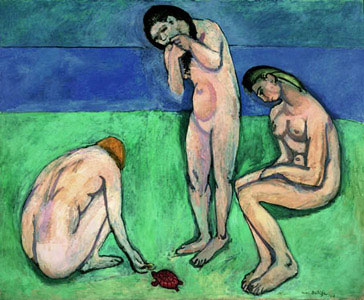
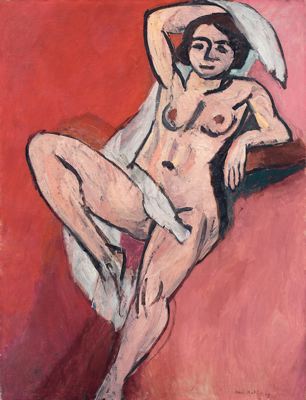
At the risk of repeating myself, the Matisse exhibit at Chicago’s Art Institute closes Sunday (then opens next month at New York’s Museum of Modern Art). How many other opportunities will you have to see this stuff?
Henri Matisse:
Seek the strongest color effect possible . . . the content is of no importance.
***
After a half-century of hard work and reflection the wall is still there.
Bathers with a Turtle (1908)
The Blue Window (1912)

Nude with a White Scarf (1909)
2010
Wednesday, 6/16/10
movies/part 3
Once upon a time, before the Gulf oil spill, before Katrina, there was a city . . .
*****

*****
New Orleans (1947)
Billie Holiday, Louis Armstrong
“Do You Know What It Means To Miss New Orleans?”
Want more Billie Holiday? Here. Here.
More Louis Armstrong? Here.
**********
lagniappe
The impact of the oil from the Gulf of Mexico spill now soiling the Louisiana shoreline was felt far inland on Thursday as P&J Oyster Company, the country’s oldest oyster processor and distributor, ceased its shucking operations.
“The bottom line is that the guys that we purchase from are not working,” said Sal Sunseri, referring to the oyster harvesters who’ve been idled by the mass closure of harvesting areas and freshwater diversions. “Today’s our last day of shucking.”
***
“Having the guy down the street deliver oysters that were shucked just that morning to our doorstep is an amazing thing,” said John Besh, who featured P&J Oysters at his five New Orleans area restaurants. “The relationship is so valuable, knowing that I can count on them to source the best oysters from the saltiest areas and deliver them in a consistent, uniform manner.”
“They provide wonderful oysters,” said Darin Nesbit, chef at the Bourbon House, whose relationship with P&J is so tight Sal Sunseri helped shuck oysters the first night the restaurant opened following Hurricane Katrina. “Even in times of trouble, they’ve always taken care of us.”
P&J was started in 1876 by John Popich, a Croatian immigrant who took on partner Joseph Jurisich at the turn of the century. In 1921, Popich and Jurisich purchased a shucking house at the corner of Toulouse and North Rampart streets. Alfred Sunseri, the current owners’ grandfather, who was married to Popich’s cousin, joined the company soon after.
—Brett Anderson, “P&J looks to bring oysters in from the West Coast for the first time In its 134 years,” New Orleans Times-Picayune, 6/10/10
*****
You’re right, not only can’t you lip-synch this stuff; you can’t really sing it if you don’t know it in your heart. That’s why it’s sooooo good. [The Pilgrim Jubilees, 6/13/10]
 music clip of the day