Here, in MP3 format, is a track featuring a guy we listened to the other day: Cecil Taylor, with drummer Tony Williams (“Morgan’s Motion,” from Williams’ 1978 album The Joy of Flying).
—Cecil Taylor (when asked what advice he would give to a young musician)
Cecil Taylor, live, 1981 (Imagine the Sound)
**********
lagniappe
art beat
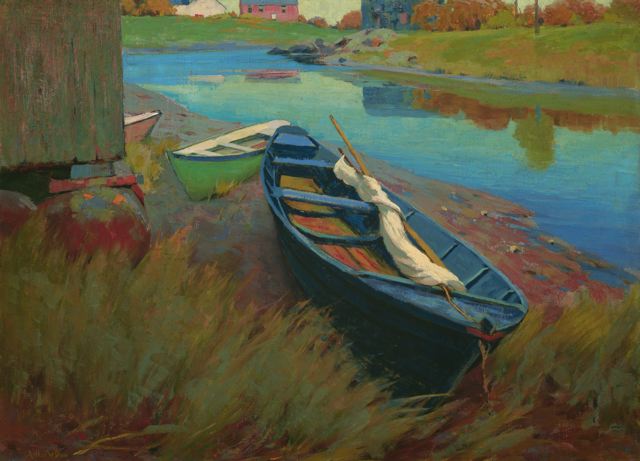
Going to an art museum you never know what you may encounter. This painting, for instance, I’d never laid eyes on—never even heard of the artist—until I happened upon it the other day at Chicago’s Art Institute.
Arthur Wesley Dow (American, 1857-1922), Boats at Rest
He doesn’t play over the drummer—he plays with him.
Keith Richards (with Willie Nelson, Ryan Adams, Hank Williams III), “Dead Flowers,” live (TV broadcast), 2002
**********
lagniappe
I’m not here just to make records and money. I’m here to say something and to touch other people, sometimes in a cry of desperation: ‘Do you know this feeling?’
—Keith Richards, Life (2010)
*****
reading table
As the fiftieth birthday approaches, you get the sense that your life is thinning out, and will continue to thin out, until it thins out into nothing . . . . Then fifty comes and goes, and fifty-one, and fifty-two. And life thickens out again. Because there is now an enormous and unsuspected presence within your being like an undiscovered continent. This is the past.
Leon Russell loved these guys so much—both, alas, have since passed—that, in 1974, he recorded them for his Shelter label.
The O’Neal Twins
“Jesus Dropped The Charges,” live
Take 1 (Say Amen, Somebody[1982])
***
Take 2
*****
“It’s A Highway To Heaven,” live (Say Amen, Somebody [1982])
*****
“Power In The Blood,” live (TV broadcast), mid-1960s
*****
“He Chose Me,” live
*****
“He’ll Give You Peace In The Midst Of The Storm,” live, Texas (Dallas), 1981
**********
lagniappe
In a 2005 interview with the Post-Dispatch, Mr. [Edgar] O’Neal spoke about the early challenges. “We always had bookings and recordings, but when we started, black gospel was not readily accepted with the wide range it is today,” he said. “And the money wasn’t there.”
The O’Neals—with Edgar on piano and both brothers singing—challenged gospel tradition. “The main gospel thrust at the time (was) male quartets, and we were a piano group,” Mr. O’Neal said. “We were considered in a different category from the male singing groups. But then the quartets got into piano. It took some years as we stayed out there before our style took hold.”
Charles Mingus Quintet (CM, bass; Dannie Richmond, drums; Eric Dolphy, alto saxophone, bass clarinet; Clifford Jordan, tenor saxophone; Jaki Byard, piano), live (TV broadcast), Belgium, 1964
“So Long, Eric”
*****
“Peggy’s Blue Skylight”
*****
“Meditations on Integration” (excerpt)
**********
lagniappe
. . . [Mingus’s] music was pledged to the abolition of all distinctions: between the composed and the improvised, the primitive and the sophisticated, the rough and the tender, the belligerent and the lyrical.—Geoff Dyer, But Beautiful: A Book About Jazz (1996)
*****
Making the simple complicated is commonplace; making the complicated simple, awesomely simple, that’s creativity.
***
I, myself, came to enjoy the players who didn’t only just swing but who invented new rhythmic patterns, along with new melodic concepts. And those people are: Art Tatum, Bud Powell, Max Roach, Sonny Rollins, Lester Young, Dizzy Gillespie and Charles Parker, who is the greatest genius of all to me because he changed the whole era around.
***
In my music, I’m trying to play the truth of what I am. The reason it’s difficult is because I’m changing all the time.
—Charles Mingus
(Originally posted on 4/22/10.)
**********
Duke Ellington, Count Basie, Miles Davis: so many of the greatest figures in jazz weren’t just great musicians, or composers, or arrangers. They were great bandleaders. As important to their artistic success as anything else was their ability to find, and showcase, players who could make the music come alive—people like Johnny Hodges and Ben Webster and Jimmy Blanton and Lester Young and Freddie Green and Jo Jones and John Coltrane and Bill Evans and Tony Williams.
That small circle of elite bandleaders includes this man. He hired musicians who played their instruments like no one else (Eric Dolphy, Jaki Byard, et al.). He gave them a musical setting in which structure and freedom were exquisitely balanced. And together they made music that sounds (even on something familiar) like nothing else.
Charles Mingus Sextet (with Johnny Coles, trumpet; Jaki Byard, piano; Eric Dolphy, alto saxophone and bass clarinet; Clifford Jordan, tenor saxophone; Dannie Richmond, drums), “Take the A Train,” live, Norway (Oslo), 1964
**********
lagniappe
I nominate Charles Mingus one of America’s greatest composers—Ran Blake (in the liner notes to his recent album Driftwoods)
Time travel’s easy on the net. With this guy we started, the other day, with music he made just last month. Then we headed back to the ’70s. Today we go back even farther—to the ’60s.
Leon Russell, Shindig! (TV)
“Hi-Heel Sneakers,” 10/28/1964
***
“Roll Over Beethoven,” 11/18/1964
***
“Jambalaya,” 2/3/1965
(Yeah, the guy in front with the banjo—that’s Glen Campbell.)
 music clip of the day