Thursday, 8/26/10
When I die, I’m moving to New Orleans for the funeral.
Funeral, Trumpeter John Brunious, New Orleans, 2/23/08
When I die, I’m moving to New Orleans for the funeral.
Funeral, Trumpeter John Brunious, New Orleans, 2/23/08
replay: a clip too good for just one day
If spirit could be sold, New Orleans would be rich.
Rebirth Brass Band, live, New Orleans, 2009
**********
lagniappe
Brass band musicians are a wild bunch. They’re hard to control. The street funk that the Rebirth Brass Band plays definitely isn’t traditional—it might be in thirty years time.
—Lajoie “Butch” Gomez (in Mick Burns, Keeping the Beat on the Street: The New Orleans Brass Band Renaissance [2006])
(Originally posted on 9/11/09.)
recipe
1 cup funkiness
1 cup elegance
Mix until thoroughly blended.
Professor Longhair (AKA Henry Roeland [“Roy”] Byrd), December 19, 1918-January 30, 1980
“Tipitina,” live
*****
“Hey Little Girl,” live
**********
lagniappe
Mike Kinnamon, Bonnie Bramlett’s Nashville-based manager, in response to an email letting him (and Bonnie) know that her music was featured here (Delaney, alas, is no longer alive), left a voice-mail message yesterday:
. . . I just love it when somebody like you cares enough to send stuff like that around. It’s really cool, and it lifts her [Bonnie] up, too. Thank you so much, buddy . . .
movies/part 3
Once upon a time, before the Gulf oil spill, before Katrina, there was a city . . .
*****

*****
New Orleans (1947)
Billie Holiday, Louis Armstrong
“Do You Know What It Means To Miss New Orleans?”
Want more Billie Holiday? Here. Here.
More Louis Armstrong? Here.
**********
lagniappe
The impact of the oil from the Gulf of Mexico spill now soiling the Louisiana shoreline was felt far inland on Thursday as P&J Oyster Company, the country’s oldest oyster processor and distributor, ceased its shucking operations.
“The bottom line is that the guys that we purchase from are not working,” said Sal Sunseri, referring to the oyster harvesters who’ve been idled by the mass closure of harvesting areas and freshwater diversions. “Today’s our last day of shucking.”
***
“Having the guy down the street deliver oysters that were shucked just that morning to our doorstep is an amazing thing,” said John Besh, who featured P&J Oysters at his five New Orleans area restaurants. “The relationship is so valuable, knowing that I can count on them to source the best oysters from the saltiest areas and deliver them in a consistent, uniform manner.”
“They provide wonderful oysters,” said Darin Nesbit, chef at the Bourbon House, whose relationship with P&J is so tight Sal Sunseri helped shuck oysters the first night the restaurant opened following Hurricane Katrina. “Even in times of trouble, they’ve always taken care of us.”
P&J was started in 1876 by John Popich, a Croatian immigrant who took on partner Joseph Jurisich at the turn of the century. In 1921, Popich and Jurisich purchased a shucking house at the corner of Toulouse and North Rampart streets. Alfred Sunseri, the current owners’ grandfather, who was married to Popich’s cousin, joined the company soon after.
—Brett Anderson, “P&J looks to bring oysters in from the West Coast for the first time In its 134 years,” New Orleans Times-Picayune, 6/10/10
*****
You’re right, not only can’t you lip-synch this stuff; you can’t really sing it if you don’t know it in your heart. That’s why it’s sooooo good. [The Pilgrim Jubilees, 6/13/10]
These guys sounded awfully good the other day—let’s hear some more.
Trombone Shorty and Orleans Avenue, “Orleans & Claiborne,” live, New Orleans, 2010
There are a lot of things to like about this performance. One is the way Shorty, following two hot solos (tenor, baritone), doesn’t try to out-blow those guys. Instead, he changes directions (3:20). Sometimes nothing packs more punch than restraint. (Yeah, I don’t know why this clip cuts off when it does, either.)
Want more? Here.
**********
lagniappe
passings
Soon I’ll be leaving for a funeral—my uncle, Hugh Frebault. Nine days ago we sat and talked and laughed for over an hour; now he’s silent. Does life get any more understandable as you get older? I don’t think so—if anything, it seems to become only more mysterious, more unfathomable.
Blind Willie Johnson, “Dark Was The Night – Cold Was The Ground” (1927, Dallas)
Same song (as last Sunday), same city, different singer.
Grandpa Elliott, “Amazing Grace,” live, New Orleans, April 29, 2010
**********
lagniappe
Interview with Grandpa Elliott, New Orleans, April 29, 2010
This is like my medicine, my doctor, my everything.
—Grandpa Elliott
Want more? Here.
New Orleans Jazz & Heritage Festival, 2010/part 2
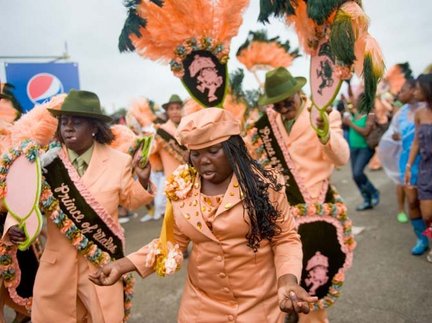
Scene 1: Parade of the New Orleans Social Aid and Pleasure Club
*****
Scene 2: Chouval Bwa
*****
Scene 3: Trombone Shorty and Orleans Avenue, “Backatown” (record-store performance)
*****
Scene 4: Pinettes Brass Band (outside another record store)
**********
lagniappe

New Orleans Jazz & Heritage Festival, 2010/part 1
Scene 1: Sousaphone Parade
*****
Scene 2: Brian Blade & The Fellowship
Want more Brian Blade? Here.
*****
Scene 3: Mardi Gras Indians (Members of the Golden Star Hunters, Carrolton Hunters, et al.), Backstage
Want more Mardi Gras Indians? Here.
**********
lagniappe
street music
New Orleans
Loose Marbles, in the French Quarter
Part 1
*****
Part 2
**********
lagniappe
The Loose Marbles is a sort of Amalgamated Jazz Corporation that creates subsidiaries around the city, to maximize tips and minimize boredom. The fifteen musicians play clarinet, trumpet, banjo, washboard, accordion, trombone, guitars, sousaphone, standup bass, and guitars, but you’re likely to see only seven or eight performers at any given gig. And since you rarely see the same configuration of instruments twice in a row, you rarely hear the same kind of jazz. If Patrick McPeck is there with the accordion, you’ll hear the Marbles’ repertoire of spooky, minor-keyed, Gypsy-influenced songs. If Alynda Segarra is there, with her banjo or washboard, and Jason Jurzek is on string bass instead of tuba, they’ll be playing songs that sound as if they were first performed in a hobo jungle during the Hoover Administration. In Washington Square, in New York, they split into two groups, one anchored by the tuba and the other anchored by the bass, and they play on opposite sides of the park. Halfway through the day, they’ll mix up the configurations to give both the musicians and the crowd a change of pace. At the end of the day, they pool all the tips and divide them equally. I’ve seen days here in New Orleans where they have a stack of bills that’s so thick it can’t be held in one hand, and that contains a lot of portraits of Hamilton and Jackson.
***
The Loose Marbles look like street urchins, and at least a few of them are. The goat-bearded guitar and tuba player, Barnabus Jones; Ruth’s boy, Kiowa Wells; and the banjo and washboard player Alynda all come from a subculture of rail-riding, outdoor-living hobos that was beautifully documented a couple of years ago by the photographer James Heil in Time. . . . But the trumpeter Ben Polcer is a University of Michigan music-school graduate, and the clarinetist Mike Magro, from suburban Philadelphia, is a virtuoso who can hold forth at length about the rare and antiquated Albert fingering of his clarinet.
In addition to their song selection and their remarkably tight and vibrant musicianship, two things particularly excite me about the Loose Marbles. One is how carefully thought out their act is; their inter-war, Mitteleuropean flavor is somehow more than accidental and less than shtick. The other is how much, and how obviously, they all love each other.
***
I asked Ben why he and his friends aren’t playing rock and roll like proper twenty-somethings. What is the attraction, I wanted to know, of music his grandparents listened to?
“I’ve played in a lot of rock bands,” he said. “I like rock and roll. We all like rock and roll. But jazz is special. To play it well, you really have to listen to each other.”—Dan Baum
The French Quarter: the spirit of some places is so strong you can go there, in mind if not in body, just by saying their name.
Rebirth Brass Band, live, New Orleans’ French Quarter, 2008
 music clip of the day