Music comes up more often in my work as a criminal defense lawyer than you might think. Recently I devoted a lot of time to a case involving a Jamaican guy, a sweet-tempered 64-year-old Rasta, who was charged with a federal immigration offense. It helped a lot, early in our relationship, to be able to talk about seeing Bob Marley in the mid-70s at a small Chicago club (Quiet Knight). And when I’d see him at the jail, talking about music (Marley, Sugar Minott, Gregory Isaacs, et al.) gave us a way to leave behind, if only briefly, the concrete walls and the locked doors and the glass window separating us. (At his sentencing hearing earlier this week, the judge, rejecting the prosecutor’s call for a minimum of 70 months’ incarceration, gave him 30 months, meaning, with credit for time served and “good time,” he’ll do less than a year.)
*****
*In 1974, following the departure of Peter Tosh and Bunny Wailer (AKA Bunny Livingston), the band became known as Bob Marley and the Wailers.
The tree of country music has lots of eccentric branches.
The Handsome Family, “My Friend” (2009)
**********
lagniappe
reading table
The Everyday Enchantment of Music
by Mark Strand
(Almost Invisible [2012])
A rough sound was polished until it became a smoother sound, which was polished until it became music. Then the music was polished until it became the memory of a night in Venice when tears of the sea fell from the Bridge of Sighs, which in turn was polished until it ceased to be and in its place stood the empty home of a heart in trouble. Then suddenly there was sun and the music came back and traffic was moving and off in the distance, at the edge of the city, a long line of clouds appeared, and there was thunder, which, however menacing, would become music, and the memory of what happened after Venice would begin, and what happened after the home of the troubled heart broke in two would also begin.
Music doesn’t care who you are, where you come from, what you know. It asks only that you pay attention.
Stefan Wolpe (1902-1972), Piece in Three Parts for Piano and Sixteen Instruments (1961), Peter Serkin (piano), Chamber Music Society of Lincoln Center (Oliver Knussen, cond.)
Slim and the Victory Aries, live, Paducah, Kentucky, c. 2008
“Alright Now”
***
“Shoes”
**********
lagniappe
musical thoughts
[I]n the African-American gospel tradition, the music is the liturgy. . . . If Jesus spoke in parables because it was hard, otherwise, for him to make clear what he intended, gospel music has a similar form, a parabolic form, as if to suggest: what we want you to know about God is in the shape of this statement, in the experience of singing this music and listening to this music. If you can be transported here, inside the church, by this music, you can be transported out there.
Today let’s leave Chicago, where the longest season, it sometimes seems, is not-yet-spring, and head south—to a little church in a small town in Georgia.
Anything can be used to make music—even a book (7:57-).
**********
lagniappe
musical thoughts
The passion for music is itself an admission. We know more about a stranger who abandons himself to it than about someone indifferent to it whom we deal with every day.
—E. M. Cioran, Anathemas and Aphorisms(translated from French by Richard Howard, 1991)
A lot of trumpet players try to bowl you over. This guy, whose last album appeared on many year-end top-10 lists (When the Heart Emerges Glistening, Blue Note), does something different. He gets under your skin.
Ambrose Akinmusire (ah-kin-MOO-sir-ee) Quintet (AA, trumpet; Walter Smith III, tenor saxophone; Fabian Almazan, piano; Harish Ragavan, bass; Justin Brown, drums); live, New York (Jazz Standard), 2011
Part 1
***
Part 2
***
Part 3
***
Part 4
**********
lagniappe
musical thoughts
Everything you don’t love, make sure that’s not in your playing.
Wislawa Szymborska (vees-WAH-vah shim-BOR-ska), poet
July 2, 1923-February 1, 2012
The world—whatever we might think when terrified by its vastness and our own impotence, or embittered by its indifference to individual suffering, of people, animals, and perhaps even plants, for why are we so sure that plants feel no pain; whatever we might think of its expanses pierced by the rays of stars surrounded by planets we’ve just begun to discover, planets already dead? still dead? we just don’t know; whatever we might think of this measureless theater to which we’ve got reserved tickets, but tickets whose lifespan is laughably short, bounded as it is by two arbitrary dates; whatever else we might think of this world—it is astonishing.
But “astonishing” is an epithet concealing a logical trap. We’re astonished, after all, by things that deviate from some well-known and universally acknowledged norm, from an obviousness we’ve grown accustomed to. Now the point is, there is no such obvious world. Our astonishment exists per se and isn’t based on comparison with something else.
Granted, in daily speech, where we don’t stop to consider every word, we all use phrases like “the ordinary world,” “ordinary life,” “the ordinary course of events” . . . But in the language of poetry, where every word is weighed, nothing is usual or normal. Not a single stone and not a single cloud above it. Not a single day and not a single night after it. And above all, not a single existence, not anyone’s existence in this world.
—Wislawa Szymborska, Nobel Lecture (excerpt, translated from Polish by Stanislaw Baranczak and Clare Cavanagh), 12/7/96
Until 1996, when she was awarded the Nobel Prize in Literature, I’d never heard of her. Since then I’ve read virtually everything of hers that’s appeared in translation. How much does she mean to me? Well, she’s one of two charter members (the other’s saxophonist Von Freeman) of the ultra-exclusive MCOTD Hall of Fame.
Otha Turner (1907-2003) and the Rising Star Fife and Drum Band (with guest Luther Dickinson, guitar), “My Babe,” live, Memphis, 1990s
**********
lagniappe
art beat: more from Wednesday’s stop at the Art Institute of Chicago
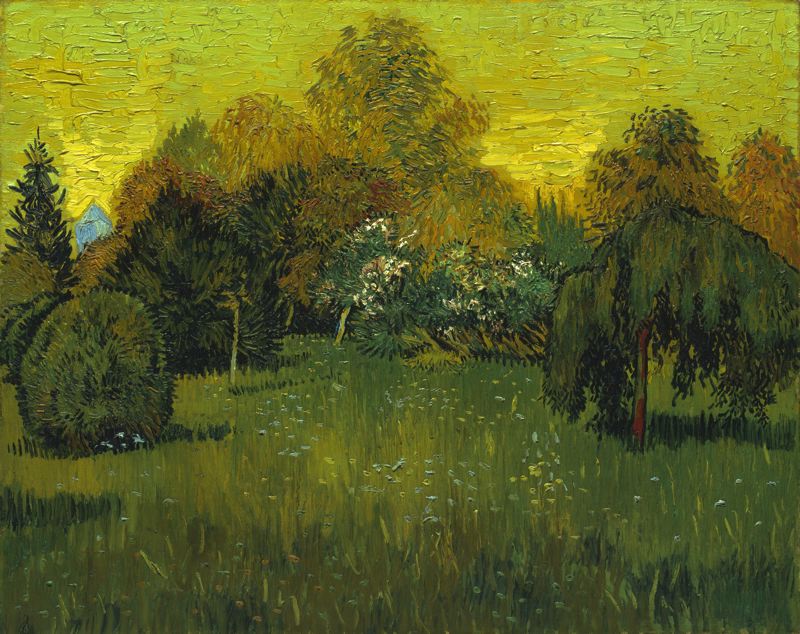
Vincent van Gogh, The Poet’s Garden (1888)
*****
musical thoughts
Last night, at the University of Chicago’s Mandel Hall, I heard what may be the finest encore I’ve ever heard. After devoting the second half of his concert to Beethoven’s mammoth Diabelli Variations, pianist Peter Serkin, following several trips offstage to rapturous applause, sat down and played, slowly, meditatively, the Aria from Bach’s Goldberg Variations. As the last note was fading, if someone had turned to me and said, with the kind of confidence one often encounters in Hyde Park, that the greatest achievements in the history of humanity can be heard at the piano, I couldn’t have done anything other than agree.
 music clip of the day