Wednesday, 9/8/10
Sunday, South Africa; Monday, Morocco; today let’s head to the center—the Democratic Republic of the Congo (formerly Zaire).
Konono No. 1, “Lufuala Ndonga”
Sunday, South Africa; Monday, Morocco; today let’s head to the center—the Democratic Republic of the Congo (formerly Zaire).
Konono No. 1, “Lufuala Ndonga”
Morocco—it’s just a click away.
Musical Brotherhoods from the Trans-Saharan Highway, excerpts (2007)
street music
Whatever it is, this guy’s got it.
Actually, you don’t even need a single string.
Steve Reich, “Clapping Music” (1972)/So Percussion, live, California (Palo Alto), 1/8/10 (music starts at 3:35)
More Steve Reich? Here.
getting older
“Where did everybody go?” you wonder.
With each passing year, more of the musicians who’ve shaped your world—who’ve made life sing—are gone.
Ed Blackwell, Lester Bowie, Betty Carter, Malachi Favors, Steve Lacy, Kate McGarrigle, Art Pepper, Professor Longhair, Sun Ra, Junior Wells, Julius Hemphill (below): the list goes on, and on, and on.
World Saxophone Quartet (Julius Hemphill, alto saxophone; Oliver Lake, soprano and alto saxophones; David Murray, tenor saxophone; Hamiet Bluiett, baritone saxophone)
Medley: “West African Snap,” “I Heard That,” “Fast Life,” “Hattie Wall,” live (TV Broadcast [Night Music]), 1990 (music starts at 2:20)
Listening to Julius Hemphill (far left), a phrase from Martin Luther King, Jr.’s “I Have a Dream” speech comes to mind: “the fierce urgency of now.” Hemphill has, it seems, so much to say—right now. Listen, for instance, to 4:30-6:35.
*****
Live, with M’Boom (Max Roach’s 9-piece percussion ensemble), New York (The Cathedral Church of St. John the Divine), 1981 (music starts at 1:55)
Want more? Here.
**********
lagniappe
musical thoughts
Without music, life would be an error.
—Friedrich Nietzsche
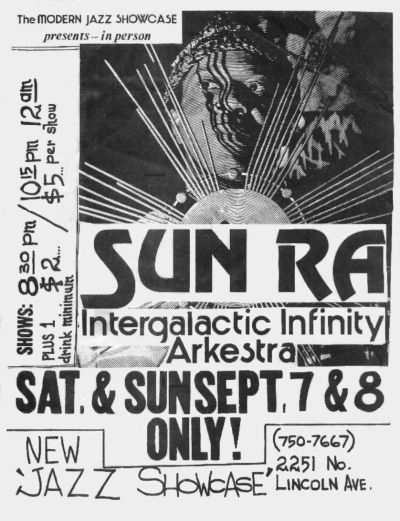
Here’s a big birthday shout-out to my wife Suzanne, who’s not nearly as crazy as I am about music—not nearly as crazy, period—but is crazy enough that she kept going out with me after I took her on our first date, in the summer of 1974, to Chicago’s Jazz Showcase (then on Lincoln Avenue) to see this guy, whose multimedia performance that night featured some of this footage—the stuff with the pyramids.
Sun Ra & His Arkestra in Egypt and Italy, 1971
**********
lagniappe
Even in the excesses of this era there were few audiences prepared for an ominous, ragtag group of musicians in Egyptian robes, Mongolian caps (Mongolian, as from the planet Mongo of Flash Gordon), and B-movie spacesuits who played on a variety of newly invented or strangely modified electronic instruments (the sun harp, the space organ, the cosmic side drum) and proclaimed the greatness of the most ancient of races (this, the Sun Ra of the Solar-Myth Arkestra); or, on yet another night, a merry band in jester’s motley, jerkins, and pointed caps (a la Robin Hood or perhaps the Archers of Arboria) who marched or crawled through the audience, chanting cheerful songs about travel to Venus. It was intensely dramatic music, moving from stasis to chaos and back, horn players leaping about, or rolling on the bandstand, sometimes with fire eaters, gilded muscle men, and midgets, an all-out assault on the senses. At the end of the evening the musicians and dancers moved among the audience, touching them, surrounding them, inviting them to join the Arkestra in marching off to Jupiter.
—John F. Szwed, Space Is The Place: The Lives And Times Of Sun Ra (1997)
*****
Sun Ra’s consistent statement, musically and spoken, is that this is a primitive world. Its practices, beliefs, religions, are uneducated, unenlightened, savage, destructive, already in the past. . . . That’s why Sun Ra returned only to say he left. Into the future. Into Space.
—Amiri Baraka (formerly known as LeRoi Jones)
*****
Silence is music. There are different kinds of silence, each silence is a world all of its own . . . silence is an integral part of all music . . .
***
When you meet a man
You meet a scheme of words
Patterns of concept
A concepted being
Whose very birth conception is called.
***
The earth cannot move without music. The earth moves in a certain rhythm, a certain sound, a certain note. When the music stops the earth will stop and everything upon it will die.
—Sun Ra
*****
What the world needs now?
Nah, not love.
What the world needs now—what it cries out for, daily—is inspired silliness.
Brave Combo, live
“The Denton Polka,” Texas (Denton), 2007
*****
“Louie, Louie,” Illinois (Berwyn [FitzGerald’s]), 2008
Brave Combo played a wild set Sunday night (the 4th) at FitzGerald’s American Music Festival—everything from “Beer Barrel Polka” to a hard-rockin’ “Hokey Pokey” to a polka-inflected “Ode to Joy” (“Any Beethoven fans in the house?”) to a Tejano-style “America the Beautiful.” By the end of the 90-minute set, everybody’s IQ, it seemed, had gone up 15 points. Or was it down?
Wealthiest state in the nation?
If music were money, it might be this.
Nathan Abshire (accordion), “Ma Negresse” (AKA “Pine Grove Blues”)
Take 1
With The Balfa Brothers (Dewey Balfa, fiddle), live, Louisiana (Dedans le Sud de la Louisiane [1974])
*****
Take 2
Live, Louisiana (Mamou [Fred’s Lounge]), 1976
**********
lagniappe
Thanks, Richard, for another tremendous clip. Art Pepper [6/21/10] left us way too soon. Along with his music, I loved his autobiography. Keep up the great work.
*****
Thanks so much!
—L. [Laurie Pepper, Art’s wife, in response to an email letting her know that Art’s music was being featured here [6/21/10]]
more music from Mali
Bassekou Kouyate (ngoni) & Ngoni ba
“Ngoni fola” (2007)
*****
Live, Mali (Timbuktu), 2010
*****
Live, Germany (Rostock), 2007
These guys sounded awfully good the other day—let’s hear some more.
Trombone Shorty and Orleans Avenue, “Orleans & Claiborne,” live, New Orleans, 2010
There are a lot of things to like about this performance. One is the way Shorty, following two hot solos (tenor, baritone), doesn’t try to out-blow those guys. Instead, he changes directions (3:20). Sometimes nothing packs more punch than restraint. (Yeah, I don’t know why this clip cuts off when it does, either.)
Want more? Here.
**********
lagniappe
passings
Soon I’ll be leaving for a funeral—my uncle, Hugh Frebault. Nine days ago we sat and talked and laughed for over an hour; now he’s silent. Does life get any more understandable as you get older? I don’t think so—if anything, it seems to become only more mysterious, more unfathomable.
Blind Willie Johnson, “Dark Was The Night – Cold Was The Ground” (1927, Dallas)
 music clip of the day