Tuesday, 3/6/12
These folks I could listen to all day—tomorrow too.
Afel Bocoum & Alkibar, live, Netherlands (Hertme), 2010
Part 1
***
Part 2
Some music creates a space so mysterious—so different from what you ordinarily inhabit—that the moment it ends you feel bereft.
Toru Takemitsu (1930-1996), Rain Tree, Line C3, New York, 2011
Vodpod videos no longer available.
Some tracks, the first time you hear them (as I did this a couple weeks ago), you wonder how you ever got along without them.
Joe McPhee (tenor saxophone) with Otis Greene (alto saxophone), Mike Kull (electric piano), Herbie Lehman (organ), Dave Jones (guitar), Tyrone Crabb (bass), Bruce Thompson & Ernest Bostic (percussion), “Shakey Jake” (Nation Time, 1970; reissued 2009)
**********
lagniappe
random thoughts
Remember when there was a whole season—not just a storm or two—called “winter”?
If you wanted to conjure a world full of mystery, what better instrument to lead the way than one that possesses neither the brightness of the violin nor the darkness of the cello?
Morton Feldman, Rothko Chapel (1971), live, Houston (Rothko Chapel), 2011; Kim Kashkashian (viola), Brian Del Signore (percussion), Sarah Rothenberg (celeste), Maureen Broy Papovich (soprano), Houston Chamber Choir (Robert Simpson, cond.)
Part 1
***
Part 2
***
Part 3
Another take? Here.
**********
lagniappe
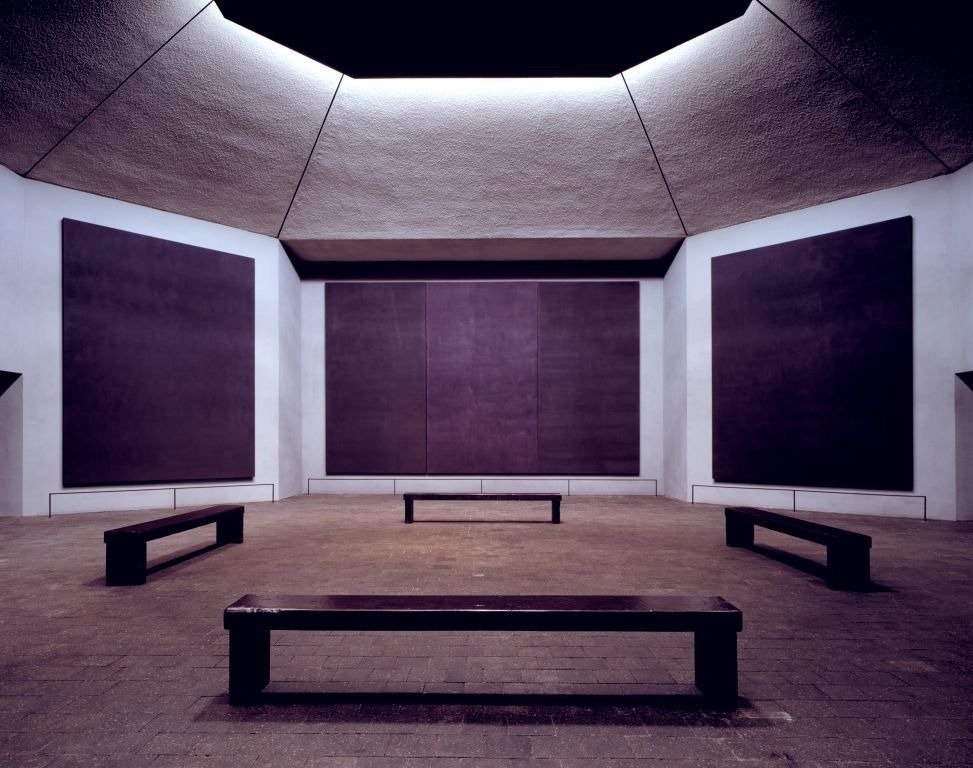
Rothko Chapel, Houston, Texas
***
The Rothko Chapel is an interfaith sanctuary, a center for human rights — and a one-man art museum devoted to 14 monumental paintings by abstract expressionist Mark Rothko. The Houston landmark, commissioned by John and Dominique de Menil, opened its doors 40 years ago, in February 1971.
For the past four decades, the chapel has encouraged cooperation between people of all faiths — or of no faith at all. While the chapel itself has become an art landmark and a center for human-rights action, the sanctuary’s creator never lived to see it finished. Rothko committed suicide in 1970.
Approaching the chapel from the south, visitors first see a steel sculpture called Broken Obelisk by Barnett Newman in the middle of a pool — it appears to be floating on the surface of the water. The chapel itself is a windowless, octagonal brick building. Solid black doors open on a tiny glass-walled foyer. (The foyer was walled off from the rest of the interior when the Gulf Coast’s notorious humidity began to affect the paintings.)
The main room is a hushed octagonal space with gray stucco walls, each filled by massive paintings. Some walls feature one canvas, while on others, three canvases hang side by side to form a triptych. A baffled skylight subdues the bright Houston sun, and the surfaces of the paintings change dramatically as unseen clouds pass outside. There are eight austere wooden benches informally arranged, and today, a few meditation mats. A young woman brings the meditation hour to a close by striking a small bowl with a mallet, creating a soft peal of three bells in the intense silence of the room.
Concerts, conferences, lectures, weddings and memorial services all take place in the chapel throughout the year, but on most days you will find visitors — about 55,000 annually come to see, to meditate, to write in the large comment book in the foyer, to read the variety of well-thumbed religious texts available on benches at the entrance.
***
These paintings do not feature the luminous color fields that made Rothko famous. The paintings in the chapel are dark, in purplish or black hues. And there’s a reason for that, says [chapel historian Suna] Umari.
“They’re sort of a window to beyond,” she explains. “He said the bright colors sort of stop your vision at the canvas, where dark colors go beyond. And definitely you’re looking at the beyond. You’re looking at the infinite.”
***
At first glance, the paintings appear to be made up of solid, dark colors. But look closely, and it becomes evident that the paintings are composed of many uneven washes of pigment that create variations in every inch. Stepping back, waves of subtle color difference appear across the broad surfaces — leading to an unmistakable impression of physical depth.
***
Though Mark Rothko didn’t live to see the sanctuary he created, Christopher Rothko says his father knew what it should be.
“It took me a while to realize it, but that’s really my father’s gift, in a sense, to somebody who comes to the chapel. It’s a place that will really not just invite, but also demand a kind of journey.”
—Pat Dowell, “Meditation and Modern Art Meet In Rothko Chapel,” NPR, 3/1/11
*****
reading table
Our lives are Swiss –
So still – so Cool –
Till some odd afternoon
The Alps neglect their Curtains
And we look farther on!Italy stands the other side!
While like a guard between –
The solemn Alps –
The siren Alps
Forever intervene!—Emily Dickinson
I don’t know what these folks call this stuff, but one thing I’m sure of: it ain’t “world music.”
Sobanza Mimanisa (“Orchestra of Light”), “Kiwembo,” live
Democratic Republic of Congo (Kinshasa), c. 2005
**********
lagniappe
reading table
The 100 Most Powerless New Yorkers
Have you noticed that power lists, which have been spreading like the clap lately, from the Time 100 to the Forbes 500, tell you things you already know about the rich and famous and give publicity to people who already have more of it than they know what to do with? For the rest of us, here’s a power list to get 2012 going in the right direction. They’re in no particular order. (Like it really matters.)
1. Weed-delivery guys
The reason so many marijuana arrests are of black and Hispanic people is not because they smoke weed more. White New Yorkers, by the NYPD’s own numbers, have a higher per-capita rate of contraband when they’re arrested. However, white people stay safe in their apartments while colored folks deliver drugs to them. Delivering drugs puts you on the bottom of a pyramid scheme where you usually earn less than minimum wage, making you vulnerable to homicide and giving you about as much of a chance of becoming a rich kingpin as being a production assistant or a media intern gives you of becoming a celebrity. . . .
—Steven Thrasher, Village Voice, 1/11/12
more favorites from the past year
Only in a city where cooking, like music, is considered an art would music be considered, like food, a necessity.
*******
Rainy?
It doesn’t matter.
Any day’s a perfect day for a parade.
The Black Men of Labor 2009 Second Line Parade, New Orleans
(Originally posted 11/18/11.)
*******
Mardi Gras Indians
Young Wild Magnolias, St. Joseph’s Night, New Orleans, 3/19/09
Vodpod videos no longer available.*****
United Indian Practice, Handa Wanda, New Orleans, 1/2/11
Vodpod videos no longer available.*****
Indian Practice, 7th Ward, New Orleans, 11/22/10
Vodpod videos no longer available.*****
Spy Boy Demond, Seminoles, New Orleans, c. 2010
Vodpod videos no longer available.(Originally posted 9/30/11.)
If sounds define a space as much as walls and windows, you don’t need to knock out a wall to open up a room—just play this.
International Contemporary Ensemble with Steve Lehman
Impossible Flow (S. Lehman), live, New York (Le Poisson Rouge), 4/19/11
The moment this ends I want to hear it again. Is there any higher compliment?
More Steve Lehman? Here.
**********
lagniappe
reading table
A strange old man
Stops me,
Looking out of my deep mirror.—Kakinomoto no Hitomaro (c. 662-710; trans. Kenneth Rexroth)
sounds of Haiti
Rara festival, Kabic (Haiti), Easter, 2005
**********
lagniappe
Rara music is a Lenten processional music with strong ties to the Vodou religious tradition. It has been commonly confused with Haitian Carnival since both celebrations involve large groups of dancing revelers in the streets. Rara is performed between Ash Wednesday (the day after Carnival ends) until Easter Sunday (or Easter Monday in some parts of Haiti.) Rara bands roam the streets performing religious ceremonies as part of their ritual obligations to the “lwa” or spirits of Haitian Voodoo. Guédé, a spirit associated with death and sexuality, is an important spiritual presence in Rara celebrations and often possesses an ougan (male Voodoo priest) or mambo (female Voodoo priest) before the band begins its procession in order to bless the participants and wish them safe travels for their nightly sojourns.
serendipity
The other day, while I was listening to the radio,* this popped out.
Derek Bailey (guitar) & Tony Oxley (percussion, electronics)
“Sheffield Phantoms,” The Advocate, Tzadik, 2007 (rec. 1975)
Rarely do you hear something that’s both this “out” and this intimate.
*Afternoon New Music, WKCR-FM (broadcasting from Columbia University), Mon.-Wed., 3-6 p.m. (EST)

