music clip of the day

jazz/blues/rock/classical/gospel/more

Category: miscellaneous percussion

Saturday, 1/14/12

If you wanted to conjure a world full of mystery, what better instrument to lead the way than one that possesses neither the brightness of the violin nor the darkness of the cello?

Morton Feldman, Rothko Chapel (1971), live, Houston (Rothko Chapel), 2011; Kim Kashkashian (viola), Brian Del Signore (percussion), Sarah Rothenberg (celeste), Maureen Broy Papovich (soprano), Houston Chamber Choir (Robert Simpson, cond.)

Part 1

***

Part 2

***

Part 3

Another take? Here.

**********

lagniappe

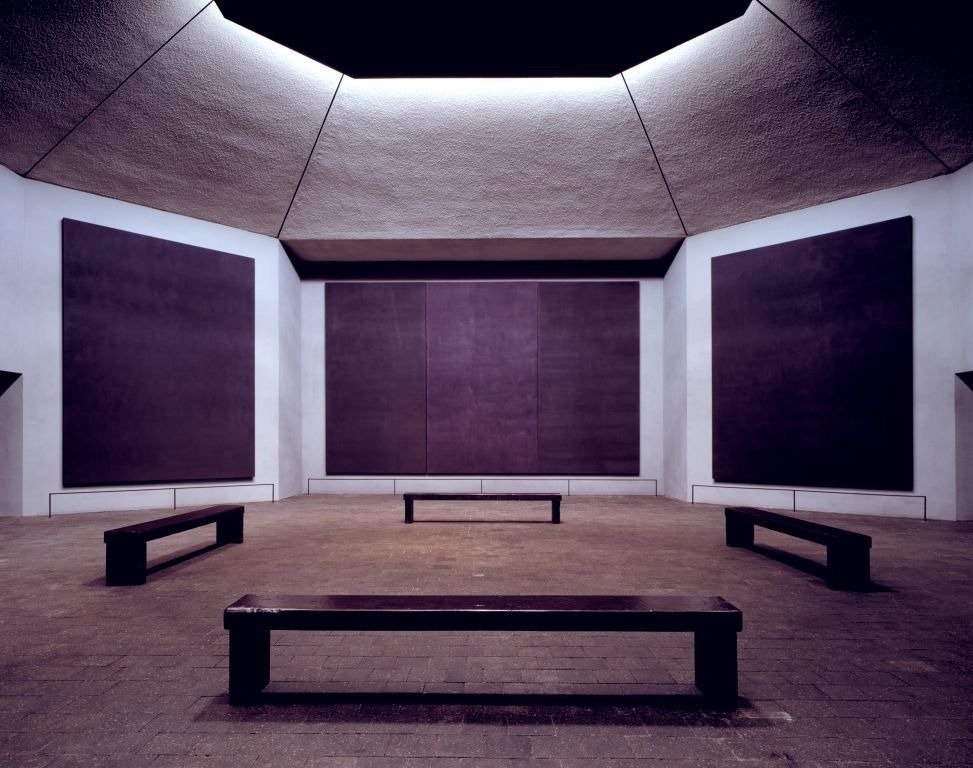
Rothko Chapel, Houston, Texas

***

The Rothko Chapel is an interfaith sanctuary, a center for human rights — and a one-man art museum devoted to 14 monumental paintings by abstract expressionist Mark Rothko. The Houston landmark, commissioned by John and Dominique de Menil, opened its doors 40 years ago, in February 1971.

For the past four decades, the chapel has encouraged cooperation between people of all faiths — or of no faith at all. While the chapel itself has become an art landmark and a center for human-rights action, the sanctuary’s creator never lived to see it finished. Rothko committed suicide in 1970.

Approaching the chapel from the south, visitors first see a steel sculpture called Broken Obelisk by Barnett Newman in the middle of a pool — it appears to be floating on the surface of the water. The chapel itself is a windowless, octagonal brick building. Solid black doors open on a tiny glass-walled foyer. (The foyer was walled off from the rest of the interior when the Gulf Coast’s notorious humidity began to affect the paintings.)

The main room is a hushed octagonal space with gray stucco walls, each filled by massive paintings. Some walls feature one canvas, while on others, three canvases hang side by side to form a triptych. A baffled skylight subdues the bright Houston sun, and the surfaces of the paintings change dramatically as unseen clouds pass outside. There are eight austere wooden benches informally arranged, and today, a few meditation mats. A young woman brings the meditation hour to a close by striking a small bowl with a mallet, creating a soft peal of three bells in the intense silence of the room.

Concerts, conferences, lectures, weddings and memorial services all take place in the chapel throughout the year, but on most days you will find visitors — about 55,000 annually come to see, to meditate, to write in the large comment book in the foyer, to read the variety of well-thumbed religious texts available on benches at the entrance.

***

These paintings do not feature the luminous color fields that made Rothko famous. The paintings in the chapel are dark, in purplish or black hues. And there’s a reason for that, says [chapel historian Suna] Umari.

“They’re sort of a window to beyond,” she explains. “He said the bright colors sort of stop your vision at the canvas, where dark colors go beyond. And definitely you’re looking at the beyond. You’re looking at the infinite.”

***

At first glance, the paintings appear to be made up of solid, dark colors. But look closely, and it becomes evident that the paintings are composed of many uneven washes of pigment that create variations in every inch. Stepping back, waves of subtle color difference appear across the broad surfaces — leading to an unmistakable impression of physical depth.

***

Though Mark Rothko didn’t live to see the sanctuary he created, Christopher Rothko says his father knew what it should be.

“It took me a while to realize it, but that’s really my father’s gift, in a sense, to somebody who comes to the chapel. It’s a place that will really not just invite, but also demand a kind of journey.”

—Pat Dowell, “Meditation and Modern Art Meet In Rothko Chapel,” NPR, 3/1/11

*****

reading table

Our lives are Swiss –
So still – so Cool –
Till some odd afternoon
The Alps neglect their Curtains
And we look farther on!

Italy stands the other side!
While like a guard between –
The solemn Alps –
The siren Alps
Forever intervene!

—Emily Dickinson

Thursday, 1/12/12

I don’t know what these folks call this stuff, but one thing I’m sure of: it ain’t “world music.”

Sobanza Mimanisa (“Orchestra of Light”), “Kiwembo,” live
Democratic Republic of Congo (Kinshasa), c. 2005

**********

lagniappe

reading table

The 100 Most Powerless New Yorkers

Have you noticed that power lists, which have been spreading like the clap lately, from the Time 100 to the Forbes 500, tell you things you already know about the rich and famous and give publicity to people who already have more of it than they know what to do with? For the rest of us, here’s a power list to get 2012 going in the right direction. They’re in no particular order. (Like it really matters.)

1. Weed-delivery guys

The reason so many marijuana arrests are of black and Hispanic people is not because they smoke weed more. White New Yorkers, by the NYPD’s own numbers, have a higher per-capita rate of contraband when they’re arrested. However, white people stay safe in their apartments while colored folks deliver drugs to them. Delivering drugs puts you on the bottom of a pyramid scheme where you usually earn less than minimum wage, making you vulnerable to homicide and giving you about as much of a chance of becoming a rich kingpin as being a production assistant or a media intern gives you of becoming a celebrity. . . .

—Steven Thrasher, Village Voice, 1/11/12

Friday, 12/30/11

more favorites from the past year

Only in a city where cooking, like music, is considered an art would music be considered, like food, a necessity.

*******

Rainy?

It doesn’t matter.

Any day’s a perfect day for a parade.

The Black Men of Labor 2009 Second Line Parade, New Orleans

(Originally posted 11/18/11.)

*******

Mardi Gras Indians

Young Wild Magnolias, St. Joseph’s Night, New Orleans, 3/19/09

Vodpod videos no longer available.

*****

United Indian Practice, Handa Wanda, New Orleans, 1/2/11

Vodpod videos no longer available.

*****

Indian Practice, 7th Ward, New Orleans, 11/22/10

Vodpod videos no longer available.

*****

Spy Boy Demond, Seminoles, New Orleans, c. 2010

Vodpod videos no longer available.

(Originally posted 9/30/11.)

Monday, 12/19/11

Rebirth Brass Band, Treme Sidewalk Steppers Parade, New Orleans, 2/6/11

If there’s a God, He loves parades.

More? Here. And here. And here. And here. And here.

Saturday, 12/10/11

If sounds define a space as much as walls and windows, you don’t need to knock out a wall to open up a room—just play this.

International Contemporary Ensemble with Steve Lehman
Impossible Flow (S. Lehman), live, New York (Le Poisson Rouge), 4/19/11

The moment this ends I want to hear it again. Is there any higher compliment?

More Steve Lehman? Here.

**********

lagniappe

reading table

A strange old man
Stops me,
Looking out of my deep mirror.

—Kakinomoto no Hitomaro (c. 662-710; trans. Kenneth Rexroth)

Saturday, 11/5/11

sounds of Haiti

Rara festival, Kabic (Haiti), Easter, 2005

**********

lagniappe


Rara music is a Lenten processional music with strong ties to the Vodou religious tradition. It has been commonly confused with Haitian Carnival since both celebrations involve large groups of dancing revelers in the streets. Rara is performed between Ash Wednesday (the day after Carnival ends) until Easter Sunday (or Easter Monday in some parts of Haiti.) Rara bands roam the streets performing religious ceremonies as part of their ritual obligations to the “lwa” or spirits of Haitian Voodoo. Guédé, a spirit associated with death and sexuality, is an important spiritual presence in Rara celebrations and often possesses an ougan (male Voodoo priest) or mambo (female Voodoo priest) before the band begins its procession in order to bless the participants and wish them safe travels for their nightly sojourns.

Wikipedia

Wednesday, 10/5/11

serendipity

The other day, while I was listening to the radio,* this popped out.

Derek Bailey (guitar) & Tony Oxley (percussion, electronics)
“Sheffield Phantoms,” The Advocate, Tzadik, 2007 (rec. 1975)

Vodpod videos no longer available.

Rarely do you hear something that’s both this “out” and this intimate.

*Afternoon New Music, WKCR-FM (broadcasting from Columbia University), Mon.-Wed., 3-6 p.m. (EST)

Friday, 9/30/11

Mardi Gras Indians, New Orleans

Young Wild Magnolias, St. Joseph’s Night, 3/19/09

Vodpod videos no longer available.

*****

United Indian Practice, Handa Wanda, 1/2/11

Vodpod videos no longer available.

*****

Indian Practice, 7th Ward, 11/22/10

Vodpod videos no longer available.

*****

Spy Boy Demond, Seminoles, c. 2010

Vodpod videos no longer available.

*****

With some forms of musical expression, value is tied to scarcity: the smaller the number of people who can do something, the more highly it’s prized. But with others, the opposite is true: the more readily other folks can join in, the greater the value.

Wednesday, 9/7/11

What’s surprising here isn’t that there are so many wonderful moments. Given the line-up, you’d expect that. What you wouldn’t expect is for these guys to sound so cohesive, as if they’d been playing together for years.

Sun Ra All Stars (SR, keyboards; Don Cherry, pocket trumpet, vocals; Lester Bowie, trumpet; Archie Shepp, tenor saxophone, vocals; John Gilmore, tenor saxophone; Marshall Allen, alto saxophone, percussion; Philly Joe Jones, drums; Clifford Jarvis, drums; Famadou Don Moye, drums, percussion), live, Germany (Berlin), 1983
Vodpod videos no longer available.

More Sun Ra? Here. And here. And here.

More Don Cherry? Here. And here. And here.

More Lester Bowie? Here. And here. And here. And here.

More Archie Shepp? Here.

More Philly Joe Jones? Here. And here.

More Famadou Don Moye? Here. And here.

Tuesday, 8/23/11

From the streets of New Orleans to the parks of New York.

John Luther Adams, Inuksuit (2009)

Take 2: Live (excerpts), New York (Morningside Park), 6/21/11

#1

Vodpod videos no longer available.

***
#2

Vodpod videos no longer available.

Take 1? Here.

**********

lagniappe

The Miller Theater made a mighty contribution to the daylong festival Make Music New York on Tuesday in the form of an expansive 80-minute performance of John Luther Adams’s “Inuksuit” (2009). Mr. Adams, who lives in Alaska, conceived this elastic percussion work as an outdoor piece for 9 to 99 players, and Melissa Smey, the theater’s director, went for the maximum, commandeering Morningside Park and inviting the percussion virtuoso Doug Perkins to lead a mega-ensemble that included So Percussion, the Percussion Group Cincinnati, the Proper Glue Duo, Mantra Percussion and students from music schools around the country.

Listeners walking through the park before 5 p.m. found small arrays of unattended drums, cymbals, xylophones and other instruments stationed along the park’s stairs and walkways, and conch shells, paper cones and rubber tubes scattered around the lawn where the performance was to begin. At 5, the 99 percussionists filed into the field, retrieved the smaller instruments and started the performance with gentle windlike sounds. They added graceful, eerie tones and harmonies by swinging the rubber tubes at various velocities; and they used sandpaper blocks and frame drums filled with bottle caps to create texture.

Gradually, the players dispersed through the park, making their way to the drum arrays. Your experience of the piece depended on where you were in the park, and most people walked around. (At one point I flipped a coin to choose which path to take.) But wherever you were, bursts of sound — loud, quiet, hard, soft — surrounded you.

There were sounds Mr. Adams may not have counted on. Birds and aircraft made their own contributions, as did camera shutters: at any moment, just about every player was being photographed by two or more listeners. And near the end of the piece, when the sounds were mostly the tactile ringing of xylophones and triangles, an ice cream truck added its cheerful melody to the mix (presumably not by design). But through the entire performance, I did not hear a single cellphone ring.

—Allan Kozinn, New York Times, 6/26/11

*****

reading table

An odd planet, and those on it are odd, too.
They’re subject to time, but they won’t admit it.
They have their own ways of expressing protest.
They make up little pictures, like for instance this:

At first glance, nothing special.
What you see is water.
And one of its banks.
And a little boat sailing strenuously upstream.
And a bridge over the water, and people on the bridge.
It appears that the people are picking up their pace
because of the rain just beginning to lash down
from a dark cloud.

The thing is, nothing else happens.
The cloud doesn’t change its color or its shape.
The rain doesn’t increase or subside.
The boat sails on without moving.
The people on the bridge are running now
exactly where they ran before.

It’s difficult at this point to keep from commenting.
This picture is by no means innocent.
Time has been stopped here.
Its laws are no longer consulted.
It has been relieved of its influence over the course of events.
It has been ignored and insulted.

On account of a rebel,
one Hiroshige Utagawa
(a being who, by the way,
died long ago and in due course),
time has tripped and fallen down.

It might well be simply a trifling prank,
an antic on the scale of just a couple of galaxies,
let us, however, just in case,
add one final comment for the record:

For generations, it’s been considered good form here
to think highly of this picture,
to be entranced and moved.

There are those for whom even this is not enough.
They go so far as to hear the rain’s spatter,
to feel the cold drops on their necks and backs,
they look at the bridge and the people on it
as if they saw themselves there,
running the same never-to-be-finished race
through the same endless, ever-to-be-covered distance,
and they have the nerve to believe
that this is really so.

—Wislawa Szymborska, “The People on the Bridge” (trans. Clare Cavanagh & Stanislaw Baranczak)

***

 Utagawa Hiroshige (1797-1858), The Landscape

*****

700 posts?

Yep.