April 1st
sounds of New Orleans
Brass band, live, New Orleans (Frenchmen Street), 2013
MVP? Without a doubt, it’s the snare drummer. Not only does he hold everything together, he pushes, pushes, pushes.
sounds of New Orleans
Brass band, live, New Orleans (Frenchmen Street), 2013
MVP? Without a doubt, it’s the snare drummer. Not only does he hold everything together, he pushes, pushes, pushes.
If you wanted to conjure a world of mystery, what better instrument to lead the way than one that possesses neither the brightness of the violin nor the darkness of the cello?
Morton Feldman, Rothko Chapel (1971), live, Houston (Rothko Chapel), 2011; Kim Kashkashian (viola), Brian Del Signore (percussion), Sarah Rothenberg (celeste), Maureen Broy Papovich (soprano), Houston Chamber Choir (Robert Simpson, cond.)
#1
***
#2
***
#3
Another take? Here.
**********
lagniappe
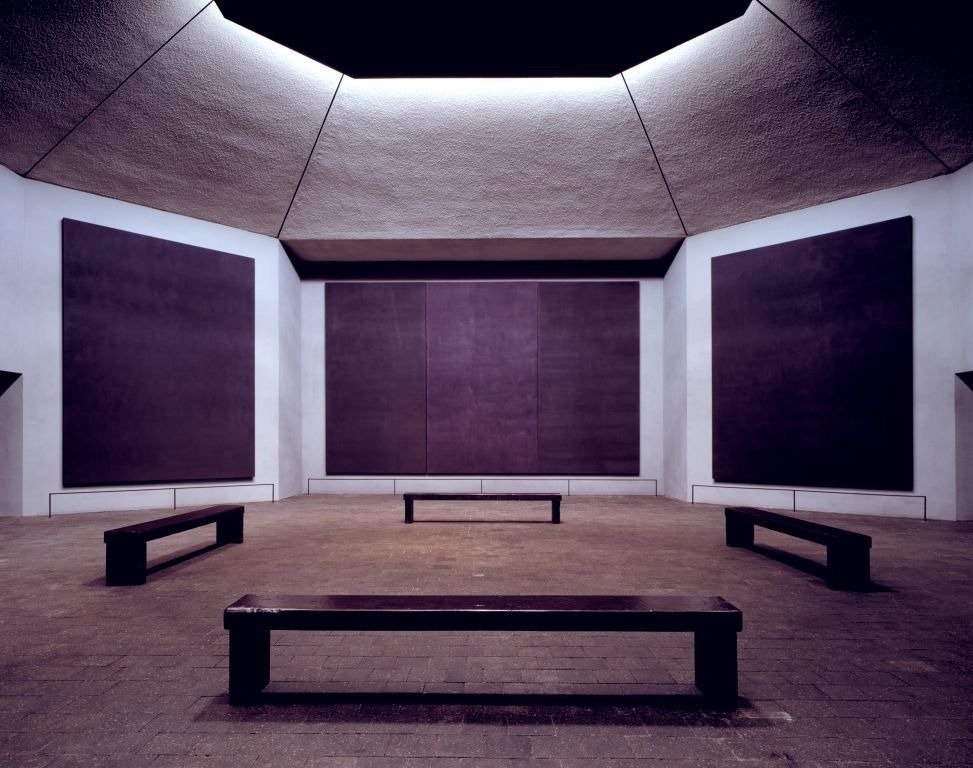
Rothko Chapel
***
The Rothko Chapel is an interfaith sanctuary, a center for human rights — and a one-man art museum devoted to 14 monumental paintings by abstract expressionist Mark Rothko. The Houston landmark, commissioned by John and Dominique de Menil, opened its doors 40 years ago, in February 1971.
For the past four decades, the chapel has encouraged cooperation between people of all faiths — or of no faith at all. While the chapel itself has become an art landmark and a center for human-rights action, the sanctuary’s creator never lived to see it finished. Rothko committed suicide in 1970.
Approaching the chapel from the south, visitors first see a steel sculpture called Broken Obelisk by Barnett Newman in the middle of a pool — it appears to be floating on the surface of the water. The chapel itself is a windowless, octagonal brick building. Solid black doors open on a tiny glass-walled foyer. (The foyer was walled off from the rest of the interior when the Gulf Coast’s notorious humidity began to affect the paintings.)
The main room is a hushed octagonal space with gray stucco walls, each filled by massive paintings. Some walls feature one canvas, while on others, three canvases hang side by side to form a triptych. A baffled skylight subdues the bright Houston sun, and the surfaces of the paintings change dramatically as unseen clouds pass outside. There are eight austere wooden benches informally arranged, and today, a few meditation mats. A young woman brings the meditation hour to a close by striking a small bowl with a mallet, creating a soft peal of three bells in the intense silence of the room.
Concerts, conferences, lectures, weddings and memorial services all take place in the chapel throughout the year, but on most days you will find visitors — about 55,000 annually come to see, to meditate, to write in the large comment book in the foyer, to read the variety of well-thumbed religious texts available on benches at the entrance.
***
These paintings do not feature the luminous color fields that made Rothko famous. The paintings in the chapel are dark, in purplish or black hues. And there’s a reason for that, says [chapel historian Suna] Umari.
“They’re sort of a window to beyond,” she explains. “He said the bright colors sort of stop your vision at the canvas, where dark colors go beyond. And definitely you’re looking at the beyond. You’re looking at the infinite.”
***
At first glance, the paintings appear to be made up of solid, dark colors. But look closely, and it becomes evident that the paintings are composed of many uneven washes of pigment that create variations in every inch. Stepping back, waves of subtle color difference appear across the broad surfaces — leading to an unmistakable impression of physical depth.
***
Though Mark Rothko didn’t live to see the sanctuary he created, Christopher Rothko says his father knew what it should be.
“It took me a while to realize it, but that’s really my father’s gift, in a sense, to somebody who comes to the chapel. It’s a place that will really not just invite, but also demand a kind of journey.”
—Pat Dowell, “Meditation and Modern Art Meet In Rothko Chapel,” NPR, 3/1/11
*****
reading table
Our lives are Swiss –
So still – so Cool –
Till some odd afternoon
The Alps neglect their Curtains
And we look farther on!Italy stands the other side!
While like a guard between –
The solemn Alps –
The siren Alps
Forever intervene!—Emily Dickinson
A pianist plays the piano.
A violinist plays the violin.
A percussionist plays . . . how much time have you got?
Augusta Read Thomas (1964-), Resounding Earth (2012); Third Coast Percussion
1st Movement
***
2nd Movement
***
3rd Movement
***
4th Movement
**********
lagniappe
musical thoughts
Augusta Read Thomas, talking about Resounding Earth:
two takes
This is, to these ears, exhilarating.
Tim Berne’s Snakeoil,* “Cornered (Duck)”
Live, New York (The Stone), 5/8/13
***
Live, Washington, D.C (Atlas Performing Arts Center), 10/9/13
*****
lagniappe
musical thoughts
Music should be no more complex than it needs to be. And no matter how complicated it may actually be, it should never seem that way to the listener. If it does, immediacy has deteriorated into abstraction.
***
*TB, alto saxophone; Oscar Noriega, bass clarinet, clarinet; Matt Mitchell, piano; Ches Smith, percussion.
sounds of Chicago
Something quiet to begin the week.
Tobias Broström (1978-), “Twilight”; Third Coast Percussion, live
**********
lagniappe
reading table
quite remarkable
being born human . . .
autumn dusk.—Kobayashi Issa (1763-1827; translated from Japanese by David G. Lanoue)
sounds of New York
David Van Tieghem, “Ear to the Ground,” 1981
**********
lagniappe
art beat
Robert Frank (1924-), New York, 1958

sounds of New York
Raya Brass Band, live, New York
7/22/12
***
12/31/11
**********
lagniappe
art beat
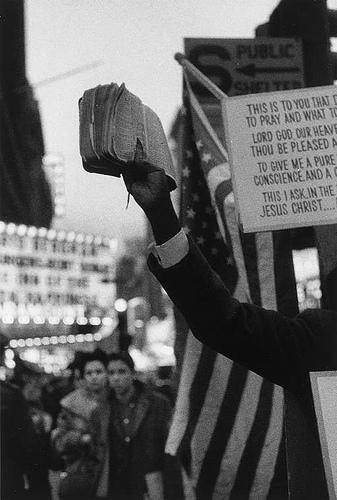
Robert Frank (1924-), New York (Times Square), 1954
passings
Kalaparusha Maurice McIntyre, saxophonist, March 26, 1936-November 9, 2013
From the New York Times obituary (Nate Chinen, 11/14/13):
Kalaparusha Maurice McIntyre, a saxophonist who was a founding member of the Association for the Advancement of Creative Musicians, a pioneering Chicago avant-garde coalition, died on Saturday in the Bronx. He was 77.
***
Present at the association’s first meeting in 1965, Mr. McIntyre later articulated its objectives in an in-house newsletter, The New Regime. The priority, he wrote, was creative autonomy. But he also touched on sociopolitical issues: “We are trying to balance an unbalanced situation that is prevalent in this society.”
Maurice Benford McIntyre was born on March 24, 1936, in Clarksville, Ark., and raised in Chicago. His father was a pharmacist, his mother an English teacher. He studied music at Roosevelt University in Chicago until a drug habit derailed him, leading to a three-year stretch in prison, in Lexington, Ky., where he later said he got most of his musical education.
After returning to Chicago, he met the pianist Muhal Richard Abrams and the saxophonist Roscoe Mitchell, who were developing an aesthetic revolving around strictly original music. Mr. McIntyre became a fixture in Mr. Abrams’s Experimental Band and appeared on Mr. Mitchell’s 1966 album, “Sound,” the first release under the Association for the Advancement of Creative Musicians banner. Mr. McIntyre released his first album, “Humility in the Light of the Creator,” in 1969, the year that he adopted the name Kalaparusha Ahrah Difda, a confluence of terms from African, Indian and astrological sources. (He later modified it to Kalaparusha Maurice McIntyre.) Like many of his fellow association musicians, he began performing in Europe.
He moved to New York in 1974 and spent a productive stretch at the Creative Music Studio in Woodstock. But his career foundered in the ’80s and ’90s, and he took to busking — a practice he continued even after making several comeback albums, notably “Morning Song,” in 2004.
*****
Talking and playing, New York, 2010
*****
Live (with Karl Berger, vibes, piano; Tom Schmidt, bass; Jack DeJohnette, drums; Jumma Santos, drums, percussion), “Ismac,” Woodstock, N.Y., 1975
*****
Recording (with J.B. Hutto, vocals, guitar; Sunnyland Slim, organ, et al.), “Send Her Home to Me,” 1968
*****
Recording (with Malachi Favors, bass; M’Chaka Uba, bass; Thurman Barker, drums; Ajaramu [A. J. Shelton], drums), “Humility in the Light of the Creator” (Alternate), 1969
**********
lagniappe
musical thoughts
A human life. A series of notes. Which is more permanent?
 music clip of the day