music clip of the day

jazz/blues/rock/classical/gospel/more

Category: reading table

Monday, 11/21/11

You can’t write a song like this, you can’t play it like this, unless your ears are open to all kinds of music.

Allen Toussaint, “Southern Nights,” live

**********

lagniappe

reading table

If they find a copy of Richard Yates’s Eleven Kinds of Loneliness, they buy it. It is as if they’ve found a baby on the front step. They peek inside, examine the dog-earing, the marginal scribbles. Or perhaps it’s a clean copy, which carries its own kind of sadness. In either case, they embrace it, though they already have multiple copies. Those are irrelevant to the one they would be abandoning if they left the book behind. This is a hostess gift you can give any fiction writer, guaranteed to delight her even though she already has it. Regifting becomes an act of spreading civilization.

—Ann Beattie, Mrs. Nixon: A Novelist Imagines a Life (2011), “7 Truths About Writers” (#2)
Saturday, 11/19/11

old stuff

Bertha “Chippie” Hill (with Louis Armstrong, cornet), “Trouble In Mind”
Rec. 2/23/1926, Chicago

**********

lagniappe

random thoughts

Growing up in the 1960s, the 1920s seemed as far away as the other side of the moon. No more—time changes your perspective on time. The distance between, say, 1926 and 1966 is smaller than that between 1966 and today.
The 1920s? They’re just down the block and around the corner.

*****

reading table

1926

The porchlight coming on again,
Early November, the dead leaves
Raked in piles, the wicker swing
Creaking. Across the lots
A phonograph is playing Ja-Da.

An orange moon. I see the lives
Of neighbors, mapped and marred
Like all the wars ahead, and R.
Insane, B. with his throat cut,
Fifteen years from now, in Omaha.

I did not know them then.
My airedale scratches at the door.
And I am back from seeing Milton Sills
And Doris Kenyon. Twelve years old.
The porchlight coming on again.

—Weldon Kees (1914-1955)

Saturday, 11/12/11

Labels are often worse than useless. This guy, for instance, is often tagged as “cerebral.” But here’s something you can’t—I can’t, anyway—listen to without smiling.

Anthony Braxton, Composition No. 58
Taylor Ho Bynum Chicago Big Band,* live, 2009, Chicago

*****

Here’s another take—Braxton’s original recording (The Complete Arista Recordings of Anthony Braxton [Mosaic], rec. 1976).

More? Here.

**********

lagniappe

reading table

To obtain the value
of a sound, a movement,
measure from zero.

***

A sound has no legs to stand on.

***

The world is teeming: anything can
happen.

—John Cage, “2 Pages, 122 Words on Music and Dance” (excerpts)

*Taylor Ho Bynum & Josh Berman (cor), Jaimie Branch (tpt), Jeb Bishop & Nick Broste (tb), Nicole Mitchell (fl), Caroline Davis, Keefe Jackson & Dave Rempis (saxes), Jeff Parker (g), Jason Adasiewicz (vib), Nate McBride (b), Tim Daisy & Tomas Fujiwara (d)

Thursday, 11/10/11

serendipity

These tracks brightened a recent Saturday afternoon, thanks to
WFMU-FM (Terre T’s Cherry Blossom Clinic, Sat., 3-6 p.m. [EST]).

The Equals, “I Can See But You Don’t Know” (1970)

*****

The Eyes, “I’m Rowed Out” (1965)

*****

The Shades of Night, “Fluctuation” (1967)

*****

The Kinks, “She’s Got Everything” (1968)

**********

lagniappe

reading table

[S]itting on the stone wall of the pump house overlooking the reservoir eating my old tuna, jalapeno and “hot” hummus sandwich I had a peaceful sense of NOTHINGNESS and that was what I was going to come to. DEATH is NOTHING. It’s not death that’s sad, it’s life. There is nothing sad about nothing. I had a very strong feeling that I am nothing visiting something. Yes, I am nothing visiting something and returning to nothing.

—Spalding Gray, The Journals of Spalding Gray (2011)

Friday, 11/4/11

only rock ’n roll

Animal Collective, Unitled/“Brothersport”
Live, Chicago (Pitchfork Festival), 7/15/11

*****

Want to hear the entire set?

Jazz, classical, gospel, rock: the names may be different, but what they offer is the same—a way, pleasurably, to lose your mind.

**********

lagniappe

In the evening darkness at a place outside New York, an outlook where/you can perceive eight million people’s homes in a single glance. . . ./Schubert’s being played in some room/there and for someone the tones at this moment are more real than everything else.

—Tomas Transtromer, “Schubertiana” (excerpt), trans. Samuel Charters

Here, in an undated audio clip, Transtromer, winner of the 2011 Nobel Prize in Literature, talks about this poem and reads it in this English translation.

*****

Transtromer suffered a stroke in 1990, at the age of fifty-nine, which robbed him of speech and impaired the use of his right arm. Rather than delivering the customary [Nobel] laureate’s address when he accepts the award, on December 10th, he will play a piece on the piano using only his left hand.

—Dan Chiasson, “Night Thoughts: The poetry of Tomas Transtromer,” New Yorker, 10/31/11

Thursday, 11/3/11

Nils Økland, Hardanger fiddle
Sigbjørn Apeland, harmonium
“Blond blå,” live

What’s more surprising—that there’s so much ugliness in the world, or so much beauty?

**********

lagniappe

reading table

Who are we, if not a combination of experiences, information, books we have read, things imagined? Each life is an encyclopedia, a library, an inventory of objects, a series of styles, and everything can be constantly reshuffled and reordered in every conceivable way.

—Italo Calvino, Six Memos for the Next Millennium (trans. Patrick Creagh; 1988)

Monday, 10/31/11

two takes

Need a Monday morning boost? You’ve come to the right place.

“Let the Good Times Roll”

Koko Taylor (1928-2009), live

Years ago, when I was at Alligator Records, I worked with her—what a sweetheart.

***

Louis Jordan And His Tympany Five, c. 1946

Vodpod videos no longer available.

**********

lagniappe

art beat

Yesterday at Chicago’s Goodman Theater:

MARK ROTHKO: Wait. Stand closer. You’ve got to get close. Let it pulsate. Let it work on you. Closer. . . . There. Let it spread out. Let it wrap its arms around you; let it embrace you, filling even your peripheral vision so nothing else exists or has ever existed or will ever exist. Let the picture do its work—But work with it. Meet it halfway for God’s sake. Lean forward, lean into it. Engage with it!

—John Logan, Red (2009)

Saturday, 10/29/11

Some music isn’t made for summer: it wants more night.

Bela Bartok, String Quartet No. 5, excerpt (3rd movement)
Calder Quartet, live, 2008, Los Angeles

More Bartok? Here.

**********

lagniappe

reading table

This road—
no one goes down it,
autumn evening.

—Matsuo Basho (1644-1694), trans. Robert Hass

Sunday, 10/23/11

Slim and The Supreme Angels, “I Wanna Go”
Live, North Carolina (Branch Memorial Tabernacle, Goldsboro), c. 1996

Vodpod videos no longer available.

**********

lagniappe

reading table

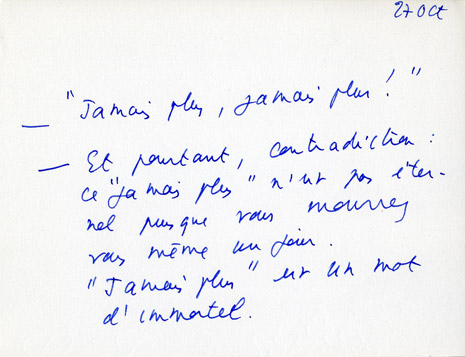
—“Never again, never again!”
—And yet there’s a contradiction: “never again” isn’t eternal, since you yourself will die one day.
“Never again” is the expression of an immortal.

—Roland Barthes, Mourning Diary (trans. Richard Howard, 2010)

More of these handwritten diary entries, which were written after Barthes’ mother died, can be found here. (Thanks to Orange Crate Art for the tip.)

Thursday, 10/20/11

Joseph Haydn, Piano Sonata No. 24 in D major, excerpt (2nd Movement)
Sviatoslav Richter, live

**********

lagniappe

musical thoughts

Logic does not exist for me. I float on the waves of art and life and never really know how to distinguish what belongs to the one or the other or what is common to both. Life unfolds for me like a theatre presenting a sequence of somewhat unreal sentiments; while the things of art are real to me and go straight to my heart.

—Sviatoslav Richter

*****

reading table

After a black day, I play Haydn,
and feel a little warmth in my hands.

The keys are ready. Kind hammers fall.
The sound is spirited, green, and full of silence.

The sound says that freedom exists
and someone pays no taxes to Caesar.

I shove my hands in my haydnpockets
and act like a man who is calm about it all.

I raise my haydnflag. The signal is:
“We do not surrender. But want peace.”

The music is a house of glass standing on a slope;
rocks are flying, rocks are rolling.

The rocks roll straight through the house
but every pane of glass is still whole.

—Tomas Transtromer (winner of the 2011 Nobel Prize in Literature), “Allegro,” trans. from the Swedish by Robert Bly

*****

More Richter? Here. And here.