music clip of the day

jazz/blues/rock/classical/gospel/more

Category: reading table

Saturday, March 22nd

passings

Scott Asheton, drummer (Stooges), August 16, 1949-March 15, 2014

Live (rehearsal), Tribute to the Stooges (SA, drums; Ron Asheton, guitar; J Mascis, guitar; Mike Watt, vocals, bass), “1970,” Belgium (Hasselt), 2002


***

Live, Iggy and the Stooges, “Now I Wanna Be Your Dog,” France (Clisson), 2011


***

Live, Stooges, “1970,” Michigan (Goose Lake Festival), 1970


**********

lagniappe

reading table

What do the sky and gardens know
of such disappointments?

—August Kleinzahler, “September” (fragment)

Thursday, March 20th

spring!

Bob Dorough (1923-; vocals, piano), “Spring Can Really Hang You Up The Most” (T. Wolf, F. Landesman), 1997


*****

Blossom Dearie (1924-2009; vocals, piano), “They Say It’s Spring” (M. Clark, B. Haymes), 1958


*****

Sun Ra Arkestra (SR [1914-1993], piano; June Tyson, vocals; John Gilmore, tenor saxophone, et al.), “Springtime Again” (S. Ra), live, Rome, 1980


**********

lagniappe

reading table

A little Madness in the Spring
Is wholesome even for the King,
But God be with the Clown—
Who ponders this tremendous scene—
This whole Experiment of Green—
As if it were his own!

—Emily Dickinson (1830-1886; Franklin #1356)

***

spring rain—
the uneaten ducks
are quacking

—Kobayashi Issa (1763-1828; translated from Japanese by David G. Lanoue)

Tuesday, March 18th

sleepless in Chicago

Some folks sleep all night, or so I’ve heard. Maybe you’re one of them. If not, here’s a mix you might try—a sonic tonic.

1. Play this on repeat.

John Luther Adams (1953-), “The Farthest Place” (2001); piano (Clint Davis), vibraphone (Brian Archinal & Andy Bliss), bass (Satoru Tagawa), violin (Lydia Kabalen); University of Kentucky (Lexington), 2008


2.
Ditto. 

Waterfall Sounds, Cow Creek


3. Adjust volume levels to taste.

**********

lagniappe

reading table

For you fleas too
the nights must be long,
they must be lonely.

—Kobayashi Issa (1763-1827; translated from Japanese by Robert Hass)

Saturday, March 15th

serendipity*

Christopher DeLaurenti (sampling Marvin Gaye, “What’s Going On” [1971]), live, Seattle, 2009


**********

lagniappe

reading table: passings

Bill Knott, February 17, 1940-March 12, 2014

Night Thought

Compared to one’s normal clothes, pajamas
are just as caricature as the dreams
they bare: farce-skins, facades, unserious
soft versions of the mode diem, they seem
to have come from a posthumousness;
floppy statues of ourselves, slack seams
of death. Their form mimics the decay
that will fit us so comfortably someday.

*****

*This I bumped into yesterday, listening to the radio (WFMU: Miniature Minotaurs [Kurt Gottschalk]).

Thursday, March 6th

never enough

Bach’s six cello suites, which I’ve been listening to for over forty years, never fail to astonish me—they breathe.

Johann Sebastian Bach (1685-1750), Suite No. 1 in G major for Unaccompanied Cello; Jan Vogler (1964-), live, New York, 2013

**********

lagniappe

reading table

Sing to me of the man, Muse, the man of twists and turns
driven time and again off course . . . .

The Odyssey, opening lines (Robert Fagles’ translation)

Smooth sailing wouldn’t make much of a story.

Saturday, March 1, 2014

If you wanted to conjure a world of mystery, what better instrument to lead the way than one that possesses neither the brightness of the violin nor the darkness of the cello?

Morton Feldman, Rothko Chapel (1971), live, Houston (Rothko Chapel), 2011; Kim Kashkashian (viola), Brian Del Signore (percussion), Sarah Rothenberg (celeste), Maureen Broy Papovich (soprano), Houston Chamber Choir (Robert Simpson, cond.)

#1

***

#2

***

#3

Another take? Here.

**********

lagniappe

Rothko Chapel

***

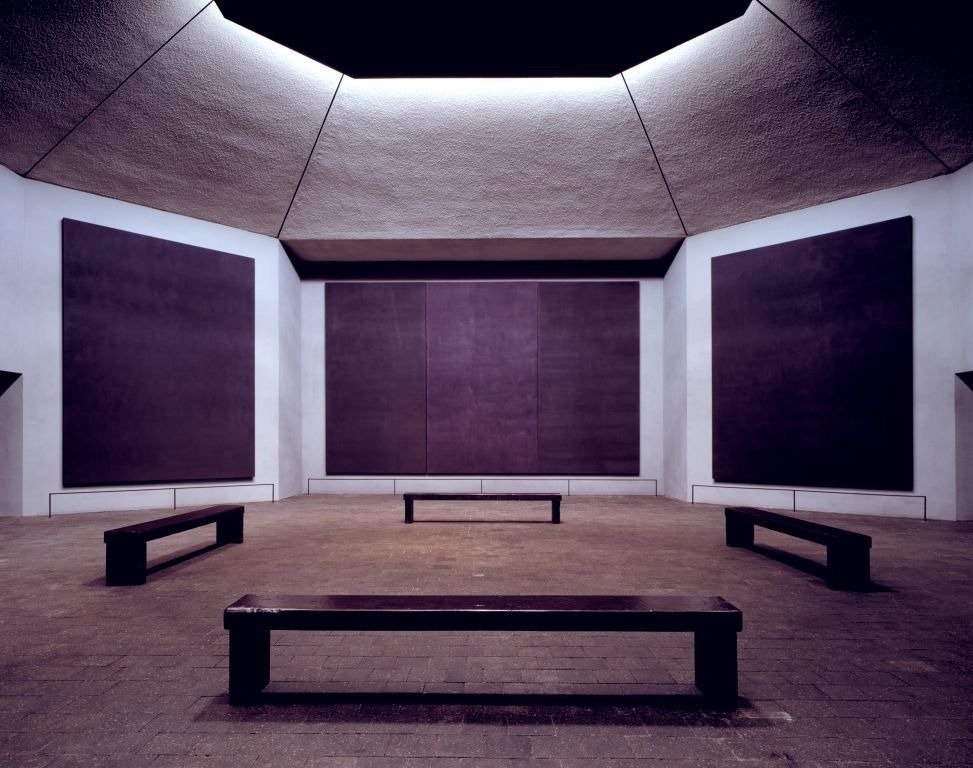
The Rothko Chapel is an interfaith sanctuary, a center for human rights — and a one-man art museum devoted to 14 monumental paintings by abstract expressionist Mark Rothko. The Houston landmark, commissioned by John and Dominique de Menil, opened its doors 40 years ago, in February 1971.

For the past four decades, the chapel has encouraged cooperation between people of all faiths — or of no faith at all. While the chapel itself has become an art landmark and a center for human-rights action, the sanctuary’s creator never lived to see it finished. Rothko committed suicide in 1970.

Approaching the chapel from the south, visitors first see a steel sculpture called Broken Obelisk by Barnett Newman in the middle of a pool — it appears to be floating on the surface of the water. The chapel itself is a windowless, octagonal brick building. Solid black doors open on a tiny glass-walled foyer. (The foyer was walled off from the rest of the interior when the Gulf Coast’s notorious humidity began to affect the paintings.)

The main room is a hushed octagonal space with gray stucco walls, each filled by massive paintings. Some walls feature one canvas, while on others, three canvases hang side by side to form a triptych. A baffled skylight subdues the bright Houston sun, and the surfaces of the paintings change dramatically as unseen clouds pass outside. There are eight austere wooden benches informally arranged, and today, a few meditation mats. A young woman brings the meditation hour to a close by striking a small bowl with a mallet, creating a soft peal of three bells in the intense silence of the room.

Concerts, conferences, lectures, weddings and memorial services all take place in the chapel throughout the year, but on most days you will find visitors — about 55,000 annually come to see, to meditate, to write in the large comment book in the foyer, to read the variety of well-thumbed religious texts available on benches at the entrance.

***

These paintings do not feature the luminous color fields that made Rothko famous. The paintings in the chapel are dark, in purplish or black hues. And there’s a reason for that, says [chapel historian Suna] Umari.

“They’re sort of a window to beyond,” she explains. “He said the bright colors sort of stop your vision at the canvas, where dark colors go beyond. And definitely you’re looking at the beyond. You’re looking at the infinite.”

***

At first glance, the paintings appear to be made up of solid, dark colors. But look closely, and it becomes evident that the paintings are composed of many uneven washes of pigment that create variations in every inch. Stepping back, waves of subtle color difference appear across the broad surfaces — leading to an unmistakable impression of physical depth.

***

Though Mark Rothko didn’t live to see the sanctuary he created, Christopher Rothko says his father knew what it should be.

“It took me a while to realize it, but that’s really my father’s gift, in a sense, to somebody who comes to the chapel. It’s a place that will really not just invite, but also demand a kind of journey.”

—Pat Dowell, “Meditation and Modern Art Meet In Rothko Chapel,” NPR, 3/1/11
*****

reading table

Our lives are Swiss –
So still – so Cool –
Till some odd afternoon
The Alps neglect their Curtains
And we look farther on!

Italy stands the other side!
While like a guard between –
The solemn Alps –
The siren Alps
Forever intervene!

—Emily Dickinson

Friday, February 28th

only rock ’n’ roll

Cloud Nothings, “Psychic Trauma”

Live, Houston, 2013


***

Recording, 2014


**********

lagniappe

reading table

August Kleinzahler (1949-), reading “Portrait of My Mother in January”:


*****

The older I get the more grateful I am not to be told how everything comes out.

William Maxwell (1908-2000), novelist, New Yorker fiction editor, etc.

Tuesday, February 25th

old stuff

Kansas City Six (Buck Clayton, trumpet; Lester Young, clarinet; Eddie Durham, electric guitar; Freddie Green, rhythm guitar; Walter Page, bass; Jo Jones, drums), “Pagin’ the Devil,” 1938

**********

lagniappe

reading table

in blossoming trees
suddenly he’s hidden . . .
my son

—Kobayashi Issa (1763-1827; translated from Japanese by David G. Lanoue)

Sunday, February 23rd

testify

Jackson Southernaires, “Can’t Make It By Myself,” live, Jackson, Miss., 1996

**********

lagniappe

reading table

Barn’s burnt down—
now
I can see the moon.

—Mizuta Masahide, 1657-1723 (translated from Japanese by Lucien Stryk and Takashi Ikemoto)

Tuesday, February 18th

never enough

Ludwig van Beethoven (1770-1827), Piano Sonata No. 21 in C major, Op. 53 (“Waldstein”); Daniel Barenboim (piano), live, Berlin, 2005

This piece, even after decades of listening, never fails to sweep me away: its second (11:30-) and third (15:45-) movements are as intimate, as panoramic, as thrilling as anything I know.

**********

lagniappe

reading table

Lorrie Moore, reading from her new story collection (Bark):