music clip of the day
jazz/blues/rock/classical/gospel/more
Category: jazz
2010
Wednesday, 7/21/10
getting older
“Where did everybody go?” you wonder.
With each passing year, more of the musicians who’ve shaped your world—who’ve made life sing—are gone.
Ed Blackwell, Lester Bowie, Betty Carter, Malachi Favors, Steve Lacy, Kate McGarrigle, Art Pepper, Professor Longhair, Sun Ra, Junior Wells, Julius Hemphill (below): the list goes on, and on, and on.
World Saxophone Quartet (Julius Hemphill, alto saxophone; Oliver Lake, soprano and alto saxophones; David Murray, tenor saxophone; Hamiet Bluiett, baritone saxophone)
Medley: “West African Snap,” “I Heard That,” “Fast Life,” “Hattie Wall,” live (TV Broadcast [Night Music]), 1990 (music starts at 2:20)
Listening to Julius Hemphill (far left), a phrase from Martin Luther King, Jr.’s “I Have a Dream” speech comes to mind: “the fierce urgency of now.” Hemphill has, it seems, so much to say—right now. Listen, for instance, to 4:30-6:35.
*****
Live, with M’Boom (Max Roach’s 9-piece percussion ensemble), New York (The Cathedral Church of St. John the Divine), 1981 (music starts at 1:55)
Want more? Here.
**********
lagniappe
musical thoughts
Without music, life would be an error.
—Friedrich Nietzsche
2010
Monday, 7/12/10
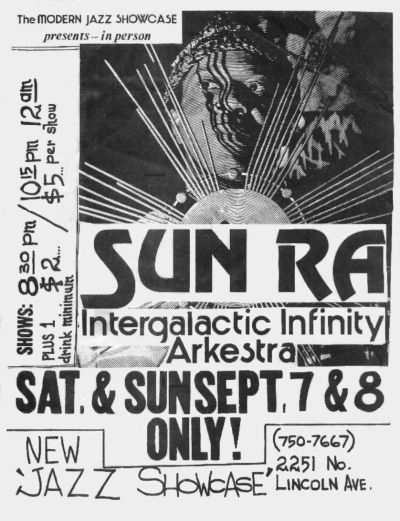
Here’s a big birthday shout-out to my wife Suzanne, who’s not nearly as crazy as I am about music—not nearly as crazy, period—but is crazy enough that she kept going out with me after I took her on our first date, in the summer of 1974, to Chicago’s Jazz Showcase (then on Lincoln Avenue) to see this guy, whose multimedia performance that night featured some of this footage—the stuff with the pyramids.
Sun Ra & His Arkestra in Egypt and Italy, 1971
**********
lagniappe
Even in the excesses of this era there were few audiences prepared for an ominous, ragtag group of musicians in Egyptian robes, Mongolian caps (Mongolian, as from the planet Mongo of Flash Gordon), and B-movie spacesuits who played on a variety of newly invented or strangely modified electronic instruments (the sun harp, the space organ, the cosmic side drum) and proclaimed the greatness of the most ancient of races (this, the Sun Ra of the Solar-Myth Arkestra); or, on yet another night, a merry band in jester’s motley, jerkins, and pointed caps (a la Robin Hood or perhaps the Archers of Arboria) who marched or crawled through the audience, chanting cheerful songs about travel to Venus. It was intensely dramatic music, moving from stasis to chaos and back, horn players leaping about, or rolling on the bandstand, sometimes with fire eaters, gilded muscle men, and midgets, an all-out assault on the senses. At the end of the evening the musicians and dancers moved among the audience, touching them, surrounding them, inviting them to join the Arkestra in marching off to Jupiter.
—John F. Szwed, Space Is The Place: The Lives And Times Of Sun Ra (1997)
*****
Sun Ra’s consistent statement, musically and spoken, is that this is a primitive world. Its practices, beliefs, religions, are uneducated, unenlightened, savage, destructive, already in the past. . . . That’s why Sun Ra returned only to say he left. Into the future. Into Space.
—Amiri Baraka (formerly known as LeRoi Jones)
*****
Silence is music. There are different kinds of silence, each silence is a world all of its own . . . silence is an integral part of all music . . .
***
When you meet a man
You meet a scheme of words
Patterns of concept
A concepted being
Whose very birth conception is called.
***
The earth cannot move without music. The earth moves in a certain rhythm, a certain sound, a certain note. When the music stops the earth will stop and everything upon it will die.
—Sun Ra
*****
2010
Saturday, 7/10/10
replay: a clip too good for just one day
Here is the onliest Thelonious.
Thelonious Monk, “Epistrophy,” live (TV broadcast), Paris, 1966
*****
Thelonoius Monk, “’Round Midnight,” live (TV broadcast)
*****
You can tell a lot about Monk’s music—about the centrality of dance, about the interplay between melody and rhythm, about the way a melody’s irregular accents override the pulse (making the dance melodic)—just by watching, in the second performance, the way his right foot moves.
**********
lagniappe
He played each note as though astonished by the previous one, as though every touch of his fingers on the keyboard was correcting an error and this touch in turn became an error to be corrected and so the tune never quite ended up the way it was meant to be.
***
You had to see Monk to hear his music properly. The most important instrument in the group—whatever the format—was his body.
—Geoff Dyer, But Beautiful: A Book About Jazz (1996)
(Originally posted 11/2/09.)
2010
Wednesday, 6/30/10
The other night, after falling asleep, my older son Alex (now 22) had an unexpected visitor—this guy showed up and began to play.
Vijay Iyer Trio (VI, piano; Marcus Gilmore, drums; Stephan Crump, bass)
“Galang,” recording session (Historicity), New York (Systems Two Studios), 2009
*****
“Questions of Agency,” live, New York (The Stone), 2007
*****
Playing and Talking about Historicity, 2009
**********
lagniappe
Presto! Here is the great new jazz piano trio.
—Ben Ratliff, New York Times (9/9/09)
2010
Monday, 6/28/10
Muscular, unadorned, direct: his playing conjures the old Chicago, when there was no Millennium Park, no flowers blooming in the middle of the street, no dining al fresco (unless you had nowhere else to eat).
Fred Anderson, tenor saxophonist, co-founder of the Association for the Advancement of Creative Musicians (AACM), club owner (Velvet Lounge), March 22, 1929-June 24, 2010
Live, with DKV (Ken Vandermark, tenor saxophone; Kent Kessler, bass; Hamid Drake, drums), Chicago (Hideout), 2008
(Hamid Drake is among my favorite drummers; he’s the perfect foil, in his buoyancy and drive, for Anderson’s dark, searching, sometimes brooding lines.)
*****
“Spirits Came In,” live (with Kidd Jordan, tenor saxophone; William Parker, bass; Hamid Drake, drums), live, New York (Vision Festival), 2002
*****
Live (with Jaribu Shahid, bass; Hamid Drake, drums), France (Le Mans), 2005
Part 1
***
Part 2
***
Part 3
***
Part 4
***
Part 5
***
Part 6
2010
Thursday, 6/24/10
Greatest prison band of all time?
No contest.
Who could beat the one that Art Pepper and this guy—both followed Charlie Parker down the path of heroin addiction—led in the 1960s at San Quentin?
Frank Morgan (alto saxophone, with Claude Black, piano; Clifford Murphy, bass; Sean Dobbins, drums), “Well You Needn’t,” live, Ohio (Toledo), 2006
lagniappe
The greatest big band I ever played with was in San Quentin. Art Pepper and I were proud of that band. We had Jimmy Bunn and Frank Butler [whom Jo Jones called “the greatest drummer in the world”], and some other musicians who were known and some who weren’t, but they could play. We played every Saturday night for what they called a Warden’s Tour, which showed paying visitors only the cleanest cell blocks and exercise yards. But people would take that tour just to hear the band.
***
Art and I played more when we were in San Quentin together than when we were on the outside.
***
Art led the way for me to recover. He got out of prison before me and started traveling all over the world before I did. He showed me by example that it could be done, and I’ll always love him for that.
—Frank Morgan
2010
Monday, 6/21/10
My favorite alto sax player?
There are days when I’d say this is the guy.
Art Pepper, September 1, 1925-June 15, 1982
“Red Car” (excerpt), live (Art Pepper: Notes From A Jazz Survivor [1982])
*****
“Mambo Koyama,” live, Italy, 1981
*****
“What’s New?” (1956)
*****
“Over the Rainbow” (1982)
**********
lagniappe
The epigraph to Straight Life: The Story of Art Pepper by Art and Laurie Pepper (1979):
What is the use of talking and there is no end of talking,
There is no end of things in the heart.—Ezra Pound [“Exile’s Letter,” from the Chinese poet Li Po; as punctuated in SL]
2010
Saturday, 6/19/10
replay: a clip too good for just one day
Muddy Waters, Saul Bellow, Steppenwolf Theater Company (John Malkovich, John Mahoney, Gary Sinise, Laurie Metcalf, et al.), Curtis Mayfield: a lot of great artists, musical and otherwise, have come out of Chicago in the last 50 years. Among the greatest is this group: the Art Ensemble of Chicago. While the horn players (Roscoe Mitchell, Joseph Jarman, Lester Bowie) got the lion’s share of the attention, what gave their music its juice—what made it dance—was (as you’ll hear) one of the finest rhythm sections ever: Malachi Favors, bass; Don Moye, drums.
Art Ensemble of Chicago, live, Poland (Warsaw), 1982 (in four parts)
Part 1
Part 2
Part 3
Part 4
(I talk about the AEC in the past tense because, while recordings are still released under this name from time to time, with two key members [they were all “key members”] now dead—trumpeter Lester Bowie [1999] and bassist Malachi Favors [2004]—it just isn’t [nor could it be] the same.)
**********
subscribe
Many things in life don’t quite seem, alas, to live up to their billing. It appears that the RSS (Real Simple Syndication) service that’s referenced in the righthand column (under “Subscribe”) may fall into this category—at least, that is, for those of us who are (as the expression goes) of a certain age. The problem seems to lie at the threshold: “real simple.”
Anyway, in the life’s-too-short, keep-it-simple-stupid department, if you’d like to “subscribe” to this blog, just send me an email (Richard McLeese/rmcleeselaw@aol.com) with “subscribe” in the subject line and—voila!—you’ll be added to an ever-growing email list that will have you receiving an e-notice whenever there’s a new blog post. As indicated in the “About” section (see righthand column), this whole thing started from a very small (like, oh, two, sometimes three, folks) email list, which then grew, then grew some more. One of many miraculous things about electronic communication is that there’s always room for one more.
(Originally posted 9/8/09.)
2010
Wednesday, 6/16/10
movies/part 3
Once upon a time, before the Gulf oil spill, before Katrina, there was a city . . .
*****

*****
New Orleans (1947)
Billie Holiday, Louis Armstrong
“Do You Know What It Means To Miss New Orleans?”
Want more Billie Holiday? Here. Here.
More Louis Armstrong? Here.
**********
lagniappe
The impact of the oil from the Gulf of Mexico spill now soiling the Louisiana shoreline was felt far inland on Thursday as P&J Oyster Company, the country’s oldest oyster processor and distributor, ceased its shucking operations.
“The bottom line is that the guys that we purchase from are not working,” said Sal Sunseri, referring to the oyster harvesters who’ve been idled by the mass closure of harvesting areas and freshwater diversions. “Today’s our last day of shucking.”
***
“Having the guy down the street deliver oysters that were shucked just that morning to our doorstep is an amazing thing,” said John Besh, who featured P&J Oysters at his five New Orleans area restaurants. “The relationship is so valuable, knowing that I can count on them to source the best oysters from the saltiest areas and deliver them in a consistent, uniform manner.”
“They provide wonderful oysters,” said Darin Nesbit, chef at the Bourbon House, whose relationship with P&J is so tight Sal Sunseri helped shuck oysters the first night the restaurant opened following Hurricane Katrina. “Even in times of trouble, they’ve always taken care of us.”
P&J was started in 1876 by John Popich, a Croatian immigrant who took on partner Joseph Jurisich at the turn of the century. In 1921, Popich and Jurisich purchased a shucking house at the corner of Toulouse and North Rampart streets. Alfred Sunseri, the current owners’ grandfather, who was married to Popich’s cousin, joined the company soon after.
—Brett Anderson, “P&J looks to bring oysters in from the West Coast for the first time In its 134 years,” New Orleans Times-Picayune, 6/10/10
*****
You’re right, not only can’t you lip-synch this stuff; you can’t really sing it if you don’t know it in your heart. That’s why it’s sooooo good. [The Pilgrim Jubilees, 6/13/10]
 music clip of the day