music clip of the day

jazz/blues/rock/classical/gospel/more

Category: jazz

Tuesday, 9/21/10

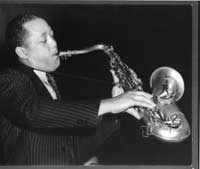
No tenor player moves me more.

Von Freeman

“I Can’t Get Started” (excerpt), live, Belgium, 1992

*****

“Blues for Sunnyland,” live, Germany (Berlin), 2002

*****

Live, Chicago, 2009

**********

lagniappe

Being a local legend can be a mixed bag. Consider Von Freeman, the 72-year-old tenor saxophonist who reigns as Chicago’s preeminent local jazz legend. In the 40s, he performed with bop genius Charlie Parker. In the 60s, Miles Davis tried to hire him as a replacement for John Coltrane. In the 80s, he and his son Chico, a formidable saxophonist himself, shared an album with the first family of jazz: trumpeter Wynton Marsalis, his saxophonist brother Branford, and his pianist father Ellis (Fathers and Sons, Columbia). And in the 90s, he’s performed at New York’s most prestigious concert halls–Lincoln Center and Carnegie Hall.

But legendary status can have drawbacks. It’s opened a lot of doors for Freeman, making him a familiar figure at a variety of local clubs (including the Bop Shop, the Green Mill, Pops for Champagne, and Andy’s). But appearing so often at so many places can make a performer seem as unremarkable as a crooked alderman. And the tag “legendary,” which smacks of the sort of hushed reverence usually reserved for the dead, can make a performer seem less a vital artist–one who continues to take chances–than a bloodless icon.

But Freeman is neither unremarkable nor bloodless. Hearing him live is like taking a tour of a fun house: you never know what you’ll find behind the next door.

Upon entering, the first thing you notice is that the floor seems tilted–the result of Freeman’s distinctively oblique intonation. His sour off-center tone–which occasionally prompts charges that he plays out of tune–invests the best of his performances with a hard-edged emotional intensity. When he played Charlie Parker’s “Confirmation” on a recent weekend at the Jazz Showcase, where he led a fine quintet (Brad Goode on trumpet; Joan Hickey on piano; Mendai on bass; Robert Shy on drums one night and Michael Raynor on drums the other), he bristled with energy but also sounded wounded. And when he played the ballad “Lover Man,” he conjured up a world that was unremittingly bleak.

Freeman’s improvisations take you quickly from one room to the next. Some of them, like the meowing slurs during an unaccompanied solo on the ballad “Body and Soul,” are breathtakingly strange. Others, like the wild chorus at the top of his range on Duke Ellington’s “Caravan,” offer hair-raising adventure.

Not all of his ideas are equally striking. But jazz improvisation on the order of Freeman’s is necessarily a hit-or-miss affair. As Somerset Maugham put it, only the mediocre are always at their best.

Throughout the recent performance Freeman played the role of genial host. One moment he was encouraging the bassist: “Hit it, Mendai!” The next he was indulging in Von-speak, adding the ending “-ski” to proper nouns, turning himself into “Vonski” and the Duke Ellington piece into “Caravanski.” And in another he was explaining, in a tone half mocking and half serious, the unpredictable nature of jazz: “Sometimes this horn plays and sometimes it doesn’t. I have no control over it.”

At their best, Freeman’s performances dazzle in ways all too rarely encountered in jazz these days. While the well-mannered music of many of today’s most acclaimed performers (Wynton Marsalis, Marcus Roberts) may have its appeal, it generally lacks those undomesticated virtues that Freeman’s music celebrates: daring, originality, and unpredictability. Like the man himself, Freeman’s musical values are a product of this city. He began developing them while attending DuSable High School, where–like many other Chicago-bred jazz giants, including fellow tenor saxophonists Gene Ammons, Johnny Griffin, and John Gilmore–he studied under the fabled music teacher Captain Walter Dyett. As Freeman once explained in a New York Times interview, Dyett stressed originality, preaching a message both simple and elusive: “Try and find yourself.” Even when performing classic material (Ellington, Parker, Monk), Freeman’s music sounds brand-new. The difference between him and many younger musicians who have achieved greater renown is like that between a fun house and a museum.

“Jazz Tilt-A-Whirl,” (review of Von Freeman, Jazz Showcase, 1/13-14/1995), Chicago Reader, 1/26/1995 (yeah, I’m cannibalizing myself here)

*****

. . . one of the most original and creative tenormen of the 1950s and, in light of other work I’ve heard by him, a great tenor player by any standards.

***

An exceptional artist, he belongs in jazz’s pantheon.

Harvey Pekar, JazzTimes, 1-2/2001

Thursday, 9/16/10

What a joy it is to hear an improvising musician whose mind moves as fast as her fingers.

Geri Allen, live, Atlanta, 2009

**********

lagniappe

art beat

In 1932 I saw a photograph by Martin Munkacsi of three black children running into the sea, and I must say that it is that very photograph which was for me the spark that set fire to the fireworks . . . and made me suddenly realize that photography could reach eternity through the moment. It is only that one photograph which influenced me. There is in that image such intensity, spontaneity, such a joy of life, such a prodigy, that I am still dazzled by it even today.

Henri Cartier-Bresson (the Cartier-Bresson exhibit continues at the Art Institute of Chicago through 10/3/10)

Martin Munkacsi, Three Boys at Lake Tanganyika, c. 1930

*****

radio: space is the place

Tonight, from 6-9 p.m. (EST), WKCR-FM (broadcasting from Columbia University) will be featuring recordings of live performances by Sun Ra & His Solar Arkestra at Soundscape, a New York loft space (West 52nd St. and 10th Ave.) that presented live music from 1979 to 1983.


Tuesday, 9/7/10

Happy (80th) Birthday, Sonny!

Sonny Rollins (with Jim Hall, guitar; Bob Crenshaw, bass; Ben Riley, drums), live (TV broadcast), 1962

Part 1 (“The Bridge”)

***

Part 2 (“God Bless the Child”)

***

Part 3 (“If Ever I Would Leave You”)

**********

lagniappe

The great tenor saxophonist Sonny Rollins turns 80 on Tuesday, awash in more than the usual veneration. The MacDowell Colony last month awarded him its Edward MacDowell Medal. This week Abrams is publishing “Saxophone Colossus: A Portrait of Sonny Rollins,” a handsome art book featuring photographs by John Abbott, with an essay by Bob Blumenthal. And Friday night Mr. Rollins will walk onstage at the Beacon Theater.

It won’t be just another Sonny Rollins concert, if there even is such a thing. In addition to his working band, Mr. Rollins has reached out to several guests. The guitarist Jim Hall is the most eagerly anticipated: at 79, he is indisputable jazz royalty himself, and a trusted partner from one of the most celebrated stretches of Mr. Rollins’s career. (Consult the ageless 1962 album “The Bridge.”) Mr. Hall sat in with Mr. Rollins in New England one night this summer. Before that they hadn’t played together since 1991, in a Carnegie Hall concert that also included the gifted young trumpeter Roy Hargrove, now 40, who will rejoin them here.

—Nate Chinen, New York Times, 9/1/10

*****

Interview (2009) (encountering W.E.B. DuBois as a child in Harlem, playing with Bud Powell at nineteen, using drugs, studying yoga in India, aging, etc.)

Thursday, 9/2/10

Earl Hines, Bud Powell, this guy, Bill Evans, Cecil Taylor, maybe one or two others: they don’t just play the piano; they hear the music—and the instrument—in a new way.

Lennie Tristano, “You Don’t Know What Love Is,” live, Copenhagen, 1965

Friday, 8/27/10

Happy Birthday, Pres!

Lester Young, August 27, 1909-March 15, 1959
(nicknamed “Pres” [or “Prez”] by Billie Holiday, who called him the “president of tenor saxophonists”)

Who else is at once so earthy and so ethereal?

Jammin’ the Blues (1944)

**********

lagniappe

On Lester Young

B.B. King:

***

Lee Kontiz:

***

Joe Lovano:

*****

Want more?

One of my favorite radio stations, WKCR-FM  (based at Columbia University and available on-line), is celebrating Pres’s birthday in the best possible way—playing his music all day. (Actually, they’re playing his music for 36 hours straight, until the middle of the day tomorrow, when they’ll begin playing the music of Charlie Parker, whose birthday is Sunday, for the next 36 hours.)

Thursday, 8/26/10

When I die, I’m moving to New Orleans for the funeral.

Funeral, Trumpeter John Brunious, New Orleans, 2/23/08

Saturday, 8/21/10

replay: a clip too good for just one day

If spirit could be sold, New Orleans would be rich.

Rebirth Brass Band, live, New Orleans, 2009

**********

lagniappe

Brass band musicians are a wild bunch. They’re hard to control. The street funk that the Rebirth Brass Band plays definitely isn’t traditional—it might be in thirty years time.

—Lajoie “Butch” Gomez (in Mick Burns, Keeping the Beat on the Street: The New Orleans Brass Band Renaissance [2006])

(Originally posted on 9/11/09.)

Wednesday, 8/11/10

Anyone can play fast.

Ben Webster (tenor saxophone, with Kenny Drew, piano; Niels-Henning Orsted Pedersen, bass; Alex Riel, drums), “How Long Has This Been Going On?”; live

Want more? Here. Here.

Saturday, 8/7/10

Let’s lift the bandstand.

—Thelonious Monk

Woody Shaw/Johnny Griffin Quintet (Woody Shaw, trumpet; Johnny Griffin, tenor saxophone; John Hicks, piano; Reggie Johnson, bass; Alvin Queens, drums), “Night in Tunisia,” live, Germany (Koln), 1986

**********

lagniappe

Now there’s a great trumpet player. He [Woody Shaw] can play different from all of them.

—Miles Davis

*****

Anthony Braxton on playing with Woody Shaw.

*****

reading table

Look after the sound and the sense will take care of itself.

—Adam Phillips, London Review of Books, 7/22/10 (reviewing Christopher Ricks’ True Friendship: Geoffrey Hill, Anthony Hecht and Robert Lowell Under The Sign Of Eliot And Pound)

Thursday, 8/5/10

He doesn’t pummel the beat, the way so many drummers do.

He pulls it out of the air.

Jo Jones (“Papa Jo” [as distinguished from “Philly Joe“]), October 7, 1911-September 3, 1985

**********

lagniappe

[W]hat really distinguished the great drummers I heard growing up, what really attracted me to men such as Sonny Greer, Chick Webb, Sid Catlett, Jo Jones and Kenny Clarke was that they all thought like composers, they all had their own way of hearing a band. They were all original thinkers who identified themselves when they played. And they stood out. They played like leaders.

Max Roach