“Easy Living” (with Barry Harris, piano; Bob Cranshaw, bass; Alan Dawson, drums), 1969 (I have no idea why, but this track, on my Mac, seems to play much better with Safari than Firefox.)
Vodpod videos no longer available.
With Moody, it’s all meat—there’s nothing superfluous.
The history of jazz, I once thought (like a lot of folks), is a story of progress. The shift from swing to bebop, for example, wasn’t simply a change; it was an advance. What bunk.
Erskine Hawkins Orchestra, “Swinging in Harlem,” 1938
Here, in MP3 format, is a track featuring a guy we listened to the other day: Cecil Taylor, with drummer Tony Williams (“Morgan’s Motion,” from Williams’ 1978 album The Joy of Flying).
Johnny Cash, “Ain’t No Grave,” 2003 (recorded), 2010 (released)
Vodpod videos no longer available.
**********
lagniappe
The Johnny Cash Project is a global collective art project, and we would love for you to participate. Through this website, we invite you to share your vision of Johnny Cash, as he lives on in your mind’s eye. Working with a single image as a template, and using a custom drawing tool, you’ll create a unique and personal portrait of Johnny. Your work will then be combined with art from participants around the world, and integrated into a collective whole: a music video for “Ain’t No Grave,” rising from a sea of one-of-a-kind portraits.
Strung together and played in sequence over the song, the portraits will create a moving, ever evolving homage to this beloved musical icon. What’s more, as new people discover and contribute to the project, this living portrait will continue to transform and grow, so it’s virtually never the same video twice.
Ain’t No Grave is Johnny’s final studio recording. The album and its title track deal heavily with themes of mortality, resurrection, and everlasting life. The Johnny Cash Project pays tribute to these themes. Through the love and contributions of the people around the world that Johnny has touched so deeply, he appears once again before us.
The Johnny Cash Project is a visual testament to how the Man in Black lives on—not just through his vast musical legacy, but in the hearts and minds of all of us around the world he has touched with his talent, his passion, and his indomitable spirit. It is this spirit that is the lifeblood of The Johnny Cash Project. Thank you for helping Johnny’s spirit soar once more. God bless.
—New Orleans restaurateur Provino Mosca, quoted in Calvin Trillin, U.S. Journal, “No Daily Specials,” New Yorker, 11/22/10
*****
radio
Happy Birthday, Hawk!
Today, Coleman Hawkins’ (106th) birthday, the folks at WKCR-FM (broadcasting from Columbia University) are celebrating in their usual way—playing his music all day (and then some [’til 9:30 a.m. tomorrow]).
—Cecil Taylor (when asked what advice he would give to a young musician)
Cecil Taylor, live, 1981 (Imagine the Sound)
**********
lagniappe
art beat
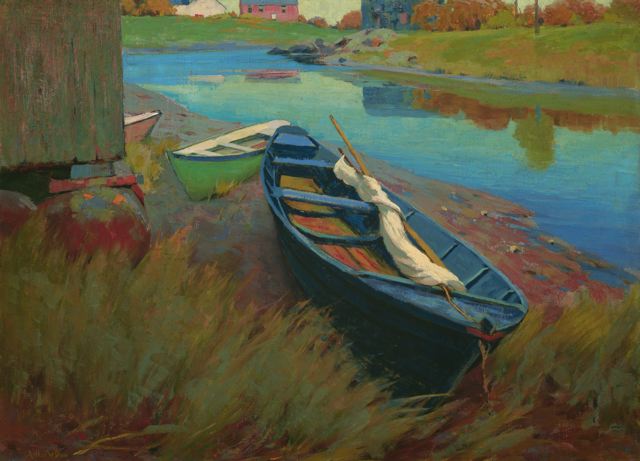
Going to an art museum you never know what you may encounter. This painting, for instance, I’d never laid eyes on—never even heard of the artist—until I happened upon it the other day at Chicago’s Art Institute.
Arthur Wesley Dow (American, 1857-1922), Boats at Rest
Charles Mingus Quintet (CM, bass; Dannie Richmond, drums; Eric Dolphy, alto saxophone, bass clarinet; Clifford Jordan, tenor saxophone; Jaki Byard, piano), live (TV broadcast), Belgium, 1964
“So Long, Eric”
*****
“Peggy’s Blue Skylight”
*****
“Meditations on Integration” (excerpt)
**********
lagniappe
. . . [Mingus’s] music was pledged to the abolition of all distinctions: between the composed and the improvised, the primitive and the sophisticated, the rough and the tender, the belligerent and the lyrical.—Geoff Dyer, But Beautiful: A Book About Jazz (1996)
*****
Making the simple complicated is commonplace; making the complicated simple, awesomely simple, that’s creativity.
***
I, myself, came to enjoy the players who didn’t only just swing but who invented new rhythmic patterns, along with new melodic concepts. And those people are: Art Tatum, Bud Powell, Max Roach, Sonny Rollins, Lester Young, Dizzy Gillespie and Charles Parker, who is the greatest genius of all to me because he changed the whole era around.
***
In my music, I’m trying to play the truth of what I am. The reason it’s difficult is because I’m changing all the time.
—Charles Mingus
(Originally posted on 4/22/10.)
**********
Duke Ellington, Count Basie, Miles Davis: so many of the greatest figures in jazz weren’t just great musicians, or composers, or arrangers. They were great bandleaders. As important to their artistic success as anything else was their ability to find, and showcase, players who could make the music come alive—people like Johnny Hodges and Ben Webster and Jimmy Blanton and Lester Young and Freddie Green and Jo Jones and John Coltrane and Bill Evans and Tony Williams.
That small circle of elite bandleaders includes this man. He hired musicians who played their instruments like no one else (Eric Dolphy, Jaki Byard, et al.). He gave them a musical setting in which structure and freedom were exquisitely balanced. And together they made music that sounds (even on something familiar) like nothing else.
Charles Mingus Sextet (with Johnny Coles, trumpet; Jaki Byard, piano; Eric Dolphy, alto saxophone and bass clarinet; Clifford Jordan, tenor saxophone; Dannie Richmond, drums), “Take the A Train,” live, Norway (Oslo), 1964
**********
lagniappe
I nominate Charles Mingus one of America’s greatest composers—Ran Blake (in the liner notes to his recent album Driftwoods)

 music clip of the day