Ken Vandermark (saxophone) & Paal Nilssen-Love (drums)
Live, Romania (Bucharest), 2010
**********
lagniappe
musical thoughts
Last night, while I was listening to these guys at a little club on Chicago’s near northwest side (The Hideout), a thought kept running through my head: there’s nothing like live music; there’s nothing at all like live music; there’s nothing at all in this world even remotely like live music.
Pete Cosey, guitar player, October 9, 1943-May 30, 2012
Miles Davis, “Ife,” live, Austria (Vienna), 1973
With Pete Cosey, guitar (solo begins at 5:30) and percussion; Dave Liebman, flute, soprano and tenor saxophones; Reggie Lucas, guitar; Michael Henderson, bass; Al Foster, drums; James Mtume Forman, conga and percussion
*****
Here’s an earlier post (12/31/09):
In the public imagination, the guitar’s associated with freedom and individuality. The musical reality’s different. Guitarists travel in herds; few stray from the pack. One who has gone his own way is this man, who’s played with everyone from Muddy Waters (as a session musician for Chicago-based Chess Records) to Miles Davis (as a member of his group [1973-1975]). He employs a variety of unusual tunings and effects. He sounds like no one else.
Pete Cosey, guitar
“Calypso Frelimo” (excerpt), Pete Cosey’s Children of Agharta (JT Lewis, drums; Gary Bartz and John Stubblefield, saxophones & flute; Matt Rubano, bass; Johnny Juice, turntables; Baba Israel, words and beats; Kyle Jason, voice; Bern Pizzitola, guitar; Wendy Oxenhorn, harmonica), live, 2002, New York
*****
Live (with Melvin Gibbs, bass; JT Lewis, drums; Johnny Juice, congas and turntables)
**********
lagniappe
. . . the guy who, after Hendrix, showed you how ‘out’ you could go with guitar playing, particularly in the improvised context.
Rebirth Brass Band, New Orleans (Treme Sidewalk Steppers Annual Second Line Parade), 2/6/12
***
***
**********
lagniappe
A highly anticipated moment of the social aid and pleasure club parade season is when the Treme Sidewalk Steppers emerge from the African-American Museum. First, comes the call of the trumpet and then a flash of color can be spied as a member waves a feathered fan and dances out the door. One by one, the Steppers strut their stuff as they energetically file down the sidewalk with a “look-at-me” attitude. Those in the waiting crowd on Gov. Nicholls Street, peer through the iron fence that surrounds the lovely building and gardens, trying to get a better look at the spectacle. They cheer at the triumph.
The Treme Sidewalk Steppers . . . was established in 1994 by a group of friends who were enthusiastic second line followers.
“We’d always go to the parades and parade on the sidewalk and have fun,” Sidewalk Steppers president Charlie Brown explains, “so we decided we might as well come up with our own.”
Brown as well as some dozen or so originators, including New Birth Brass Band’s Tanio Hingle and Kerry “Fat Man” Hunter, all hailed from the Treme so the name of their club was a natural. “That’s our neighborhood; that’s where we’re from,” Brown proudly states. “Being the oldest Black neighborhood in America and being raised around all these different musicians and just to have the culture makes it special to us. It’s in your blood–that’s what makes it so authentic with us.
***
Since most of the club’s members grew up in the Treme neighborhood, they boast deep roots in and respect for the second-line culture. The Steppers take that base and serve it up with its certain, individual style and personality.
“We try to keep it in the tradition but we have our own little swagger,” Brown says. “We try to be unique in our dress and our ways. We love the fun in dancing and showing off our little parade gear. We take pride in it. We don’t take shortcuts with our parade.”
The Sidewalk Steppers’ outfits are usually specially designed and tailored for them rather than store-bought. Creating their decorative fans is a group effort that’s accomplished under the direction of original member Corey Holmes. . . .
While some clubs keep the colors of their outfits secret, the Treme Sidewalk Steppers declare them right on the route sheet . . .
“We want the people to know,” Brown explains. “Maybe our followers would like to dress in the colors we’re wearing. We invite that. We really love the people that love us and we appreciate them all. The followers made us–they made us as good as we are or are supposed to be.”
The Treme Sidewalk Steppers also kept the second liners in mind when drawing up the parade route. The procession primarily travels on wide thoroughfares like Basin Street, Broad Street, N. Claiborne Ave. and St. Bernard Ave. that offer the crowd room to move.
“We use main streets so people can be comfortable and we try to spread out so you can enjoy us and view us well,” he explains.
***
“The Sidewalk Steppers mean everything to me,” Brown says with deep sincerity. “We give thanks to all the people who came before and how they gave this history to us and showed us the way.”
“Spring Can Really Hang You Up The Most” (T. Wolf & F. Landesman)
Bob Dorough, vocals & piano (Right On My Way Home, 1997)
*****
Betty Carter, vocals (Inside Betty Carter, 1964)
**********
lagniappe
reading table
Alcove
by John Ashbery
(Planisphere, 2009)
Is it possible that spring could be
once more approaching? We forget each time
what a mindless business it is, porous like sleep,
adrift on the horizon, refusing to take sides, “mugwump
of the final hour,” lest an agenda—horrors!—be imputed to it,
and the whole point of its being spring collapse
like a hole dug in sand. It’s breathy, though,
you have to say that for it.
And should further seasons coagulate
into years, like spilled, dried paint, why,
who’s to say we weren’t provident? We indeed
looked out for others as though they mattered, and they,
catching the spirit, came home with us, spent the night
in an alcove from which their breathing could be heard clearly.
But it’s not over yet. Terrible incidents happen
daily. That’s how we get around obstacles.
Von Freeman,* tenor saxophone; Clifford Jordan, tenor saxophone (first solo); Willie Pickens, piano; Dan Shapera, bass; Robert Shy, drums; “Oleo” (S. Rollins), live, Chicago (Chicago Jazz Festival), 1988
Peter Brötzmann Chicago Tentet,* “Aziz” (M. Zerang), recorded live in Chicago (Empty Bottle), 9/17/97 (Okka Disk OD-12022)
**********
lagniappe
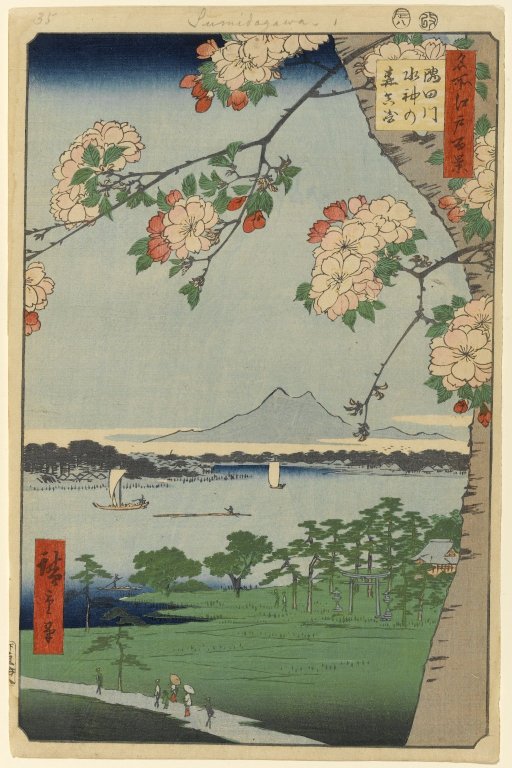
art beat: yesterday at the Art Institute of Chicago (after meeting with a client at the nearby federal jail)
Utagawe Hiroshige, Suijin Shrine and Massaki on the Sumida River (from the series One Hundred Famous Views of Edo), c. 1856
*****
reading table
Were I to choose an auspicious image for the new millennium, I would choose . . . the sudden agile leap of the poet-philosopher who raises himself above the weight of the world, showing that with all his gravity he has the secret of lightness, and that what many consider to be the vitality of the times—noisy, aggressive, revving and roaring—belongs to the realm of death, like a cemetery for rusty old cars.
—Italo Calvino, “Lightness,” in Six Memos for the New Millenium (1988, translated from Italian by Patrick Creagh)
*****
*PB, tenor sax/clarinet/tarogato; Mars Williams, tenor/alto/soprano sax/clarinet; Ken Vandermark, tenor sax/clarinet/bass clarinet; Mats Gustafsson, baritone sax/fluteophone; Joe McPhee, pocket cornet/valve trombone/soprano sax; Jeb Bishop, trombone; Fred Lonberg-Holm, cello; Kent Kessler, bass; Michael Zerang, drums/percussion; Hamid Drake, drums/percussion.
Charles Mingus Quintet,* “So Long Eric,” “Peggy’s Blue Skylight,” “Meditations On Integration” (all by Mingus), live (TV show), Belgium, 1964
Mingus’s music, it seems, has everything. Call it “simple” or “complex” and you’d be both right and wrong—it’s both. Compositional elegance is balanced, exquisitely, with improvisational unruliness. Rhythmic momentum is no less—and no more—important than melodic invention. Like Ellington and Monk, he will, I’m confident, still be listened to a hundred years from now.
(Excerpts from this program have been posted previously.)
**********
lagniappe
art beat: yesterday at the Art Institute of Chicago
Ludovico Carracci, The Vision of Saint Francis, c. 1602
Going to the Art Institute again, after being away for a while, I felt a bit like someone who doesn’t realize he’s starving until he finds himself at a feast.
*****
*CM, bass; Eric Dolphy, alto saxophone, flute, bass clarinet; Clifford Jordan, tenor saxophone; Jaki Byard, piano; Dannie Richmond, drums.

 music clip of the day