Tuesday, January 13th
sounds of Chicago (day one)
Art Ensemble of Chicago (Roscoe Mitchell, reeds; MCOTD Hall-of-Famer Lester Bowie [1941-1999], trumpet; Malachi Favors [1927-2004], bass; Don Moye, drums), live, Hungary (Budapest), 1995
sounds of Chicago (day one)
Art Ensemble of Chicago (Roscoe Mitchell, reeds; MCOTD Hall-of-Famer Lester Bowie [1941-1999], trumpet; Malachi Favors [1927-2004], bass; Don Moye, drums), live, Hungary (Budapest), 1995
two takes
Rebirth Brass Band, “A. P. Tureaud,” live, New Orleans
Treme Sidewalk Steppers Second Line, 2011
***
Revolution Social Aid and Pleasure Club Second Line Parade, 2012
**********
lagniappe
art beat
Lee Friedlander (1934-), Second Liners at Mardi Gras, New Orleans, 1957

voices I miss
Lester Bowie’s From the Root to the Source (MCOTD Hall-of-Famer Lester Bowie [1941-1999], trumpet; Fontella Bass, vocals, piano; Martha Bass, vocals; Malachi Favors, bass, et al.), live, 1983
**********
lagniappe
reading table
I walked through the mountains today. The weather was damp, and the entire region was grey. But the road was soft and in places very clean. At first I had my coat on; soon, however, I pulled it off, folded it together, and laid it upon my arm. The walk on the wonderful road gave me more and even more pleasure; first it went up and then descended again. The mountainous world appeared to me like an enormous theatre. The road snuggled up splendidly to the mountainsides. Then I came down into a deep ravine, a river roared at my feet, a train rushed past me with magnificent white smoke. The road went through the ravine like a smooth white stream, and as I walked on, to me it was as if the narrow valley were bending and winding around itself. Grey clouds lay on the mountains as though that were their resting place. I met a young traveller with a rucksack on his back, who asked if I had seen two other young fellows. No, I said. Had I come here from very far? Yes, I said, and went farther on my way. Not a long time, and I saw and heard the two young wanderers pass by with music. A village was especially beautiful with humble dwellings set thickly under the white cliffs. I encountered a few carts, otherwise nothing, and I had seen some children on the highway. We don’t need to see anything out of the ordinary. We already see so much.
—Robert Walser (1878-1956), “A Little Ramble” (translated from German by Tom Whalen)
sounds of New Orleans
Henry Butler (piano, vocals), Steven Bernstein (trumpet), Herlin Riley (drums), et al., “Some Iko,” recording session (Viper’s Drag, 2014)
**********
lagniappe
reading table
One must always fight back, not in the hope of winning but just to delay the moment of losing.
—Samantha Harvey, The Wilderness
genius at play
Henry Threadgill (alto saxophonist, composer, bandleader) leading a master class (excerpt), Big Indian, N.Y. (Creative Music Studio), 2014
***
More.
Henry Threadgill and His Very Very Circus, “Too Much Sugar for a Dime,” live, New York, c. 1993
*****
Today Henry, who’s been lifting my spirits for over three decades, enters the MCOTD Hall of Fame, joining tenor saxophonist Von Freeman, trumpeter Lester Bowie, poets John Berryman, William Bronk, and Wislawa Szymborska, and gospel singer Dorothy Love Coates.
**********
lagniappe
art beat: more from Friday at the Art Institute of Chicago
Claude Monet (1840-1926), Irises (1914/17)

*****
radio
One of my favorite musical events begins tonight: the annual Bach Festival on WKCR (Columbia University), which runs through midnight New Year’s Eve.
sounds of New York (day two)
Here, as in the city itself, density and spaciousness coexist.
Tim Berne’s Cornered,* “Embraceable Me,” live, New York, 10/12/14
*TB, alto saxophone; Oscar Noriega, clarinets; Ryan Ferreira, guitar; Matt Mitchell, piano; Michael Formanek, bass; Ches Smith, drums, vibraphone.
passings
Bunny Briggs, tap dancer, February 26, 1922-November 15, 2014
Duke Ellington Orchestra with Bunny Briggs (dance) and Jon Hendricks (vocal), “David Danced Before the Lord with All His Might,” live (A Concert of Sacred Music), San Francisco (Grace Cathedral), 1965
*****
And David danced before the Lord with all his might . . .
—2 Samuel 6:14 (King James)
**********
lagniappe
art beat
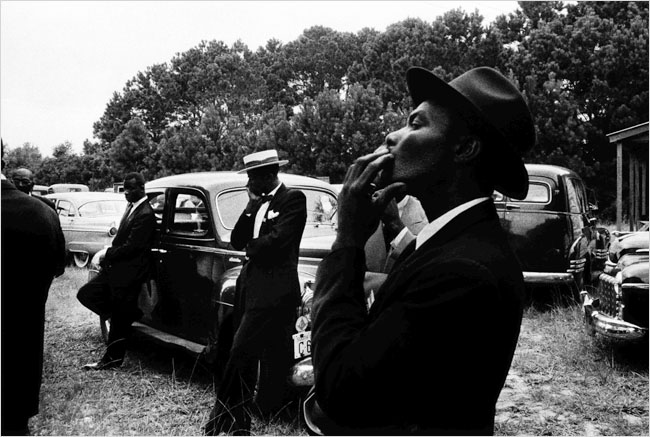
Robert Frank (1924-), Funeral—St. Helena, South Carolina, 1955
tonight in Chicago
These guys will be playing at Constellation.
Frode Gjerstad Trio (FG, reeds; Jon Rune Strøm, bass; Paal Nilssen-Love, drums)
Live, Poland (Poznan), 2012
***
Live, New York, 2012
**********
lagniappe
random thoughts
What’s surprising isn’t that we die: it’s that we live.
four takes
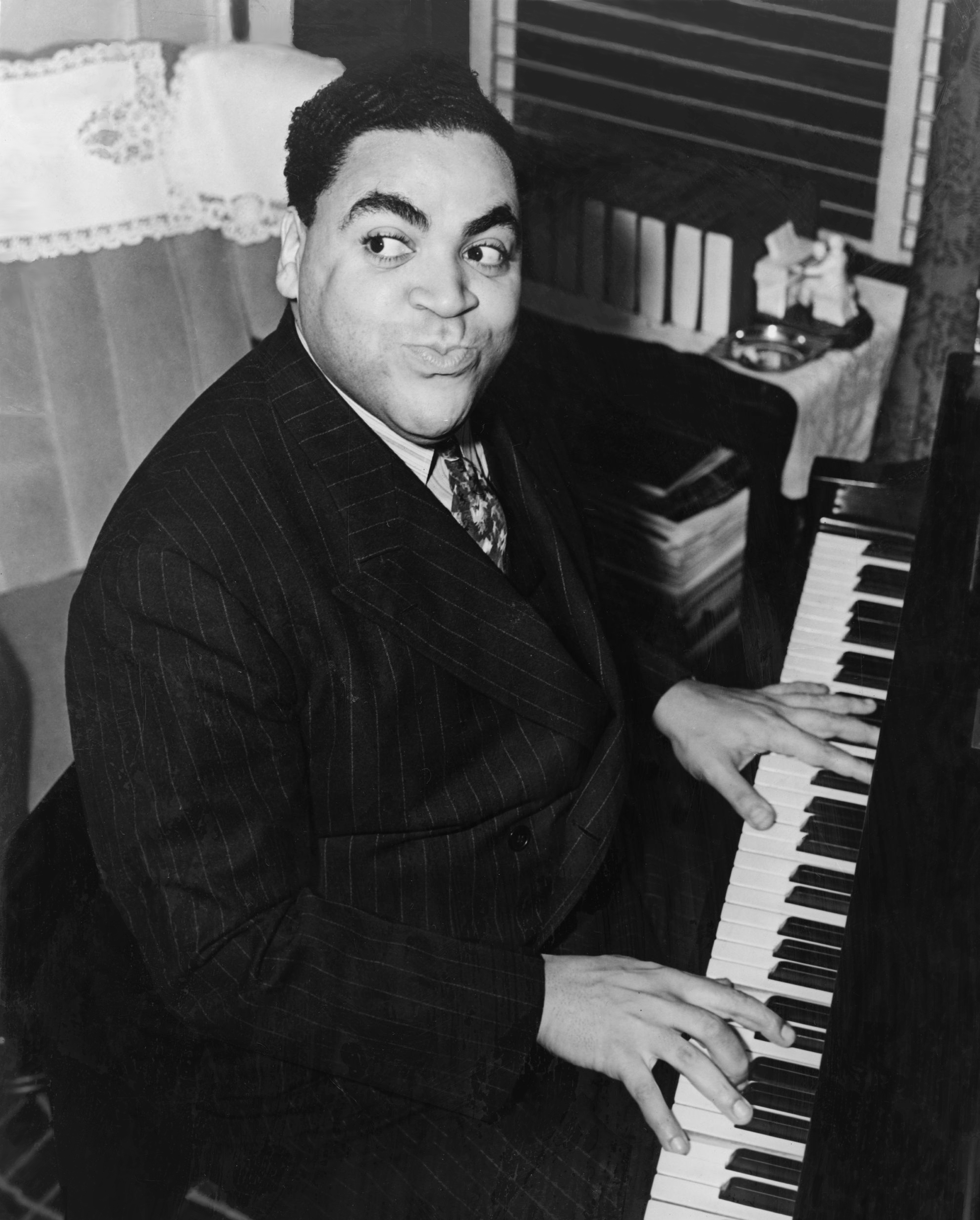
“Lulu’s Back In Town” (A. Dubin, H. Warren)
Fats Waller (studio recording), 1935
***
Art Tatum (live), 1935
***
Thelonious Monk (live, Paris; Charlie Rouse [tenor saxophone], Larry Gales [bass], Ben Riley [drums]), 1966
***
Jason Moran (live, New York [East Village apt.]), 2011
**********
lagniappe
art beat
Helen Levitt (1913-2009), New York, c. 1940

voices I miss
Leroy Jenkins (1932-2007), violin, live (“Lush Life” [B. Strayhorn], “Keep on Trucking, Brother (A Message to Bruce)” [L. Jenkins], “Nobody Knows the Trouble I’ve Seen” [Trad.]), New York, 1977
**********
lagniappe
musical thoughts
A jazz musician playing alone is like a tightrope walker working without a net. Playing a music of rhythmic verve, he lacks a rhythm section. Playing a music of spirited interplay, he lacks the company of others. And when the musician’s instrument happens to be the violin, he’s working not only without a net but without a tightrope.
The violin lacks all the advantages of the one instrument with a long-standing tradition of solo jazz performance, the piano. Where a pianist can play more than one musical line at a time (accompanying herself with her left hand, for example, while “soloing” with her right), a violinist can’t. Where a pianist can readily play complex chords, a violinist is limited to four strings and beset by innumerable fingering problems. And the range of pitches available to a violinist is only about half that available to a pianist. When a jazz violinist steps onstage by himself, he either falls flat on his face or, defying the conventions of gravity, flies.
Last Friday at HotHouse, jazz violinist Leroy Jenkins not only flew but soared. A dignified man so diminutive that he makes a violin appear large, Jenkins focused the listener’s attention not on what was absent—other musicians, multiple lines, an expansive tonal range—but on what was present. His concert provided a response of sorts to the familiar Zen koan: What is the sound of one hand clapping?
Playing for a small but attentive audience, the longtime associate of the Chicago-based Association for the Advancement of Creative Musicians—who hadn’t performed here for several years—displayed a powerful and original musical vocabulary. Just as a poem forces one to consider language word by word, a solo jazz performance forces one to consider music sound by sound. And that was how Jenkins constructed each of his pieces: sound by sound.
He began most of them with a simple melodic statement that sang. Then he would veer off into gradually accelerating repetitions of two-, three-, and four-note patterns. Unlike a horn player, he never had to stop for breath, so these patterns could go on and on. Out of them would emerge long, winding bursts of melody, like swallows taking flight through a swarm of bees. Then Jenkins would return to repeated patterns, steadily building the intensity until he reached a climax and suddenly stopped.
The narrative structure of many of his pieces was thus not unlike that of a sexual encounter. But the steadily mounting intensity was invariably coupled with precise articulation, lucid organization, and exquisite control. When near the end of his set Jenkins rocked back and forth like a man possessed, his seemingly unshakable control of his instrument only heightened the dramatic impact.
A master colorist, Jenkins called forth a seemingly limitless array of sounds, from singing to fluttering to stinging to rasping to wheezing. But what was ultimately even more impressive than the variety and virtuosity of his playing was its logic and coherence. And unlike some jazz musicians, whose solos can be neatly divided into segments “inside” or “outside” normal harmonic and tonal conventions, Jenkins’s playing was all of a piece.
Jenkins’s HotHouse set readily calls to mind Richard Goode’s magnificent recent performance at Pick-Staiger Concert Hall of five Beethoven piano sonatas. Neither musician spoke a word to the audience, but neither seemed remote. Both played so wholeheartedly that they virtually disappeared in the music. Both are virtuosos who put their virtuosity entirely at the service of the music, never exploiting it simply for effect. Both played music that often pitted a coming-apart-at-the-seams emotional intensity against an ultimately prevailing clarity and order. Perhaps one day, solo jazz concerts of the caliber of Jenkins’s will be met with the same degree of anticipation and excitement that performances of Beethoven piano sonatas by artists such as Goode typically receive today.
—Richard McLeese, “Flying Solo,” Chicago Reader, 10/27/1994
*****
art beat: yesterday at the Art Institute of Chicago
Vincent van Gogh (1853-1890), The Bedroom, 1889


