Wednesday, 4/28/10
As I mentioned a while back, I’m leaning toward a career, in the next life, as a tap-dancer.
Marilyn Miller, “All I Want To Do, Do, Do Is Dance” (Sally, 1929)
Want more? Here.
As I mentioned a while back, I’m leaning toward a career, in the next life, as a tap-dancer.
Marilyn Miller, “All I Want To Do, Do, Do Is Dance” (Sally, 1929)
Want more? Here.
Originally, Morton Feldman was commissioned to compose the score for the film [Something Wild], but when the director heard the music, he promptly withdrew his commission, opting to enlist Aaron Copland instead. The reaction of the baffled director [Jack Garfein] was said to be, ‘My wife is being raped and you write celesta music?’
Morton Feldman, “Something Wild in the City: Mary Ann’s Theme,” 1960
[T]he greatest rock is birthed from equal parts intelligence and stupidity.—Chris Bohn (The Wire, 2/10)
Jandek
“Real Wild,” live, Glasgow, 2004
*****
Live, Houston, 2009
**********
lagniappe
Much speculation has been made over the true identity of the mysterious singer/songwriter Jandek, and his equally obscure record label, Corwood Industries. For over 25 years, the artist released album after album of twisted, ghostly, and utterly unique songs that crooned a tale of despair.
***
Jandek played his first ever concert on October 17th, 2004 in Glasgow, Scotland as part of the Instal Festival, accompanied by Richard Youngs on bass, and Alexander Neilson on drums. The name Jandek did not appear on any of the promotional material for the festival. Some members of the audience, in disbelief, recognized the man from his album covers and could not mistake the sound for any other. Word quickly spread that Jandek had indeed performed . . . —Raphi Gottesman
*****
art beat
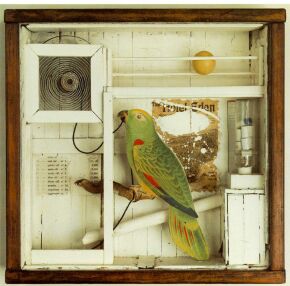
Joseph Cornell, Hotel Eden (c. 1945)
This guy, like Captain Beefheart, studied at the Howlin’ Wolf School of Vocal Alchemy.
Tom Waits, “Make It Rain,” live (TV broadcast), 2004
**********
lagniappe
More on William Eggleston and Alex Chilton
Yesterday, while at the Art Institute, I stopped again at the William Eggleston exhibit (previously mentioned here and here), which runs through May 23rd. It includes not only the album cover I posted earlier (Big Star’s Radio City), but also this one. Eggleston, an accomplished piano player, once accompanied Chilton on a track—the Nat King Cole classic “Nature Boy,” which appears on Big Star’s Third/Sister Lovers (expanded reissue), produced by Jim Dickinson, as well as Keep an Eye on the Sky (2009 boxed set).

looking back
Today, celebrating our 200th post, we revisit a few favorites.
If I didn’t have kids, would my ears be stuck, forever, on “repeat”?
Here’s something my younger son Luke, who just started college, played for me recently, after first pronouncing it, with quiet but absolute authority, the best thing this guy has done (already Luke’s learned that what’s important isn’t to be right; it’s to seem right).
Lupe Fiasco, “Hip Hop Saved My Life,” live, Los Angeles, 2008
*****
And here’s a track my older son Alex played for me a couple weeks ago, before heading back to school.
Dirty Projectors, “Stillness Is The Move”
*****
Koan for aging parents: What is the sound of a childless house?
**********
How to be both solid and fluid, both fat and delicate. How to make the beat breathe. These are things that, as a child, Philly Joe Jones began to learn while dancing—tap-dancing. Just watch the way Thelonious Monk, listening to this solo, rocks back and forth (1:25-1:50), as if he’s about to break into a little dance himself.
Philly Joe Jones, live (with Thelonious Monk), 1959
**********
lagniappe
He breathed our history as/his walking beat . . . The Man/So Hip/A City/Took/His/Name.—Amiri Baraka (formerly LeRoi Jones, in Eulogies [1996])
**********
The first time I stood before a judge at Chicago’s Criminal Courts Building at 26th and California—this was back in the ’70s (when I was working at Alligator Records)—it was to speak on behalf of this man, Hound Dog Taylor. The day before, during a drunken argument at his apartment, he’d shot his longtime guitarist Brewer Phillips (who survived). In his own way, Hound Dog was a pretty canny guy. When he told me about this incident over the phone, shortly after it happened, he put it this way: “Richard, they say I shot Phillip.”
(No, don’t touch that dial; these stills are way out of focus—which, for Hound Dog, seems just right.)
*****
Hound Dog Taylor and the Houserockers, live, Ann Arbor Blues Festival, 1973
“Wild About You Baby”
***
“Taylor’s Rock”
***
“I Held My Baby”
**********
Here’s Arthur Russell, the “seminal avant-garde composer, singer-songer-writer, cellist, and disco producer” who died in 1992 at the age of 40 (of AIDS-related complications) and is the subject of both a recent documentary, Wild Combination, and a new book, Hold On To Your Dreams: Arthur Russell and the Downtown Music Scene, 1973-1992.
Arthur Russell
“Get Around To It”
*****
“You And Me Both”
*****
“This Is How We Walk on the Moon”
*****
“That’s Us/Wild Combination”
(Yeah, the fact that I’m posting four tracks by this guy shows how much his music, which I just encountered recently, has been getting under my skin.)
**********
Here one of the greatest American artists of the 20th century (composer Morton Feldman [1926-1980]) pays homage to another (painter Mark Rothko [1903-1970]).
Morton Feldman, “Rothko Chapel” (composed in 1971; first performed, at Houston’s Rothko Chapel, in 1972)
Part 1
Part 2
Part 3
Part 4
Part 5
**********
I first heard this guy back in the mid-1970s, after reading a review in the New York Times, by the late Robert Palmer, of his first album, The Gospel Saxophone of Vernard Johnson—and I’ve been listening to him ever since.
Vernard Johnson, saxophone
Live, Texas (Roanoke)
**********
lagniappe
reading table
Music . . . helped me to go deeper inside myself, to find new things there: the variety which I had vainly sought in life and in travel, yet the longing for which was stirred in me by the surge of sound whose sunlit wavelets came to break at my feet.
—Marcel Proust, The Prisoner (Trans. Carol Clark)
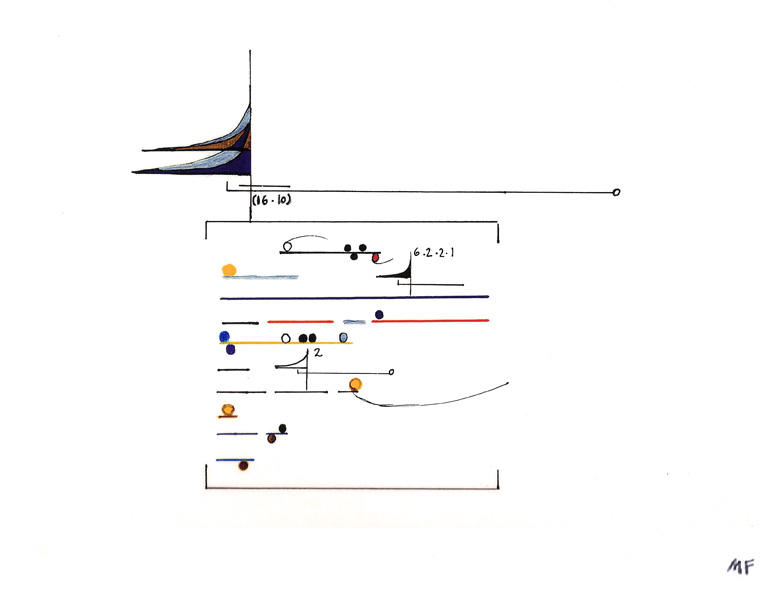
Trying to capture jazz in standard notation can be like trying to translate poetry into another language—what you wind up with is everything but the poetry. So composer/trumpeter Wadada Leo Smith (who, like many of his peers, eschews “jazz” as a label for his music) invented his own system of graphic notation.

***************
Wadada Leo Smith (trumpet) with his Golden Quartet (Vijay Iyer [piano], John Lindberg [bass], Ronald Shannon Jackson [drums]); Eclipse, 2005
Part 1
*****
Part 2
*****
Part 3
*****
Part 4
*****
Part 5
*****
Part 6
*****
Part 7
*****
Part 8
**********
lagniappe
art beat
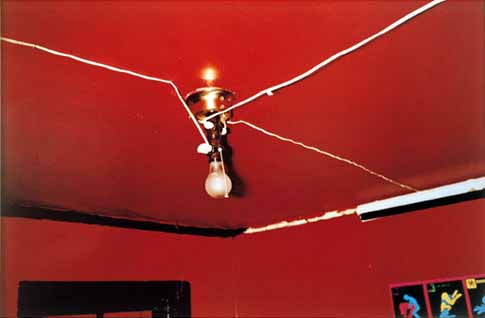
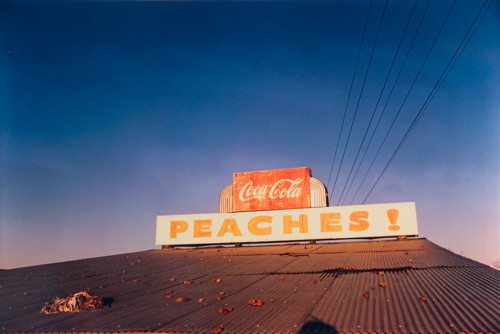
Earlier this month, when I mentioned the exhibit of William Eggleston’s photographs that’s currently at the Art Institute—posting an album cover that you’ll find in a display case there—I didn’t expect that Big Star would appear here again before the month’s end. But then I didn’t expect that Alex Chilton would pass away, either. Alex had more than simply an artistic interest in Eggleston and his work. He’d known the photographer, who was a good friend of his parents, since he was a little boy. Here, again, is the image Alex chose for that album cover, followed by a couple more from this exhibit.
***


***
Career plans for the next life? At the moment, I’m leaning toward tap-dancing.
Teddy Hale, c. 1950
*****
Gregory Hines, early 1980s
*****
Will Gaines, My Home Is My Shoes (2009)
Some music—like, say, Emil Gilels performing Beethoven’s Waldstein sonata or Ben Webster playing “Old Folks” or Al Green singing “Jesus Will Fix It”—transports you to another place. Other music, like this, transforms the space around you.
Steve Reich, “Music for 18 Musicians” (1974-76)
Part 1
Excerpt (beginning), live, Cincinnati, 2008
*****
Part 2
Excerpt, recording (Grand Valley State University New Music Ensemble)
*****
Part 3
Excerpt (ending), live, Tokyo, 2008
*****
I first encountered Steve Reich’s music in 1971, while in college and living for a few months in New York. At a concert at New York University, I heard Reich and his ensemble perform his then-new piece “Drumming.” Stunning, mesmerizing, it was unlike anything my 19-year-old ears had ever heard.
**********
lagniappe
The other day, I watched as Steve Reich walked away from Carnegie Hall, where celebrations of his seventieth birthday were under way, and out into his native city. Trim and brisk, he darted into West Fifty-seventh Street, fell back before oncoming traffic, bopped impatiently in place, then darted forth again. He soon disappeared into the mass of people, his signature black cap floating above the crowd. Perhaps I should have lamented the fact that one of the greatest living composers was moving around New York unnoticed, but lamentation is not a Reichian state of mind, and I thought instead about how his work has blended into the cultural landscape, its repeating patterns and chiming timbres detectable all over modern music. Brian Eno, David Bowie, David Byrne, and a thousand d.j.s have paid him heed. On Fifty-seventh Street, Reich-inflected sounds may have been coursing through the headphones of a few oblivious passersby.
Three decades ago, New York’s leading institutions would have nothing to do with Reich. A riot broke out when Michael Tilson Thomas presented “Four Organs” at Carnegie in 1973: one woman tried to stop the concert by banging on the edge of the stage with her shoe. Now uptown is lionizing the longtime renegade.
***
Reich changed music, and he also changed how music relates to society. In the face of early incomprehension, he took a do-it-yourself approach to getting his work before the public. Nonclassical musicians were among his models: he saw John Coltrane some fifty times, and marvelled at how the great man would unleash mind-bending sounds, pack up his sax, and disappear into the night. With his namesake ensemble, Reich performed in galleries, clubs, and wherever else he felt welcome. The effects of this paradigm shift can be seen on any day of the week in New York, as composer-led ensembles proliferate.
***
The Reich ensemble retains most of its original members, and they remain an awesome force, even as shaggy hairdos have given way to dignified shocks of white. At Zankel Hall, they played Part I of “Drumming,” a phase-shifting tour de force in which bongos are struck with sticks. I was curious to see how they would compare with two sharp young ensembles who had performed the same stretch of music in recent weeks—So Percussion, at Symphony Space, and four Juilliard percussionists, at Carnegie. The youngsters drummed with effortless grace, as if the score were written into their genetic code. But the veterans more than held their own, bringing to bear a kind of disciplined wildness, in the spirit of the Ghanaian drummers with whom Reich studied before he wrote the piece. The energy that blazed up at climactic moments could have powered the hall in a blackout.
street music
New Orleans
Loose Marbles, in the French Quarter
Part 1
*****
Part 2
**********
lagniappe
The Loose Marbles is a sort of Amalgamated Jazz Corporation that creates subsidiaries around the city, to maximize tips and minimize boredom. The fifteen musicians play clarinet, trumpet, banjo, washboard, accordion, trombone, guitars, sousaphone, standup bass, and guitars, but you’re likely to see only seven or eight performers at any given gig. And since you rarely see the same configuration of instruments twice in a row, you rarely hear the same kind of jazz. If Patrick McPeck is there with the accordion, you’ll hear the Marbles’ repertoire of spooky, minor-keyed, Gypsy-influenced songs. If Alynda Segarra is there, with her banjo or washboard, and Jason Jurzek is on string bass instead of tuba, they’ll be playing songs that sound as if they were first performed in a hobo jungle during the Hoover Administration. In Washington Square, in New York, they split into two groups, one anchored by the tuba and the other anchored by the bass, and they play on opposite sides of the park. Halfway through the day, they’ll mix up the configurations to give both the musicians and the crowd a change of pace. At the end of the day, they pool all the tips and divide them equally. I’ve seen days here in New Orleans where they have a stack of bills that’s so thick it can’t be held in one hand, and that contains a lot of portraits of Hamilton and Jackson.
***
The Loose Marbles look like street urchins, and at least a few of them are. The goat-bearded guitar and tuba player, Barnabus Jones; Ruth’s boy, Kiowa Wells; and the banjo and washboard player Alynda all come from a subculture of rail-riding, outdoor-living hobos that was beautifully documented a couple of years ago by the photographer James Heil in Time. . . . But the trumpeter Ben Polcer is a University of Michigan music-school graduate, and the clarinetist Mike Magro, from suburban Philadelphia, is a virtuoso who can hold forth at length about the rare and antiquated Albert fingering of his clarinet.
In addition to their song selection and their remarkably tight and vibrant musicianship, two things particularly excite me about the Loose Marbles. One is how carefully thought out their act is; their inter-war, Mitteleuropean flavor is somehow more than accidental and less than shtick. The other is how much, and how obviously, they all love each other.
***
I asked Ben why he and his friends aren’t playing rock and roll like proper twenty-somethings. What is the attraction, I wanted to know, of music his grandparents listened to?
“I’ve played in a lot of rock bands,” he said. “I like rock and roll. We all like rock and roll. But jazz is special. To play it well, you really have to listen to each other.”—Dan Baum

