music clip of the day

jazz/blues/rock/classical/gospel/more

Category: hard-to-peg

Wednesday, 2/1/12

Morton Feldman, For Bunita Marcus (1985)
John Tilbury, piano

According to iTunes, I’ve listened to this piece, which I often put on “repeat” before going to sleep, over a thousand times.

***

More Feldman?

Here.

And here.

Here. 

And here. And here. And here.

Here. 

And here.

**********

lagniappe

musical thoughts

Compositionally I always wanted to be like Fred Astaire.

***

 I never feel that my music is sparse or minimal; the way fat people never really think they’re fat. I certainly don’t consider myself a minimalist at all.

***

No one has the Houdini school of composition.

Morton Feldman (1926-87)

*****

reading table

Last week a record store in Dupont Circle announced that it was closing. The immediate cause of its demise—it had outlasted national and regional chains—was Price Check, Amazon’s new idea for exterminating competition. It is an app that allows shoppers to scan the bar code on any item in any store and transmit it to Amazon for purposes of comparison, and if it compares favorably to Amazon’s price, Amazon’s special promotion promises a discount on the same item. In this way shoppers become spies, and stores, merely by letting customers through their doors, become complicit in their own undoing. It will not do to shrug that this is capitalism, because it is a particular kind of capitalism: the kind that entertains fantasies of monopoly. For all its technological newness, Amazon’s “vision” is disgustingly familiar. (“Amazon is coming to eat me,” a small publisher of fine religious books stoically told me a few weeks ago.) Nor will it do to explain that Amazon’s app is convenient, unless one is prepared to acquiesce in a view of American existence according to which its supreme consideration must be convenience. How easy must every little thing be? A record store in your neighborhood is also convenient, and so is a bookstore. There is also a sinister side to the convenience of online shopping: hours once spent in the sensory world, in the diversified satisfaction of material needs and desires, can now be surrendered to work. It appears to be a law of American life that there shall be no respite from screens. And so Amazon’s practices raise the old question of the cultural consequences of market piggishness. For there are businesses that are not only businesses, that also have non-monetary reasons for being, that are public goods. Their devastation in the name of profit may be economically legitimate, but it is culturally calamitous. In a word, wrong.

WHEN MY FRIEND at Melody Records told me about the death of his store, I was bereft. This was in part because he is my friend—after my father died, I received a letter from the Holocaust Museum informing me that he had made a donation in my father’s memory—and now he must fend for himself and his family and his staff in the American wreckage. But my dejection was owed also to the fact that this store was one of the primary scenes of my personal cultivation. For thirty years it stimulated me, and provided a sanctuary from sadness and sterility. “Going to Melody” was a reliable way of improving my mind’s weather. The people who worked there had knowledge and taste: they apprised me of obscure pressings of Frank Martin’s chamber music, and warned me about the sound quality of certain reissues of Lucky Thompson and Don Byas, and turned me on to old salsa and new fado. They even teased me about my insane affection for Rihanna. When they added DVDs to the store, my pleasures multiplied. (Also my amusements. Not long ago Marcel Ophuls’ great film arrived in the shop, and the box declared: “Woody Allen presents The Sorrow and The Pity.” Beat that.) Of course all these discs can be found online. But the motive of my visits to the store was not acquisitiveness, it was inquisitiveness. I went there to engage in the time-honored intellectual and cultural activity known as browsing.

IT IS A MATTER OF some importance that the nature of browsing be properly understood. Browsing is a method of humanistic education. It gathers not information but impressions, and refines them by brief (but longer than 29 seconds!) immersions in sound or language. Browsing is to Amazon what flaneurie is to Google Earth. It is an immediate encounter with the actual object of curiosity. The browser (no, not that one) is the flaneur in a room. Browsing is not idleness; or rather, it is active idleness—an exploring capacity, a kind of questing non-instrumental behavior. Browsing is the opposite of “search.” Search is precise, browsing is imprecise. When you search, you find what you were looking for; when you browse, you find what you were not looking for. Search corrects your knowledge, browsing corrects your ignorance. Search narrows, browsing enlarges. It does so by means of accidents, of unexpected adjacencies and improbable associations. On Amazon, by contrast, there are no accidents. Its adjacencies are expected and its associations are probable, because it is programmed for precedents. It takes you to where you have already been—to what you have already bought or thought of buying, and to similar things. It sells similarities. After all, serendipity is a poor business model. But serendipity is how the spirit is renewed; and a record store, like a bookstore, is nothing less than an institution of spiritual renewal.

—Leon Wieseltier, “Going To Melody,” The New Republic, 2/2/12

Tuesday, 1/31/12

on & on & . . .

Lyn Horton, Goldmine Brook: The Day After Christmas (2011)
Glenn Branca, Lesson No. 1 for Electric Guitar (1980, reissued 2004)

Vodpod videos no longer available.

Tuesday, 1/24/12

If you’re looking for sunshine, you’ll have to go elsewhere.

This is one of the saddest, darkest, most chilling things I know.

Nina Simone, “Black Is The Color Of My True Love’s Hair”

**********

lagniappe

reading table

[L]ife needs a lot of imaginative fixing, since it regularly fails to provide us with wild adventure and comfortable closure. ‘In life,’ Proust wrote in a notebook, ‘novels don’t finish.'”

—Michael Wood, “At the Movies,” London Review of Books, 1/5/12

Sunday, 1/22/12

With voices like these who needs microphones?

Davis Sisters, “On the Right Road,” live (TV Broadcast), c. 1964

**********

lagniappe

my back pages

Thirty-five years ago tonight—how could I possibly begin a sentence “thirty-five years ago tonight” and be referring to something that happened when I was, at least nominally, an adult? Well, this actually happened that night so I guess it must be possible. On that cold, clear January night, at a small church thirty miles north of Chicago, Suzanne and I were married. Yes, there was music. Tenor saxophonist Von Freeman and pianist John Young (now gone) played before and after the ceremony. The processional was Duke Ellington’s “In a Sentimental Mood,” played by Von alone. What did all this sound like? Thanks to my friend (and ace recording engineer) James C. Moore, these sounds can be heard, thirty-five years later, here (M4A—give it a few seconds).

Thursday, 1/19/12

Tim Hecker, “The Piano Drop” (Ravedeath, 1972), 2011*
The First MIT Baker House Piano Drop, 11/1972

**********

lagniappe

random thoughts

Suppose you had to assign a number: what percentage of your daily life do you understand?

*****

*One of the year’s top 10 albums—Ben Ratliff (New York Times).

Wednesday, 1/18/12

He does covers, too.

“Pale Blue Eyes” (L. Reed)

Alejandro Escovedo, live, Paris, 2007

***

Velvet Underground (The Velvet Underground, 1969)

Tuesday, 1/17/12

keep on dancing

Theo Parrish (Detroit-based DJ/producer), live, Spain (Madrid), 2010

#1

***

#2

***

#3

***

#4

**********

lagniappe

musical thoughts

[I]f you think about it, sound behaves a lot like sculpture except there’s a time limit. Look at that sculpture right there behind you. You look at it and there’s a front, a back, an up, a down, around and through. So you’re talking about volume. You’re talking about spatial relationships.

The thing about sound is that there is a beginning and there is usually an end, there’s a certain amount of space that it takes up, but the big difference is that all of that is merely alluded to. It’s not something that’s concretely in front of you. It’s fluid. You may hear a snare, but the way that it’s presented and the textures that it has, you can bring certain mental images to it. If you’re listening. If you’re listening.

A lot of times you’ll put something on and it’s just another track, but if you’re listening to it you can hear a lot of the nuances that are in there and really start to understand . . . start to really get your head around it . . .

Repetition kind of sets a certain mass in a song. That’s a constant, that’s something you can ‘see’ all the time. Then there’s little bits that come in and out and these changes that kinda shift on that pivot. If you think of it visually, sometimes you’re dealing with almost a mobile-like thing. This is where I go in my head sometimes. Mobile means shifting, spinning, all kinds of stuff.

If you look at it, it could almost be like sculpting air. It’s like you have all of these shapes . . . but you have to rely on a structure, but then again you really don’t have to. So your structure tends to be your time limit—how long your recording is from beginning to end. Anything that happens in that amount of time is on you. Totally up to your creativity.

Theo Parrish

Thursday, 1/12/12

I don’t know what these folks call this stuff, but one thing I’m sure of: it ain’t “world music.”

Sobanza Mimanisa (“Orchestra of Light”), “Kiwembo,” live
Democratic Republic of Congo (Kinshasa), c. 2005

**********

lagniappe

reading table

The 100 Most Powerless New Yorkers

Have you noticed that power lists, which have been spreading like the clap lately, from the Time 100 to the Forbes 500, tell you things you already know about the rich and famous and give publicity to people who already have more of it than they know what to do with? For the rest of us, here’s a power list to get 2012 going in the right direction. They’re in no particular order. (Like it really matters.)

1. Weed-delivery guys

The reason so many marijuana arrests are of black and Hispanic people is not because they smoke weed more. White New Yorkers, by the NYPD’s own numbers, have a higher per-capita rate of contraband when they’re arrested. However, white people stay safe in their apartments while colored folks deliver drugs to them. Delivering drugs puts you on the bottom of a pyramid scheme where you usually earn less than minimum wage, making you vulnerable to homicide and giving you about as much of a chance of becoming a rich kingpin as being a production assistant or a media intern gives you of becoming a celebrity. . . .

—Steven Thrasher, Village Voice, 1/11/12

Monday, 1/9/12

What do you get when you combine a pianist who plays with the percussive intensity of a drummer and a drummer who plays with the melodic buoyancy of a pianist?

Cecil Taylor (piano), Max Roach (drums), live
New York (Columbia University), 2000

**********

lagniappe

art beat: more from Thursday’s stop at the Art Institute of Chicago (after a hearing at the nearby federal court building)

Mark Rothko, Painting (1953-54)

Friday, 1/6/12

two takes

Here’s her first record as a solo artist.

Dionne Warwick, “Don’t Make Me Over” (B. Bacharach & H. David), 1962
Billboard Hot 100 #21, R&B #5

TV broadcast

***

Recording

***

When I first began, the kind of music I was recording was so unorthodox. It was like nothing else that was being played on radio at the time, and most people said, ‘Well, she won’t be around that long.’

—Dionne Warwick, 2011 Interview

More? Here. And here.

**********

lagniappe

art beat: yesterday at the Art Institute of Chicago (after a hearing at the nearby federal court building)

Franz Kline, Painting (1952)

***

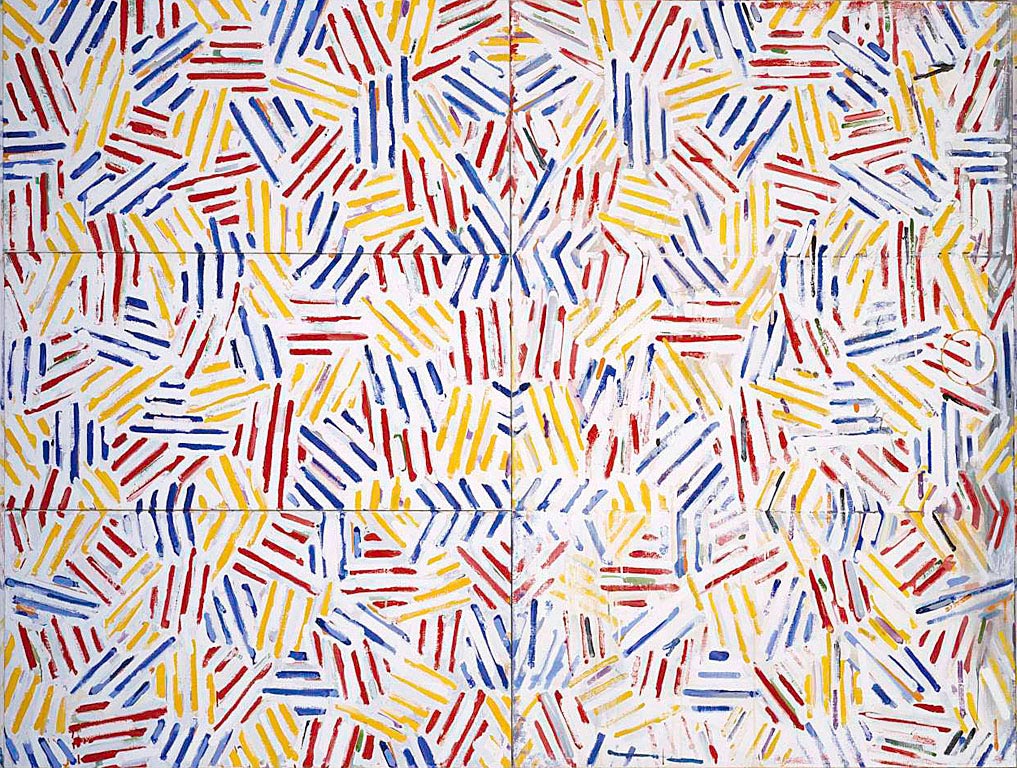
Jasper Johns, Corpse and Mirror II (1974-75)

(Some folks duck into a church in the noon hour—this is my church.)