music clip of the day

jazz/blues/rock/classical/gospel/more

Category: hard-to-peg

Wednesday, April 24th

passings

Richie Havens, January 21, 1941-April 22, 2013

“All Along The Watchtower” (B. Dylan), live, Mountain Jam (Hunter, N.Y.), 2009

**********

lagniappe

reading table

Nakamichi, 1892 (Japanese Death Poems, Yoel Hoffman, ed.)

Ice in a hot world:
my life
melts.

Tuesday, April 23rd

There seem to be two possibilities here. One is that you’ll find this mesmerizing, as I do. The other is that it’ll drive you bonkers.

Roscoe Mitchell, alto saxophone, live, Italy (Bologna, Angelica Festival), 2011

**********

lagniappe

reading table

Wang Wei (699-759), “Deer Park”
(translated from Chinese by Gary Snyder)

Empty mountains:
            no one to be seen.
Yet—hear—
            human sounds and echoes.
Returning sunlight
            enters the dark woods;
Again shining
            on the green moss, above.

Thursday, April 18th

keep on dancing

Hieroglyphic Being (AKA Jamal Moss), Imaginary Soundscapes (B1), 2013


Who knew electronic music could be so warm, so joyous?

Wednesday, April 17th

late yesterday afternoon

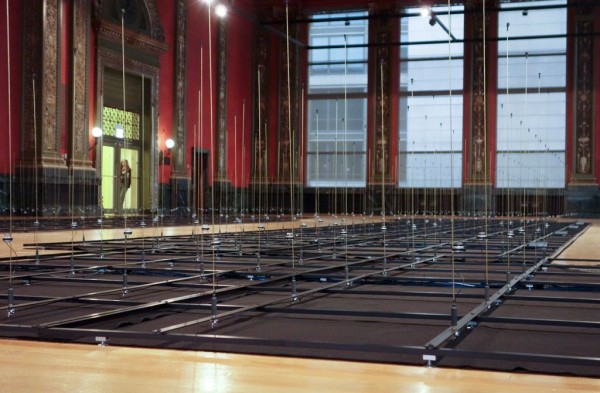
After a court hearing and a client meeting, I stopped at the Chicago Cultural Center, where this piece—on a scale many times larger than this—is installed through May 5th. One-word review: go.

Shawn Decker, Prairie

*****

As with an outdoor prairie, what the current installation looks like—and sounds like—depends on where you’re situated. Here’s one view:

Shawn-Decker-Prairie-wide-600x393

Wednesday, April 10th

two takes

Julius Eastman (1940-1990), Evil Nigger (1979)

Julius Eastman, Frank Ferko, Janet Kattas, Patricia Martin, pianos; live, Northwestern University (Evanston, Ill.), 1980 (Unjust Malaise, New World Records, 2005)

http://vimeo.com/58118363


*****

Jace Clayton, electronics; David Friend & Emily Manzo, pianos (The Julius Eastman Memory Depot, New Amsterdam Records, 2013)


**********

lagniappe

musical thoughts

Today’s composer, because of his problematical historical inheritance, has become totally isolated and self-absorbed. Those composers who have gained some measure of success through isolation and self-absorption will find that outside of the loft door the state of the composer in general and their state in particular is still as ineffectual as ever. The composer must become the total musician, not only a composer. To be only a composer is not enough.

Julius Eastman

*****

reading table

Ecstasy affords/the occasion and expediency determines the form.

—Marianne Moore (1887-1972), “The Past is the Present”

Tuesday, April 9th

passings

Les Blank, filmmaker, November 27, 1935-April 7, 2013

Always For Pleasure (1978)


**********

lagniappe

Les Blank, whose sly, sensuous and lyrical documentaries about regional music and a host of other idiosyncratic subjects, including Mardi Gras, gaptoothed women, garlic and the filmmaker Werner Herzog, were widely admired by critics and other filmmakers if not widely known by moviegoers, died on Sunday at his home in Berkeley, Calif. He was 77.

***

Mr. Blank, who received lifetime achievement awards from the American Film Institute and the International Documentary Association, did not think of himself as a documentarian, his former wife Chris Simon said, but rather as a filmmaker whose work happened to be about real people.

And his films are hardly standard documentary fare, dominated by archival footage and interviews with talking heads; nor are they of the Frederick Wiseman-D. A. Pennebaker fly-on-the-wall exposé school. Rather, the films, most of them less than an hour long, are “brilliantly sympathetic, well-crafted essays,” as John Rockwell wrote in The New York Times in 1979, rife with deftly framed portraiture, cunningly observed social scenes, beautiful nature photography and the poetic juxtaposition of imagery and sound.

“I think he’s a national treasure,” the director Taylor Hackford said in a telephone interview. “Although his films are not well known at the moment, they’ll take their place. Films are great when they live a long time, and I think Les’s will live.”

Mr. Blank trolled for subject matter on the American periphery, in cultural pockets where the tradition is long but the exposure limited. His films often have a geographic as well as cultural specificity, and food and music are often the featured elements. His musical subjects included norteño bands of the Rio Grande Valley in Texas, Cajun fiddlers of Louisiana and polka enthusiasts from across the country.

***

“You could call him an ethnographer; you could call him an ethnomusicologist or an anthropologist,” Mr. Hackford said. “He was interested in certain cultures that Americans are unaware of. He shot what he wanted, captured it beautifully, and those subjects are now gone. The homogenization of American culture has obliterated it.”

***

In 2007 Mr. Blank received the Edward MacDowell Medal, presented annually since 1960 by the MacDowell Colony in Peterborough, N.H., to an individual who has made an outstanding contribution to the arts. Its previous winners included Thornton Wilder, Robert Frost, Aaron Copland, Leonard Bernstein and only two film directors, the avant-gardist Stan Brakhage and the animator Chuck Jones. Mr. Hackford was the chairman of the jury, which included the directors Ken Burns, Steven Soderbergh, Mira Nair and Spike Jonze, as well as Thomas Luddy, a founder of the Telluride Film Festival.

“We all met in New York City, and I was expecting that we’d be discussing names like Francis, Marty, David Lynch and so on,” Mr. Luddy wrote in an e-mail. “Taylor Hackford spoke first and said we’d be talking about many of the obvious great names, but his candidate was Les Blank. He said that in 100 years his own films and many of the films by the big names may well be forgotten, but Les Blank’s films will be revered as time-capsule classics. I said ‘Amen,’ as did all the other members of the committee. We never even discussed another name, and our meeting was over in less than an hour.”

New York Times, 4/8/13

Saturday, April 6th

Composers, too, like singers, saxophonists, even drummers, have distinctive voices. Here’s one we haven’t heard in a while.

Morton Feldman (1926-1987), For Stefan Wolpe (1986), The Choir of Saint Ignatius of Antioch (Harold Chaney, cond.), Benjamin Ramirez & Thomas Kolor, vibraphones

**********

lagniappe

random thoughts

My father, gone since 1977, does he miss being alive?

Friday, April 5th

Jose James, “Do You Feel”
Live, KCRW Berkeley Street Session, Santa Monica, 12/17/12

**********

lagniappe

musical thoughts

R&B?

Jazz?

Pop?

We need a new vocabulary—or maybe none at all.

Thursday, April 4th

Feel like floating?

Steve Reich (1936-), Music for 18 Musicians (1974-76)
eighth blackbird, Third Coast Percussion, et al., live, Chicago, 2011

Wednesday, April 3rd

Rock drummers trying to play jazz usually sound like, well, rock drummers trying to play jazz. Jazz drummers trying to play rock are no different; they typically sound like tourists pretending to be natives. This guy, no matter the idiom (rock, jazz, gospel, whatever), sounds right at home.

Brian Blade and The Fellowship Band, live, Chicago, 3/14/13

**********

lagniappe

reading table

Maybe we think that nirvana is a place where there are no problems, no more delusions. Maybe we think nirvana is something very beautiful, something unattainable. We always think nirvana is something very different from our own life. But we must really understand that it is right here, right now.

—Taizan Maezumi, Appreciate Your Life (2001)