The power of conviction?
Look at that smile (1:35).
The Consolers (Sullivan & Iola Pugh [husband and wife])
“The Grace of God,” live (TV broadcast [TV Gospel Time]), early 1960s
***
“Waiting For My Child,” live
***
“I Feel Good,” live
**********
lagniappe
In its classic form, gospel was music designed to kill—to slay the congregation in spirit, moving them not just to laughter, tears, and hollers, but to screams and even seizures. The first woman who started shrieking was known, in the parlance of the gospel quartets, as “Sister Flute.” Big churches had volunteers in nurses’ uniforms to tend to the stricken.
Later these forces were unleashed on white teenagers, to memorable effect. Little Richard, Sam Cooke, James Brown, Aretha Franklin, Tina Turner, Marvin Gaye, Al Green—two whole generations of soul singers got their start and their sound in church. You know what they can do. And you know the idioms too: You set me free. You set my soul on fire. Have mercy. Help me now. I need you early in the morning/in the midnight hour/in the evening/to hold my hand. Not to mention that rock and roll standby: I feel all right.
But—at the risk of a) sounding like a Christian or b) stating the obvious—in gospel those words make a kind of sense they will never make in secular music. In gospel a grownup can perform them and mean them right down to the ground. The lyrics may not be much in themselves: as [Anthony] Heilbut writes, “the music’s success depended more on its singers than its songs.” But for all the group participation in gospel, for all its expression of communal feeling (and political protest), these songs deal very deeply with loneliness, abandonment, and death. They ask more of God than we can ask of one another. The very idea of “needing” the one you love may predate the gospel explosion, but it is a gospel idea.
—Lorin Stein, “The Gospel According To Gospel,” The Paris Review (blog), 7/2/10
In the wrong hands no genre is more tedious.
In the right hands none is more riveting.
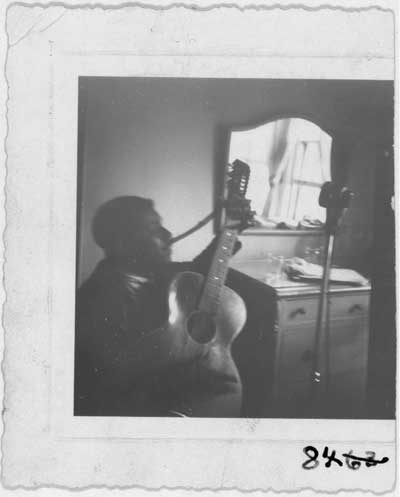
Robert Pete Williams, live, England, 1966
**********
going forward
It will still be “music clip of the day”—it just won’t be every day. Some weeks, I expect, I’ll be here nearly every day; other weeks less often. Stay tuned.
Looking for a soundtrack for today?
Daniel Lanois, guitar, 2010
(As with other clips, if you encounter brief interruptions when playing this clip, you can get rid of them by doing this: (1) start the clip at the beginning and then stop it immediately, so as to let the clip load completely; (2) once the clip is fully loaded, restart it.)
**********
lagniappe
Simple music is the hardest music to play.
—Albert Collins
**********
taking a break
After more than 300 consecutive daily posts, I’ve decided to take a little break. I shouldn’t be gone too long (probably a week or so). In the meantime, there’s plenty of wonderful music here. Enjoy!
replay: a clip too good for just one day
Great drummers are like great basketball players—they lift everybody’s game.
Trixie Whitley with Brian Blade (drums) and Daniel Lanois, “I’d Rather Go Blind,” recording session, 2008
lagniappe
Johnny [Vidacovich, featured on 9/30/09], man . . . what an inspiration. His playing is so liquid but at the same time just the street of it is so intoxicating. Studying with him, the drumming aspect was never about fundamental things. It was never about the drums as much as it was about the music and playing with this melodic sensibility. That sticks with me even more than the thickness or the groove, which he never spoke about, really. That was like a given. If you have it inside of you, that groove, you need to lay it down. But also need to be able to sing through the drums.—Brian Blade
(Originally posted on 2/13/10.)
two takes
“I Just Don’t Know What To Do With Myself” (Burt Bacharach & Hal David)
Dusty Springfield, TV broadcast, 1964
*****
The White Stripes, live, Australia, 2006
When the groove is strong enough, even the walls seem to sway.
Group Inerane, “Ano Nagarus,” live, Niger, 2004
recipe
1 cup funkiness
1 cup elegance
Mix until thoroughly blended.
Professor Longhair (AKA Henry Roeland [“Roy”] Byrd), December 19, 1918-January 30, 1980
“Tipitina,” live
*****
“Hey Little Girl,” live
**********
lagniappe
Mike Kinnamon, Bonnie Bramlett’s Nashville-based manager, in response to an email letting him (and Bonnie) know that her music was featured here (Delaney, alas, is no longer alive), left a voice-mail message yesterday:
. . . I just love it when somebody like you cares enough to send stuff like that around. It’s really cool, and it lifts her [Bonnie] up, too. Thank you so much, buddy . . .
Simple, subtle, soulful: blues is (as Artur Schnabel said of Mozart’s piano sonatas) “too easy for children, too difficult for adults.”
R.L. Burnside, “Goin’ Down South,” live, early 1970s, Mississippi
**********
lagniappe
musical thoughts
Music is the healing force of the universe.
—Albert Ayler
Music can be made anywhere—a street corner, a subway station, even a bathroom.
Shiyani Ngcobo
“The Bathroom Recordings,” live, France (Nantes), 1997
*****
“Izinyembezi” (Introducing Shiyani Ngcobo [2004])
**********
lagniappe
I’d like to make a plea for a new concept—elastic precision. It’s what [South African musician] Shiyani Ngcobo has, and what so many musicians have: an absolutely determined (in both senses of the word) and precise groove, with infinite, fractal variants that relate to what comes before and after. . . . Perfection may be infinitely seductive, but it’s the flaws and differences that make the beauty.
—Ben Mandelson, liner notes, Introducing Shiyani Ngcobo (2004)