The other night, as my older son Alex packed up his stuff for the next day’s trip back to school, this played on his computer—over and over and over.
The Mountain Goats, “This Year”
#1: recording (The Sunset Tree), 2005
Vodpod videos no longer available.
***
#2: live, Iowa (Ames), 2006
Vodpod videos no longer available.
**********
lagniappe
art beat
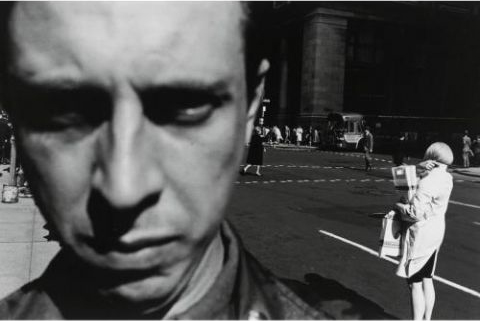
Lee Friedlander, New York City (Self-Portrait), c. 1960(?)
*****
More Son Seals
Last night I discovered that two of the sets Son played at the Bottom Line in January of 1978 can be heard here and here. The second features a guest
artist—Johnny Winter.
Back in the ’70s, when I was at Alligator Records, I worked with this guy—coproducing albums, booking live performances, traveling to New York for a series of “showcase” performances (little pay, big exposure) at the Bottom Line (opening for Buddy Guy & Junior Wells). But I was a fan before that. In college I had a weekly radio show, where I often played his first album, released in 1973. Now, like so many others I worked with (Hound Dog Taylor, Big Walter Horton, Fenton Robinson, Koko Taylor, Albert Collins, et al.), he’s gone.
Son Seals, August 13, 1942-December 20, 2004
“I Think You’re Fooling Me,” live (TV broadcast), 1987
Vodpod videos no longer available.
***
“Your Love Is Like A Cancer” (The Son Seals Blues Band, Alligator, 1973)
Vodpod videos no longer available.
**********
lagniappe
reading table
for . . . Son Seals, who left to work a better room
It might be thought the height of poor taste to ascribe good fortune to a healthy man with a young family struck down at the age of sixty by an incurable degenerative disorder from which he must shortly die. But there is more than one sort of luck. To fall prey to a motor neuron disease is surely to have offended the Gods at some point, and there is nothing more to be said. But if you must suffer thus, better to have a well-stocked head.
The Consolers (Sullivan & Iola Pugh [husband and wife])
“The Grace of God,” live (TV broadcast [TV Gospel Time]), early 1960s
***
“Waiting For My Child,” live
***
“I Feel Good,” live
**********
lagniappe
In its classic form, gospel was music designed to kill—to slay the congregation in spirit, moving them not just to laughter, tears, and hollers, but to screams and even seizures. The first woman who started shrieking was known, in the parlance of the gospel quartets, as “Sister Flute.” Big churches had volunteers in nurses’ uniforms to tend to the stricken.
Later these forces were unleashed on white teenagers, to memorable effect. Little Richard, Sam Cooke, James Brown, Aretha Franklin, Tina Turner, Marvin Gaye, Al Green—two whole generations of soul singers got their start and their sound in church. You know what they can do. And you know the idioms too: You set me free. You set my soul on fire. Have mercy. Help me now. I need you early in the morning/in the midnight hour/in the evening/to hold my hand. Not to mention that rock and roll standby: I feel all right.
But—at the risk of a) sounding like a Christian or b) stating the obvious—in gospel those words make a kind of sense they will never make in secular music. In gospel a grownup can perform them and mean them right down to the ground. The lyrics may not be much in themselves: as [Anthony] Heilbut writes, “the music’s success depended more on its singers than its songs.” But for all the group participation in gospel, for all its expression of communal feeling (and political protest), these songs deal very deeply with loneliness, abandonment, and death. They ask more of God than we can ask of one another. The very idea of “needing” the one you love may predate the gospel explosion, but it is a gospel idea.
Sullivan Pugh, interview, “May The Work I’ve Done Speak For Me”
Vodpod videos no longer available.
***
Sullivan Pugh was born in Moorhaven, Florida in 1925. When his mother was killed in the 1926 Lake Okeechobee hurricane, Pugh and his five siblings were adopted by a family in the community of Punta Gorda. Pugh began singing as a child soloist at the First Born Church of the Living God in Miami.
He met his wife lola when she was singing with the Miami Gospel Singers. The couple married in 1950. In 1952 the pair decided to form a gospel trio with Pearl Nance-Rayford, and they called themselves the Miami Soul Stirrers. Their original repertoire was based on the traditional spirituals and songs of the Holiness Church. Early influences included other African American gospel groups such as the Soul Stirrers of Chicago (from which they took their name) and the National Gospel Twins of Delray Beach, Florida. In 1953, Nance-Rayford quit the trio and Sullivan and lola took the name The Spiritual Consolers for their duet.
During the early period of their careers, the Pughs sang for both the Glory and DeLuxe recording labels. In 1955 they signed with Nashboro Records in Nashville, Tennessee and shortened their name to The Consolers. Their first recording with Nashboro was “Give Me My Flowers.” “Flowers” would remain their best selling recording and signature song.
For forty years Sullivan and lola Pugh were considered among the elite traditional African American gospel performers in America. During this period they sang on numerous single releases and produced twenty-five albums. They performed concerts in the Bahamas, England, Africa, Canada, and throughout the United States. Favorite southern gospel performers, The Consolers performed at countless church conventions and camp meetings in Florida, Their blended vocals along with Sullivan’s guitar playing were considered trademarks in the world of gospel music. A gifted composer, Pugh wrote many of the songs heard on their recordings and in concert.
lola Pugh died in October 1994. Sullivan Pugh remains a member of his childhood church in Miami. He is actively involved with The Consolers Progressive Charity Club which assists the needy. Pugh continues to sing and participate in community and church activities.
The Consolers’ “Waiting For My Child,” released in the early ’60s and written by Sullivan, was covered a couple years ago by Mavis Staples and Patty Griffin.
James Brown, “I Got You (I Feel Good),” live (TV broadcast), c. 1965
Vodpod videos no longer available.
Like Lester Young and Charlie Parker and John Coltrane, James Brown floats over the bar lines, defying, as he dances, the gravitational pull of the downbeat.
[I]nside New Orleans, the genius of sissy bounce is how perfectly mainstream it is; in the world beyond, the genius of sissy bounce is how incredibly alternative it is.
***
The first of Freedia’s three successive New York gigs in May began with a preshow bounce dance class, which should give you some idea of how far from home Freedia and [Freedia’s D.J. and de facto manager Rusty] Lazer were. But “every night it got better,” Freedia said. “They was all on the Internet, posting up the pictures, like ‘If you missed last night, OMG, you missed a party.’ Each night it built, and the last night” — at a traveling dusk-to-dawn festival known as Hoodstock, held on this occasion in a raw space in the Bed-Stuy neighborhood of Brooklyn — “it was just unbelievable. Five hundred people in there. Everybody was dripping wet. The walls was dripping wet.”
Any doubt that that space, like any space in which Freedia performs, quickly belonged to the women in the crowd may be dispelled by a story Lazer laughingly told about a blog post he’d seen the day after their Hoodstock set. It consisted of two photos taken at the show, and their captions: in the first, a group of women were horizontally p-popping in what amounted to a flesh pile. “To the men,” the caption beneath it read, “we don’t need you.” The second photo depicted a woman at the same show sitting on the floor while a man prone in front of her performed a sexual act that might traditionally be described as submissive. “But we like having you around,” the caption beneath that one read.
What strikes Lazer most about the dynamic at these shows, though, is not how unexpected it is but how familiar. Long before he started D.J.-ing, he was a drummer in a series of rock bands; he is old enough to have come of age in the latter days of punk. And when he started playing shows with Freedia almost two years ago — when he started witnessing, over and over again, a same-sex group taking over the dance floor in order to perform an ecstatic act of physical aggression that is both exceptionally demanding and socially unacceptable in other contexts, at the behest of music that’s ritualized and played at seemingly impossible tempos — it all began to remind him of something.
“It’s as if punk had been reinvented for women,” he said, smiling. “I remember going to punk shows when I was 13, slam-dancing, stage-diving. It was a kind of reckless abandon, something you really couldn’t stop yourself from doing. If the girls weren’t just outright afraid of being in there, there was somebody literally shoving them out of the way. Now it’s exactly what was happening when I was young, but in reverse: the girls literally push the dudes right out of the middle. It’s just pure empowerment, physical aggression that’s not spiteful or vicious. I think it’s no accident that the slang term for a gay kid in New Orleans is ‘punk.’ It’s pretty rewarding.”
 music clip of the day