music clip of the day

jazz/blues/rock/classical/gospel/more

Category: guitar

Wednesday, 3/23/11

More Lester

The world became a less interesting place the day Lester Bowie died.

Digable Planets with Lester Bowie (trumpet), Joe Sample (keyboard), Melvin “Wah-Wah Watson” Ragin (guitar), “Flying High in the Brooklyn Sky,” live

**********

lagniappe

Part of the job of a musician is that of a messenger. If you ain’t ready to be a messenger, forget it. You need to get a job in the post office or somewhere. If you ain’t ready to travel, pack up your family, or pack up yourself and hit the road, you’re in the wrong business. Because that’s what music is about. It’s about spreading knowledge and education, and re-education. It’s about spreading. You have got to travel with it to spread the word. Like all the people in the past that have had to travel to spread the music.

*****

It’s life itself that this [music] is about.

—Lester Bowie (in George E. Lewis, A Power Stronger Than Itself: The AACM and American Experimental Music [2008])

(Previously posted 10/28/09.)

Sunday, 3/20/11

Sherman Washington Jr. (Zion Harmonizers)
December 13, 1925-March 14, 2011

Zion Harmonizers with Aaron Neville, “Wonderful,” live, New Orleans (Gospel Tent, New Orleans Jazz & Heritage Festival), 1991

Vodpod videos no longer available.

*****

lagniappe

Sherman Washington Jr., the leader of the Zion Harmonizers and the godfather of the New Orleans Jazz and Heritage Festival’s Gospel Tent, died early Monday at his home in Boutte after a long illness. He was 85.

sherman washington 2002 fest.jpg

What Ellis Marsalis is to jazz, Mr. Washington was to gospel. For three decades, he hosted a Sunday morning gospel show on WYLD-AM that served as the gospel community’s town hall. He led the Zion Harmonizers, New Orleans’ longest-running gospel vocal group, since the 1940s. The Harmonizers appeared at the very first Jazz Fest, staged in 1970 in what is now Armstrong Park.

After the festival moved to the Fair Grounds in 1972, he oversaw the growth of the Gospel Tent, building it into a cornerstone of the festival’s roots-music presentation. The tent introduced a music largely unknown outside the African-American churches where it was born to a much broader audience.

Until deteriorating health finally slowed him down in recent years, he administered the Gospel Tent with a steadfast integrity and intimate knowledge of the music, musicians and singers. Given that many acts consist of large choirs, the tent features more performers than any other stage at the festival.

“Gospel, even after jazz and blues came down to the front of the bus, was still in the back of the bus,” said Jazz Fest producer/director Quint Davis. “To a large extent, Sherman’s work through the Gospel Tent has helped bring gospel music to the front of the bus. An enormous debt is owed to him by the festival, and the whole gospel world.”

Davis expects the upcoming Jazz Fest to feature a tribute to Mr. Washington.

“You can talk about soul with either a lower-case ‘s’ or an upper-case ‘S,'” Davis said. “Sherman had soul with a capital S.”

***

In the late 1960s, the Harmonizers roster included a Mississippi-born bass singer named John Hawkins. In early 1970, Hawkins met Quint Davis at Mason’s Hotel on Claiborne Avenue and came back to Mr. Washington with news of this young music fan who was organizing a music and heritage festival.

Mr. Washington went to meet Davis and partner Allison Miner, and the Zion Harmonizers were booked for the first Jazz Fest at Congo Square. The forerunner of today’s Gospel Tent was a 15-by-20-foot open-sided tent with an upright piano and no floor, stage or sound system.

When Jazz Fest moved to the Fair Grounds in 1972, Davis approached Mr. Washington with an idea.

“Quint said, ‘I had a dream,’” Mr. Washington recalled. “And I thought, ‘This isn’t Dr. King, is it?’ He said, ‘I had a dream that I’m going to build a Gospel Tent, and I want you to run it.’ ”

Mr. Washington’s diplomatic skills came in handy. In the early 1970s, gospel choirs rarely performed outside of churches or church functions. They certainly didn’t perform at “hippie” events where beer was served. Pastors resisted the idea of choirs performing at Jazz Fest.

“The preachers were against me,” Mr. Washington said, “because people would drink beer in the Gospel Tent. I would ask the choir’s president or manager, and he’d tell me yeah. Then he’d come back and say, ‘Our pastor doesn’t want us to sing in the Gospel Tent.’ ”

So instead of church choirs, Mr. Washington booked vocal quartets that weren’t affiliated with churches.

“Those are the ones I had to depend on,” he said. “They would tear the place up, pack it out. We didn’t pay those preachers no mind. We kept going.”

Opinions eventually changed and choirs lobbied Mr. Washington to be included. “I think the choir members got on the pastors about it. Because if a person drinks a beer or something, that’s their soul, not yours. If you’re singing, you’re doing what God wants you to do.”

Eventually, a small staff was assigned to assist Mr. Washington, but he still screened most acts in person. He attended rehearsals and private auditions, offering advice along the way.

“He had never been in a role like this,” Davis said. “He was a true man of God who was not in it to advance himself or build an empire. He worked through his community and spiritual connections to put it all together. He knew who was the real deal, who needed to play.”

Mr. Washington insisted on a high level of professionalism and skill, as he knew any group could well be some Jazz Fest’s attendee’s first exposure to gospel. He wanted the music to make a good first impression.

“This Gospel Tent has brought more white people to gospel than anybody had ever seen, ” Mr. Washington said in 2002. “Now, it’s more white people than black people. And they get into it. It brings the white and black together. People get together and stand up, you don’t know who is who.”

—Keith Spera, The Times-Picayune (New Orleans), 3/14/11

On March 14, 2011 at 2:36 AM, the music stopped and his lyrics became a reality.

Obituary (The Times-Picayune)

*****

listening room: what’s playing

• Bach, Cello Suites, Steven Isserlis, Jean-Guihen Queyras

• Von Freeman, Walkin’ Tuff, Vonski Speaks, Young & Foolish

• Milton Babbitt, Piano Works, Robert Taub

• Buddy & Julie Miller, Written in Chalk

Nneka, Concrete Jungle

Jason Moran, Ten

Steve Lehman, Travail, Transformation, and Flow

Friedrich Gulda, Piano Recital 1959 (Bach, Haydn, Beethoven)

• Theo Parrish, First Floor

• Theo Parrish, Sound Sculptures, Vol. 1

• Roger Sessions, Works for Violin, Cello, Piano; Curtis Macomber (violin), Joel Krosnick (cello), Barry David Salwen (piano)

• Roger Sessions, Sonatas Nos. 1 & 3; Ralph Shapey, Mutations and Mutations II, 21 Variations, David Holzman (piano)

• Yascha Heifetz (violin), Chamber Music Collection, Vol. 1 (Mozart, et al.)

• Morton Feldman, For Bunita Marcus, Stephane Ginsburgh (piano)

Sinner’s Crossroads, Kevin Nutt, WFMU-FM (Thursday, 8-9 p.m. [EST])

Gospel Memories, Bob Marovich, WLUW-FM (Saturday 10-11 a.m. [CST])

Give the Drummer Some, Doug Schulkind, WFMU-FM (Friday, 9 a.m.-noon [EST]; web stream only)

Bird Flight, Phil Schaap, WKCR-FM (M-F, 8:20-9:30 a.m. [EST])

• WFMU-FM, Annual Fundraising Marathon

Saturday, 3/19/11

Sometimes, when the world just seems too noisy, too busy, what you need is something that couldn’t be simpler.

Slim Harpo, “Rainin’ In My Heart” (1961)

Vodpod videos no longer available.

Friday, 3/18/11

Original?

Nah.

But, uh, who cares?

The Hives, “Hate To Say I Told You So,” live, France (Belfort), 6/30/07

*****

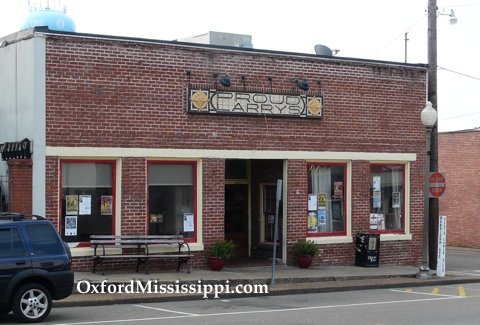
Many of my most vivid musical experiences were the product of serendipity. A few years ago, I spent a long weekend in Oxford, Mississippi, where, as it turned out, these guys had just finished recording an album. Saturday night, as a farewell, they played a little club off the Square. Floor-rumbling, bone-rattling loud they were—and a whole lotta fun.

Proud Larry’s, Oxford, Mississippi

*****

Tuesday, 3/15/11

Big Jack Johnson, July 30, 1940-March 14, 2011

Live (Deep Blues, 1992)

“Catfish Blues”

Vodpod videos no longer available.

***

“Daddy, When Is Mama Coming Home”

Vodpod videos no longer available.

**********

lagniappe

art beat

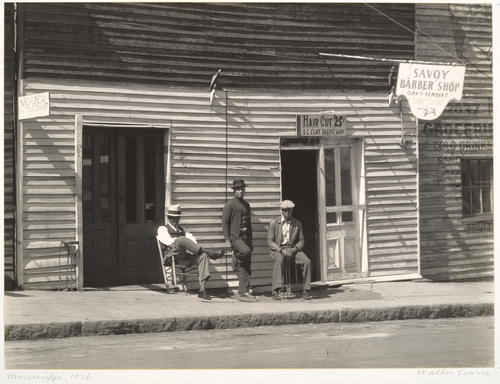
American Modern: Abbott, Evans, Bourke-White
Art Institute of Chicago (through 5/15/11)

Walker Evans, Barbershops, Vicksburg, Mississippi (1936)

Friday, 3/11/11

Don’t try to tell me there’s anything incongruous—anything at all—in loving Beethoven and loving Chopin and loving Del Shannon.

Del Shannon, December 30, 1934-February 8, 1990

“Runaway” (with Burton Cummings [Guess Who], piano), 1982

Vodpod videos no longer available.

***

“I Go To Pieces,” 1988 (?)

Vodpod videos no longer available.

***

“Sea of Love,” 1982

Vodpod videos no longer available.

**********

lagniappe

mail

One of the best ever [Ornette Coleman, 3/9/11].

I am so glad I am on this list!!

Thursday, 3/10/11

Happy (108th) Birthday, Bix!

God the poet, the master of metaphor, wanting to comment on what a big, open, unruly country this is, put the birthdays of Ornette Coleman, born in 1930 in Fort Worth, Texas, and Bix Beiderbecke, born in 1903 in Davenport, Iowa, back to back.

Bix Beiderbecke, cornet, with Frankie Trumbauer and His Orchestra
“I’m Coming, Virginia,” “Way Down Yonder In New Orleans,” 1927

Vodpod videos no longer available.

**********

lagniappe

Speaking of Bix’s playing, Louis Armstrong said:

Those pretty notes went right through me.

*****

. . . “I’m Coming, Virginia” became the most beautiful thing in my life . . . The coherence of its long Bix solo still provides me with a measure of what popular art should be like: a generosity of effects on a simple frame. The melodic line is particularly ravishing at its points of transition: there are moments when even a silent pause is a perfect note, and always there is a piercing sadness to it, as if the natural tone of the cornet, the instrument of reveille, were the first sob before weeping.

—Clive James, London Times, 5/16/07

*****

radio

Yesterday, at WKCR-FM (broadcasting from Columbia University), it was all Ornette all day; today it’s Bix. (Listening to so much Ornette seems to have rearranged my brain cells—permanently, I hope.)

(Some of this was previously posted on Bix’s last birthday.)

Wednesday, 3/9/11

Happy (81st) Birthday, Ornette!

His sound—his whole approach (simple melodies, vocal phrasing, off-center intonation)—is drenched in the blues.

Ornette Coleman (alto saxophone) with The Roots
Live, London (Meltdown Festival), 2009

#1

Vodpod videos no longer available.

***

#2

Vodpod videos no longer available.

The tenor player at the end—that’s David Murray.

More Ornette? Here.

**********

lagniappe

radio

What am I listening to today?

That’s easy—WKCR-FM (broadcasting from Columbia University), where it’s all Ornette all day.

Tuesday, 3/1/11

More Von

The other night, during a performance and interview at the University of Chicago, he seemed, at times, a bit frail. He’s nearing 90 and was recently in the hospital. But what I said a while back still holds true: no tenor player moves me more.

Von Freeman (tenor saxophone, with Mike Allemena, guitar; Matt Ferguson, bass; Michael Raynor, drums), “Bewitched, Bothered and Bewildered,” live, Chicago (Mandel Hall, University of Chicago), 2/24/11

Vodpod videos no longer available.

More? Here. And here. And here.

**********

lagniappe

better late, etc.

The University of Chicago recently awarded Von the Rosenberger Medal, which “was established in 1917 . . . [and recognizes] achievement through research, in authorship, in invention, for discovery, for unusual public service, or for anything deemed of great benefit to humanity.” Past recipients include Toni Morrison, Pierre Boulez, and Frederick Wiseman.

*****

musical thoughts

It takes years to explain those vibrational things in verbal language. And it still might not work. One time I asked Von Freeman about his voice-leading in harmony, he’s the master of that shit. I asked him, “How did you learn that shit? You’re so fluent at it.” And he said, “Well, you know, I sat down one day and I said, let me look at this thing.” He said, “I began with one tone. I studied one tone. And I studied all that I could study about one tone.” When these old guys talk, you don’t ask too many questions. You pretty much just listen to what they say. And so, I didn’t know what he meant, but I just listened. And he said, “I worked on that for a long time, you know, for months. Just seeing what could be done with one tone. When I felt pretty good about that, I moved on to two tones. That was a bit harder. I worked a lot longer, but I worked and saw all that I could do with two tones. Then I moved to three tones, and so on. After I went on for a while I realized that you can pretty much do everything that you need to do with two tones.” That’s what he told me. I spent years thinking about this shit. Years. I’m still thinking about it, you know. I feel like I have a better handle on knowing what he meant now than then, although it is not a simple thing to explain. And when I tell the story to somebody playing in my group or something, and they ask me, “What did he mean?” it takes me literally years to explain what I think he means. And I’m sure I only have part of what he means. What it means to me. Some things, you have to explain them with a million examples over a period of time. The meaning dawns on a person and when they have to explain it it’s funny. We live in this McDonald’s type society where everybody thinks everything is just quick. It’s not like that. You have to actually build the understanding, slowly over time. So this thing that Von Freeman explained to me, it sounds like a very simple thing, but it really doesn’t make any sense at all without the experience. It’s maybe fifteen years ago that he told me, and I found it to be absolutely true. I could never explain it in one day, or in a lecture over an hour.

Steve Coleman (whose latest album was named one of the year’s ten best in the 2010 Village Voice Jazz Critics’ Poll)

*****

my back pages

No other musician, in any genre, has meant so much to me in so many ways for so many years. I first heard Von in the mid-70s, when I was in my twenties (and working for Alligator Records) and he was in his fifties. The setting, coincidentally, was the University of Chicago; he opened for Cecil Taylor. I got to know him and booked a few shows for him. In 1977, when I got married, he and pianist John Young played at our wedding ceremony. Later, when I was reviewing live jazz, I wrote a piece about him for the Chicago Reader. Over the last three decades, I’ve listened, avidly, to his growing catalog of albums and seen him live more times than I could count. He is now an old man. And I am getting there.

Monday, 2/28/11

When something is this lyrical, this convincing, there’s only one thing I want to do when it ends—hear it again.

Michael Burks, “Empty Promises,” live, Falls Church, Virginia, 8/21/09

Vodpod videos no longer available.