music clip of the day

jazz/blues/rock/classical/gospel/more

Category: guitar

Friday, 4/29/11

When you’re young you can’t imagine that the things that make your life sing won’t always be there. Then you get older. And they aren’t.

Hound Dog Taylor & The Houserockers (Brewer Phillips, guitar; Ted Harvey, drums), “Sadie,” live, Ann Arbor Blues Festival, 1973

More? Here.

**********

langiappe

mail

This arrived yesterday, in response to an email letting her know that she was featured here (with Hazel Dickens):

Thanks for letting me know about this.  We said goodbye to Hazel yesterday and singing was never more difficult.  She was my musical guide and my beloved friend.  Smart, funny, complicated, always real.   She’ll live in my music, and my life, forever.  “Fly away, Little Pretty Bird.”

Ginny

***

Hazel Dickens, “Pretty Bird,” 1967

Vodpod videos no longer available.

Thursday, 4/28/11

Yesterday we heard music of “nostalgia” and “homesickness,” of “loneliness” and “separation,” from Mali. Today it comes from West Virginia.

Hazel Dickens, singer, songwriter
June 1, 1925-April 22, 2011

Live, with Ginny Hawker, vocals, and Tracy Schwartz, fiddle

“West Virginia My Home” (H. Dickens), Kentucky (Morehead State University), 2008

Vodpod videos no longer available.

***

I Love To Sing The Old Songs” (H. Dickens), 2008

Vodpod videos no longer available.

**********

lagniappe

Hazel Dickens, a clarion-voiced advocate for coal miners and working people and a pioneer among women in bluegrass music, died on Friday in Washington. She was 75.

The cause was complications of pneumonia, said Ken Irwin, her longtime friend and the founder of Rounder Records, her label for more than four decades.

Ms. Dickens’s initial impact came as a member of Hazel and Alice, a vocal and instrumental duo with Alice Gerrard, a classically trained singer with a passion for the American vernacular music on which Ms. Dickens was raised. Featuring Ms. Dickens on upright bass and Ms. Gerrard on acoustic guitar, Hazel and Alice toured widely on the folk and bluegrass circuits during the 1960s and ’70s, captivating audiences with their bold, forceful harmonies and their empathetic approach to songs of struggle and heartbreak.

***

The influence of the staunchly traditional duo extended beyond bluegrass to commercial country music. Hazel and Alice’s arrangement of the Carter Family’s “Hello Stranger” became the blueprint for Emmylou Harris’s version of the song, and their adaption of “The Sweetest Gift (A Mother’s Smile)” inspired Naomi Judd, then a single mother in rural Kentucky, to start singing with her daughter Wynonna.

***

Hazel Jane Dickens was born June 1, 1935, in Mercer County, W.Va. One of 11 children, she grew up in a family whose survival depended on the coal industry. Her father, a Primitive Baptist preacher and a forceful singer, hauled timber to feed the household. Her brothers were miners and one of her sisters cleaned house for a supervisor at the mines. The music they sang in church and heard on the radio, particularly the music of the Grand Ole Opry in Nashville, offered one of their few diversions.

She moved to Baltimore in the early 1950s and worked in factories there. City living was hardly more prosperous than the life she’d known in the coal fields of Mercer County, but it did afford her exposure to the larger social and political world. She met and started playing music with the singer and folklorist Mike Seeger, who eventually introduced her to Ms. Gerrard.

***

A reluctant feminist role model, Ms. Dickens said she was originally scared to write about issues like sexism and the oppression of women.

“I can remember the first time I sang ‘Don’t Put Her Down, You Helped Put Here There,’ ” she said in her 1999 No Depression interview. “I was at a party standing in the middle of all these men. It was here in Washington. Bob Siggins was playing banjo, and when I got done, everyone just looked at each other, and Bob said, ‘That’s a nice song, but I won’t be able to sing it.’ And I said, ‘Of course you can.’ ”

“We were writing about our own experience,” she explained. “They were things we needed to say.”

—Bill Frisksics-Warren, New York Times, 4/23/11

Wednesday, 4/27/11

more sounds from the desert

Tinariwen, “Cler Achel,” live, London, 2007

Vodpod videos no longer available.

**********

lagniappe

The desert is where I feel the most comfortable, the most at ease, the most relaxed. It’s also where I’m inspired to create music. To be honest, I don’t like spending too long away from the desert now. Well, that’s to say, I still like touring and travelling and seeing different parts of the globe, but I also like to be at home. And in the desert there are a lot of people who can help us . . . by hiring us a house, by cooking, by playing music with us. We can’t take all those people with us if we go and record in Bamako or Paris.

***

Assouf means nostalgia, homesickness. We’ve all felt it a lot, ever since the time of exile began after the first [Tuareg] rebellion in 1963. It’s the feeling that is most important in our music. But it also means other things. It’s like a pain that you can’t see and can’t touch, a pain that lives in your heart. It means loneliness and separation too. When I was living in Algeria and Libya in the 1980s and 1990s I felt assouf a lot, and that’s when I wrote a lot of the songs I play today.

***

In the desert, everybody is always moving. That’s our culture. It’s very very hard sometimes to get together, or to stay in the same place. We need our freedom. So Tinariwen has survived because really almost every Tamashek musician in the northeast of Mali or the south of Algeria is part of Tinariwen. And if just two of them come together to sing our songs, that’s enough for it to be Tinariwen. In the past, that’s how our concerts happened. Hassan and Abdallah might perform in Bamako or Abidjan while I was hundreds of miles away in Tamanrasset or someplace. So I know that some people have been frustrated for example when I haven’t been present on stage in America. But that’s how Tinariwen has always been, loose and flexible. Otherwise we could never survive.

Ibrahim Ag Alhabib (songwriter, singer, guitarist)

Saturday, 4/23/11

The Heart asks Pleasure – first –

—Emily Dickinson (588, excerpt)

Steve Reich, Bang on a Can All-Stars (Robert Black, bass; David Cossin, drums; Evan Ziporyn, piano; Bryce Dessner & Derek Johnson, guitars)
Rehearsal, 2×5 (S. Reich), 2009

Vodpod videos no longer available.

More? Here. And here.

**********

lagniappe

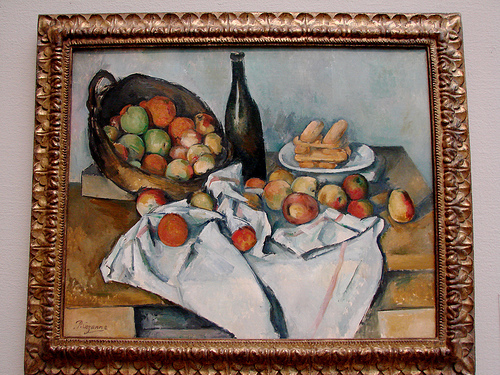
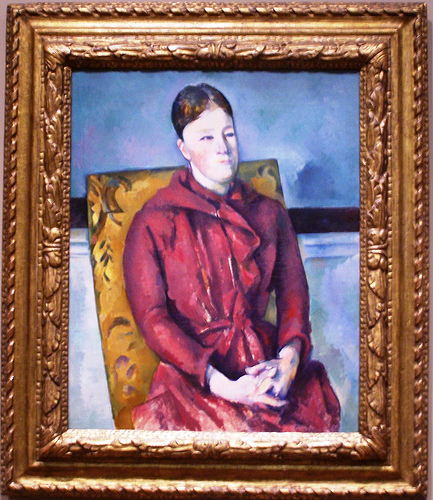
art beat: Art Institute of Chicago

A sea of Cezanne’s blues surrounds The Bay of Marselleilles, Seen From L’Estaque (4/18/11).

Here’s what’s on its left.

Paul Cezanne, Madame Cezanne in a Yellow Chair, 1888-90

***

Here’s what’s on its right.

Paul Cezanne, The Basket of Apples, c. 1893

***

And here’s what’s on the adjacent wall.

Paul Cezanne, Harlequin, 1888-90
(on loan from the National Gallery of Art, Washington, D.C.)

***

I still work with difficulty, but I seem to get along. That is the important thing to me. Sensations form the foundation of my work, and they are imperishable, I think. Moreover, I am getting rid of that devil who, as you know, used to stand behind me and forced me at will to “imitate”; he’s not even dangerous any more.

—Paul Cezanne (last letter to his son Paul, dated October 15, 1906, a week before his death; quoted in Ambroise Vollard, Cezanne)

*****

Art ______ of Chicago

In the department of duh, after decades of going there and decades of listening to them, I’ve just noticed the verbal similarity between the Art Institute of Chicago and the Art Ensemble of Chicago.

Thursday, 4/21/11

three takes

I’ve heard, mainly through my (19-year-old) son Luke, more hip-hop tracks celebrating weed (and other stuff) than I could count. Here’s a different take.

Macklemore, “Otherside”

Live, Seattle (Bumbershoot), 2009

Vodpod videos no longer available.

***

Live, radio broadcast, Seattle, 2009

Vodpod videos no longer available.

***

Recording, 2009

Vodpod videos no longer available.

More? Here.

Tuesday, 4/19/11

can’t wait
(an occasional series)

Bombino (AKA Omar Moctar, Goumar Almoctar, Bambino)
Chicago (Millennium Park), 7/11/11

More desert guitar.

Live, Niger

#1

Vodpod videos no longer available.

***

#2

Vodpod videos no longer available.

More? Here.

Monday, 4/18/11

can’t wait
(an occasional series)

Group Doueh, Chicago (Old Town School of Folk Music), 6/26/11

Live, Europe, 2009

Vodpod videos no longer available.

***

Doueh (guitar), Tony Allen (drums)
Live, rehearsal, Western Sahara (Dakhla), 2010

Vodpod videos no longer available.

More Group Doueh? Here. More Tony Allen? Here.

**********

lagniappe

I live in Dakhla [in Western Sahara]. There are other groups in the area, but Group Doueh is the main group for this area. We are the most in demand group for weddings and parties.

***

The power of Jimi Hendrix’s guitar is something that is inspirational on so many levels.

***

The main group is myself on guitar and tinidit. My wife Halima and friend Bashiri are the vocalists. My son Jamal is the keyboardist. There are also many percussionists that play with us from time to time. Also other singers will perform with us depending on who is available for certain weddings or parties.

***

For many years, most of our material was recorded on cassette. I have had many cassette recorders, some two-track, four-track and eight-track models. Now I am able to record digitally to a 16-track model. I am always experimenting to get the best situation. We always record at home and we record all of our performances.

***

[T]here really is no [music] industry [in Western Sahara]. I am an industry unto myself. I record music and have two shops that sell music to the community. Most of the recordings are done at home in makeshift studios, and cassettes or CDs are sold throughout the region.

Doueh (AKA Baamar Salmou)

*****

art beat: yesterday at the Art Institute of Chicago

Paul Cezanne, The Bay of Marselleilles, Seen From L’Estaque, c. 1885

The greatest jazz musicians—Miles Davis, Ornette Coleman, Von Freeman, et al.—can be identified by just one note. Cezanne’s that way, too. His blues are all his own.

Friday, 4/15/11

There’s nothing quite like riding a train that feels like it’s going to run off the rails and yet, somehow, it doesn’t.

Mike Watt + the Missingmen (MW, bass & vocals; Tom Watson, guitar & vocals; Raul Morales, drums), with guests (Joe Biza, guitar; Bob Lee, drums), “The Red and the Black,” live, Los Angeles (Safari Sam’s, Hollywood), 3/31/07 (benefit for musician Richie Hass)

Vodpod videos no longer available.

Wednesday, 4/13/11

what’s new
an occasional series

The future of hip-hop?

Odd Future (with The Roots), “Sandwitches,” live (TV broadcast), 2/16/11

Vodpod videos no longer available.

**********

lagniappe

reading table

The bad news is the ship hasn’t arrived;
the good news is it hasn’t left yet.

—John Ashbery, “He Who Loves And Runs Away” (excerpt; Planisphere [2009])

*****

radio

WKCR-FM (broadcasting from Columbia University) will be playing the music of jazz violinist Billy Bang, who died Monday night, all day.

Monday, 4/11/11

energy + delicacy = kinetic beauty

Rashied Ali, drums
Don Cherry, pocket trumpet
James Blood Ulmer, guitar

Live (TV broadcast, Sweden), 1978

Vodpod videos no longer available.

More Don Cherry? Here.

I interviewed Rashied in 2008 just before he died, and he showed me this clip on his Mac. He was psyched that it was up on YouTube.

—YouTube comment

**********

lagniappe

art beat

Paul Cezanne, Study of Trees (c. 1904)
Arthur M. Sackler Museum, Harvard University, Cambridge, Massachusetts