flashback, n.1. An unexpected recurrence of the effects of a hallucinogenic drug long after its original use. 2. A vivid memory that arises spontaneously or is provoked by an experience. 3. An experience that has characteristics of an earlier experience.
Jimmie Lunceford and his Dance Orchestra, “Rhythm Coming to Life Again,” “Rhythm Is Our Business,” “You Can’t Pull the Wool Over My Eyes,” “Moonlight on the Ganges,” “Nagasaki,” “Jazznochracy,” 1936
Bill Frisell (guitar) with Tony Scherr (bass) & Kenny Wollesen (drums)
Live, Rochester (NY), 2007
***
The Delfonics, 1968
(First clip originally posted 5/28/10.)
**********
lagniappe
reading table
And this disease which was Swann’s love had so proliferated, was so closely entangled with all his habits, with all his actions, with his thoughts, his health, his sleep, his life, even with what he wanted after his death, it was now so much a part of him, that it could not have been torn from him without destroying him almost entirely: as they say in surgery, his love was no longer operable.
—Marcel Proust, Swann’s Way (translated from French by Lydia Davis)
Dan Penn (guitar, vocals) & Spooner Oldham (keyboards), TV show, 1999
***
This is one of the sadder, and stranger, love songs I know. “I’ll do funny things if you want me to”: someone who’ll “do funny things” on command but isn’t, as far as we can tell, otherwise funny is someone who’s desperate to please. And that, to me, is what this song’s about more than anything else—desperation. This is a guy who’ll “do anything.” He’s “hanging on a string.”
Weasel Walter (drums), Peter Evans (trumpet), Mary Halvorson (guitar), live, Toronto (Placebo Space), 2011
**********
lagniappe
reading table
We call it a grain of sand,
but it calls itself neither grain nor sand.
It does just fine without a name,
whether general, particular,
permanent, passing,
incorrect, or apt.
Our glance, our touch mean nothing to it.
It doesn’t feel itself seen and touched.
And that it fell on the windowsill
is only our experience, not its.
For it, it is no different from falling on anything else
with no assurance that it has finished falling
or that it is falling still.
The window has a wonderful view of a lake,
but the view doesn’t view itself.
It exists in this world
colorless, shapeless,
soundless, odorless, and painless.
The lake’s floor exists floorlessly,
and its shore exists shorelessly.
Its water feels itself neither wet nor dry
and its waves to themselves are neither singular nor plural.
They splash deaf to their own noise
on pebbles neither large nor small.
And all this beneath a sky by nature skyless
in which the sun sets without setting at all
and hides without hiding behind an unminding cloud.
The wind ruffles it, its only reason being
that it blows.
A second passes.
A second second.
A third.
But they’re three seconds only for us.
Time has passed like a courier with urgent news.
But that’s just our simile.
The character is invented, his haste is make-believe,
his news inhuman.
—Wislawa Szymborska (1923-2012), “View with a Grain of Sand” (translated from Polish by Stanislaw Baranczak and Clare Cavanagh)
Some tracks, the first time you hear them (as I did this a couple weeks ago), you wonder how you ever got along without them.
Joe McPhee (tenor saxophone) with Otis Greene (alto saxophone), Mike Kull (electric piano), Herbie Lehman (organ), Dave Jones (guitar), Tyrone Crabb (bass), Bruce Thompson & Ernest Bostic (percussion), “Shakey Jake” (Nation Time, 1970; reissued 2009)
**********
lagniappe
random thoughts
Remember when there was a whole season—not just a storm or two—called “winter”?
Otha Turner (1907-2003) and the Rising Star Fife and Drum Band (with guest Luther Dickinson, guitar), “My Babe,” live, Memphis, 1990s
**********
lagniappe
art beat: more from Wednesday’s stop at the Art Institute of Chicago
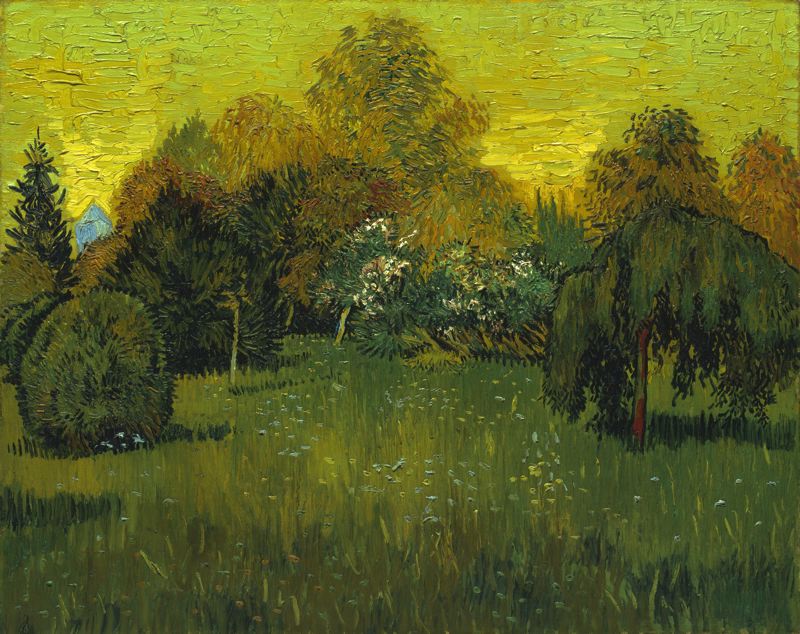
Vincent van Gogh, The Poet’s Garden (1888)
*****
musical thoughts
Last night, at the University of Chicago’s Mandel Hall, I heard what may be the finest encore I’ve ever heard. After devoting the second half of his concert to Beethoven’s mammoth Diabelli Variations, pianist Peter Serkin, following several trips offstage to rapturous applause, sat down and played, slowly, meditatively, the Aria from Bach’s Goldberg Variations. As the last note was fading, if someone had turned to me and said, with the kind of confidence one often encounters in Hyde Park, that the greatest achievements in the history of humanity can be heard at the piano, I couldn’t have done anything other than agree.
 music clip of the day