Most of the time I think of the self as a snare, and I don’t like being trapped in it. I try to reach out beyond my pittance of experience and connect to the world, but it turns out one way to do that is to be honest and accurate about my own life. I’m not convinced the personal is all that unique, anyway. It sometimes seems immoderate to claim really exceptional personal experiences, even though some of those experiences, particularly the painful ones, leave you with the worst feelings of isolation, feelings that have all the character of an absolutely individual, completely unprecedented experience—but you always find out that you aren’t alone. There are others, lots of others.
—Charles D’Ambrosio, email interview, New Yorker blog, 11/26/14
Thankful I am, too, for the unruly pleasures of rock ‘n’ roll.
Flamin’ Groovies, “Shake Some Action,” 1976
**********
lagniappe
musical thoughts
The story told in “Shake Some Action” is complete in its title—though in the song it’s a wish, not a fact, a desperate wish the singer doesn’t expect to come true. The words hardly matter: “Need” “Speed” “Say” “Away” are enough. It starts fast, as if in the middle of some greater song. A bright, trebly guitar counts off a theme, a beat is set, a bass note seems to explode, sending a shower of light over all the notes around it. The rhythm is pushing, but somehow it’s falling behind the singer. He slows down to let it catch up, and then the sound the guitar is making, a bell chiming through the day, has shot past both sides. Every beat is pulling back against every other; the whole song is a backbeat, every swing a backhand, every player his own free country, discovering the real free county in the song as it rises up in front of him, glimpsing that golden land, losing it as the mirage fades, blinking his eyes, getting it back, losing it again—that is its reckless abandon, the willingness of the music, in pursuit of where it needs to go, where it must go, to abandon itself.
—Greil Marcus, The History of Rock ‘n’ Roll in Ten Songs (2014)
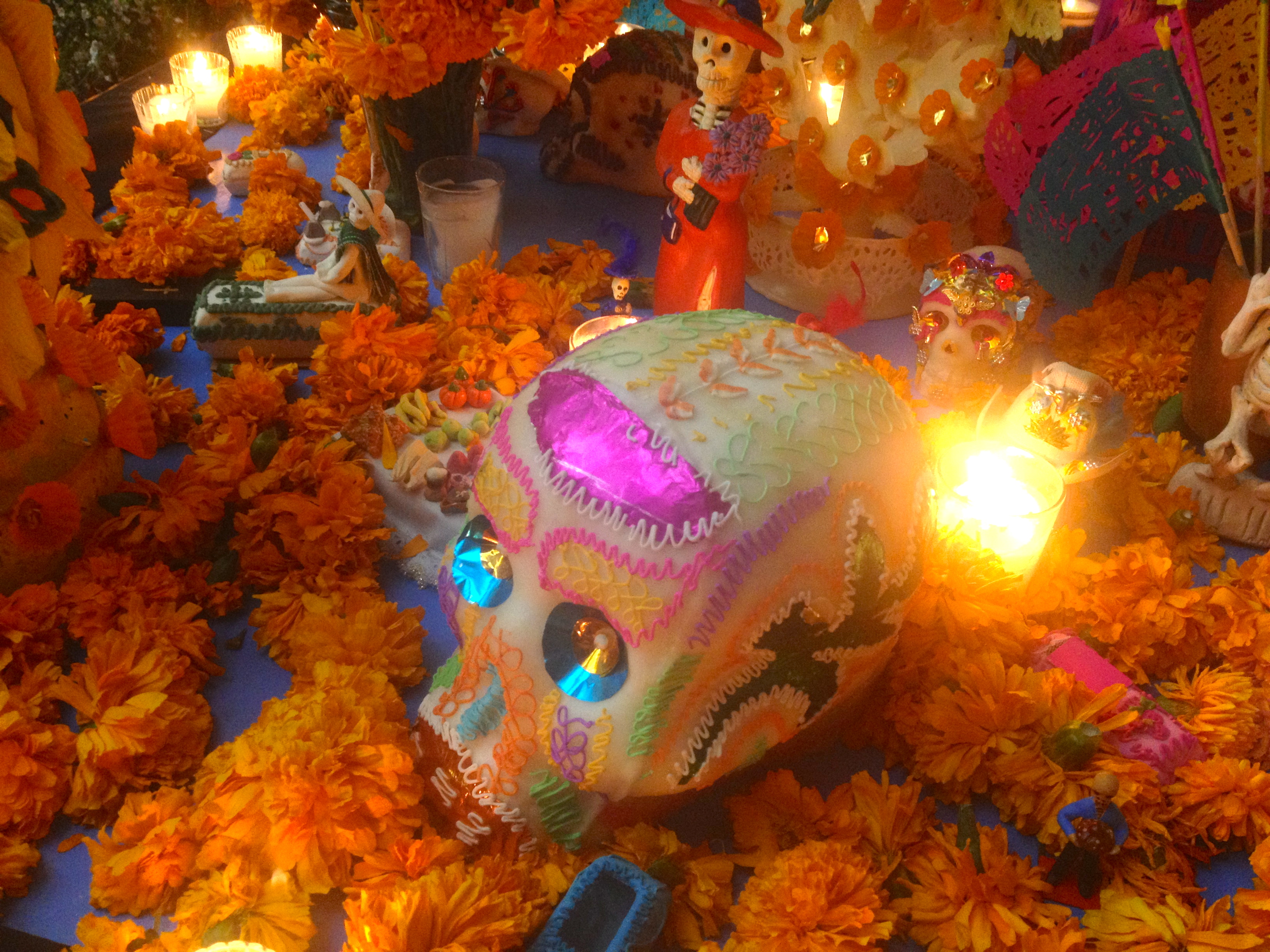
art beat: yesterday afternoon, Rito y Recuerdo: Day of the Dead, National Museum of Mexican Art (1852 W. 19th St., Chicago; through December 14th)
*****
onstage: last night, Happy Days (Samuel Beckett), Theatre Y (2649 N. Francisco Ave., Chicago; through November 23rd)
Sometimes I hear sounds. But not often. They are a boon, sounds are a boon, they help me . . . through the day. The old style! Yes, those are happy days, when there are sounds. When I hear sounds.
Steve Dawson’s Funeral Bonsai Wedding (SD, vocals and guitar; Jason Adasiewicz, vibraphone; Jason Roebke, bass; Frank Rosaly, drums), “As Soon As I Walk In” (S. Dawson), 2014
**********
lagniappe
musical thoughts
Music and family have provided two of my life’s through lines. As little boys, my brother Don and I would play in the basement, listening, on the brightly lit juke box, to the Everly Brothers (“Wake Up, Little Susie”), and Johnny Horton (“The Battle of New Orleans”), and Gene Pitney (“The Man Who Shot Liberty Valance”). Soon we were out the door, hearing the Beatles at Comiskey Park, the Velvet Underground at the Kinetic Playground, and the MC5 in Lincoln Park. Still the beat goes on, undiminished by the passing years. Last week, for my sixty-second birthday, Don gave me (what else?) a record—the new album by this guy, Steve Dawson.
Junior Wells (vocals, harmonica), Buddy Guy (guitar), Phil Guy (guitar), et al., “Ships on the Ocean,” live, Chicago (Theresa’s Lounge, 4801 S. Indiana), c. 1975