Friday, 3/5/10
Elvis!
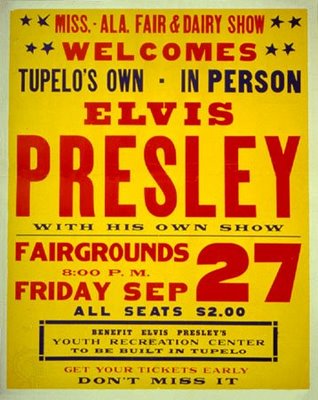
Elvis Presley, live, Tupelo, Mississippi (Mississippi-Alabama Fair & Dairy Show), 1956
“Heartbreak Hotel”
*****
“Long Tall Sally”
**********
lagniappe
Elvis!
Elvis Presley, live, Tupelo, Mississippi (Mississippi-Alabama Fair & Dairy Show), 1956
“Heartbreak Hotel”
*****
“Long Tall Sally”
**********
lagniappe
What other pop star has made such stunning contributions as a guest artist?
Sinead O’Connor
With Willie Nelson, “Don’t Give Up”
*****
With the Chieftains, “The Foggy Dew”
*****
With Shane MacGowan, “Haunted”
It used to be that music came from a particular place. No more. Whether it’s Sohrab Saadat Ladjevardi (the Iranian saxophonist who’s lived in Germany, in Japan, and now in New York City [2/18/10]), or Burkina Electric (whose members come from Burkina Faso, from Germany, and from New York City [by way of Austria] [2/22/10]), or this singer, who’s lived (and has homes) in Nigeria and in Germany, much of today’s most intriguing music has its ears and heart and feet on more than one continent.
Nneka, “Heartbeat”
Take 1: recording/video
*****
Take 2: live, Philadelphia, 2009
*****
Take 3: J. Period Remix, featuring Talib Kweli
recipe
1. Take a singer whose range includes about as many notes as he has fingers (on one hand).
2. Add a saxophonist who’s renowned for his melodic and harmonic inventiveness.
3. Mix?
Leonard Cohen with Sonny Rollins, “Who By Fire,” live (TV broadcast), 1989
These two mostly sound (to these ears) like, well, what they are: two distinctive artists whose musical worlds couldn’t be more different. But when Sonny finally leaves his world and enters Leonard’s—a world where melodic invention counts for nothing and subtle changes in inflection count for everything—the results are breathtaking (5:47 and following).
**********
lagniappe
Salam Richard!
Thanks for the post! How did you find me?
Have you check my personal website: http://www.sohrab.info?
Do you know about my music on-line mag Doo Bee Doo Be Doo (which is looking for writers. What about you?)? Please visit http://www.doobeedoobeedoo.info
***
Hope that sometime I will play in your city to have a chance to meet you.
Greetings!
—Sohrab Saadat Ladjevardi [2/18/10]
Digital Africa is here . . . —DJ Spooky
Burkina Electric (Mai Lingani, vocals; Wende K. Blass, guitar, vocals; Lukas Ligeti [son of composer Gyorgy Ligeti], electronics, drums; Pyrolator [Kurt Dahlke], electronics), “Sankar Yaare”
Take 1: DJ Spooky Remix
***
Take 2: Mapstation Remix
**********
lagniappe
Marilyn Monroe, DJ Andy Warhol Remix

Ever wonder what Brian Eno has on his iPod?
I’ve been listening a lot lately to a box-set called ‘Goodbye Babylon’ which is 6 CDs of early 20th-century American religious music, black and white music, you know.
It’s got those Norfolk a cappella quartets and it’s got country singers, and there’s church services and everything. It’s the best compilation I’ve seen for years. It comes with a fantastic book. I find that so intriguing that I just listen again and again.—Brian Eno (quoted in L.A. Weekly)
*****
Sister O.M. Terrell
“The Bible’s Right” (1953, Nashville; included in Goodbye, Babylon)
*****
“Gambling Man” (1953, Nashville)
*****
“Swing Low, Chariot” (1953, Nashville)
**********
lagniappe
Ola Mae Long was born in Atlanta in 1911. She was raised by her mother, a laundress, near Decatur Street, and in 1922 she had a religious conversion at a revival. Thereafter, she began a street ministry under the auspices of the Fire Baptized Holiness Church of God, originally a South Carolina sect. Singing and playing guitar in the slide style, Terrell (her married name) spent the next half-century evangelizing on streets, in churches, and on the radio in South Carolina, Georgia, and Tennessee.—Goodbye Babylon (accompanying book)
Want more? Here.
Bessie Smith, Clifford Brown, Scott LaFaro, Duane Allman: the road where musicians lose their lives goes on, and on, and on.
Lil’ Dave Thompson, May 21, 1969-February 14, 2010 (killed in a car accident Sunday morning en route home to Greenville, Mississippi, after a Saturday night performance in Charleston, South Carolina)
“I Got The Blues,” live, Kentucky (Bowling Green), 2008
*****
“Lil’ Girl,” live, Pennsylvania (Blakeslee), 2008
*****
“Call Me, Baby,” live, South Carolina (Charleston), 2009
From Reminders for Daily Living (3d ed. 2007):
Always keep a cape handy.
James Brown, “Please, Please, Please,” live, 1964, California (Santa Monica), The T.A.M.I. Show
More people than ever are cultural nomads. Take this guy, for instance: a Swiss-born Iranian, he moved to New York in 2008, after living in Japan. His music conjures places that can’t be found on any map—a jazz club in the desert, sand hills in Manhattan.
The Tehran-Dakar Brothers (Sohrab Saadat Ladjevardi, tenor saxophone, with Ladell McLin, guitar; Al MacDowell, bass; Lukas Ligeti [son of composer Gyorgy Ligeti], drums), live, New York, 2009
“Welcome New Iran”
*****
“Desert Blues”
*****
“Khorasan”
*****
“Tavalod”
Delmar Allen “Dale” Hawkins, a rockabilly pioneer who gave the music world the hit “Oh! Suzy-Q,” died Saturday in Little Rock of colon cancer. He was 73.
Hawkins, originally from Goldmine, in Richland Parish, recorded his first hit in the KWKH Radio studios in downtown Shreveport in 1956 with then-15-year-old guitarist James Burton, who later went on to perform and record with Elvis Presley, Ricky Nelson, John Denver and Jerry Lee Lewis, among others.
***
[Burton] recalled the guitar lick that became the hook for “Oh! Suzy-Q.”
“I wrote that little guitar lick when I was 14,” Burton recalled. “It got to be so pop in the club that Dale decided to write some lyrics to it and that became ‘Suzy-Q.’ It became a good record for him and (me) both.
“I was probably his first fan. He was a good guy, a good friend, and I think he lived life to the fullest, right up to the end.”
***
Bassist Joe Osborn, whose career on hundreds of No. 1 and Top 10 hits includes work with Ricky Nelson, Johnny Rivers, the Carpenters, the Fifth Dimension and Bob Dylan, credits Hawkins with starting his career and transitioning him from the guitar to the electric bass.
“In 1956, I was working at Sears in the hardware department and Dale came in,” Osborn said. “‘Suzy-Q’ was already out and a hit, and he wanted me to play with his brother Jerry and his band at the Skyway Club. That’s how me and Dale started. If he hadn’t come in that day I’d still be at Sears, selling hardware.”
***
In addition to his classic “Suzy-Q,” Hawkins recorded more than 40 songs on the “Chess” label. According to an obituary, he was the third entertainer to appear on Dick Clark’s American Bandstand and was the first white artist to perform at the “Apollo Theatre” in Harlem and the “Regal” in Chicago.
***
In the mid-1980s, after moving to Arkansas and entering into a second career as a social worker and counselor, Hawkins returned to live performances in a comeback concert at then-Cowboys nightclub in Bossier City, an event put together by Oil City producer Tom Ayres.
Hawkins, a Navy veteran of the Korean War, is in the Rockabilly Hall of Fame and the Louisiana Music Hall of Fame.
Dale Hawkins (August 22, 1936-February, 13, 2010)
“Susie Q” (1956 [variously spelled over the years])
*****
“Little Pig” (1957)
*****
With James Burton (guitar), “Who Do You Love?”, live, Louisiana (Shreveport), 2008
 music clip of the day