Someone could offer me a million dollars to forget this voice and I still couldn’t do it.
The Soul Stirrers featuring R.H. Harris
“Walk Around” (1939)
*****
“Lord I’ve Tried” (1946)
*****
“I Want To Rest” (1946)
*****
“I’m Willing To Run” (1947)
**********
lagniappe
“He [R.H. Harris] was The Man – the guy everyone tried to sound like,” says gospel historian Anthony Heilbut. “If you’ve been to a black church or listened to R&B music, you’ve heard the influence of R.H. Harris.”
The Rock and Roll Hall of Fame made the Soul Stirrers its first gospel inductees in 1989.
Musically, Harris and the Soul Stirrers helped shape gospel’s transition from the old “jubilee” a cappella style into the “quartet” style, with a more distinct lead voice and musical parts.
Harris sang in a striking high voice Heilbut calls “a combination of gospel moans, cowboy yodels and a clear Irish tenor.”
Harris helped found the Soul Stirrers in Texas in the 1930s. When he left in 1950, Cooke took over as lead singer and always called Harris his major stylistic influence. He then passed the style to the likes of Al Green.—David Hinckley, New York Daily News, September 6, 2000 (obituary)
Earlier this week the last surviving member of the Chicago-based Gay Sisters passed away. She was a piano wizard—sometimes referred to as the “Erroll Garner of gospel piano.” A musical tribute is scheduled for Friday evening, April 16th, at the Prayer Center Church of God in Christ, which is located at 526 E. 67th St. in Chicago.
Geraldine Gay, 1931-April 6, 2010
Gay Sisters, Savoy Records, 1951
“I’m A Soldier In The Army Of The Lord”
That’s Geraldine on the right.
*****
“I’m Goin’ To Walk Out In His Name”
*****
“God Will Take Care Of You”
**********
lagniappe
‘God Will Take Care Of You’ . . . sold an easy 100,000 units (an astounding amount of records for any genre to sell at the time), which in today’s sales would be equal to the popularity of a platinum album.—Bill Carpenter, Uncloudy Days: The Gospel Music Encyclopedia (2005)
*****
Chicago is known the world over as the birthplace of gospel music. So it comes as no surprise that city officials can barely contain their excitement over the possibility of a gospel museum opening on the city’s south side. How excited are they? Well, an official with the Chicago Board of Tourism recently made this commitment: the gospel museum “is exactly the kind of thing,” she said, that they “would put up” on their Web site. Yes, you heard that right: a city official announced, publicly, that they would include it on their Web site. Take that, Nashville!
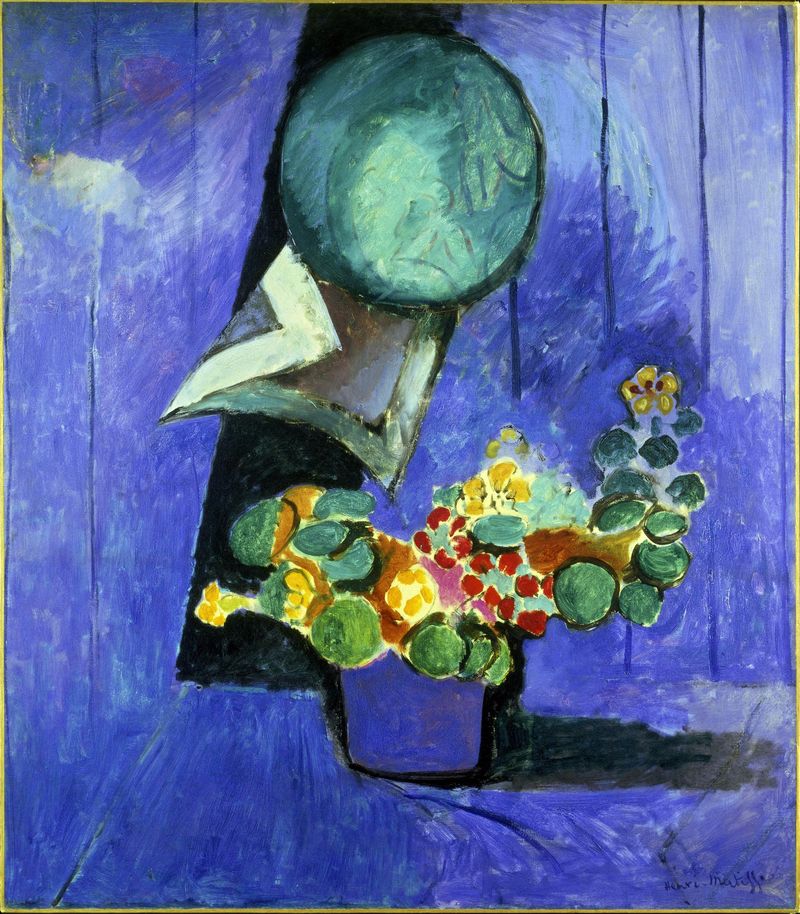
This is just one of dozens of reasons to see “Matisse: Radical Invention, 1913-1917,” which will be at the Art Institute through June 20th, then at the Museum of Modern Art beginning July 18th. At the risk of sounding like a PR flack, this exhibit (which I saw opening weekend and will return to soon) has critics scrambling for superlatives: “revelatory” (Artforum), “thrilling” (San Francisco Chronicle), “breathtaking” (Los Angeles Times)—well, you get the idea.
Long after a song has ended, you still hear that voice.
Dorothy Love Coates & the Gospel Harmonettes
“They Won’t Believe,” live (TV broadcast)
*****
“That’s Alright With Me”
*****
“I’m Just Holding On,” live (TV broadcast)
**********
lagniappe
Were gospel to be more publicly acclaimed, she [Dorothy Love Coates] might have the stature of a Billie Holiday or a Judy Garland. Instead, for thousands of black people, she is the message carrier.—Anthony Heilbut, The Gospel Sound: Good News and Bad Times (6th ed. 2002)
*****
[I]t was obvious that Keith [Richards] and Gram [Parsons] enjoyed spending time together. . . . [W]e just all cared deeply about the same things. We just loved, for instance, to sit and listen to Dorothy Love Coates, the gospel singer.—Stanley Booth
*****
Want more gospel?
A couple weeks ago I mentioned Bob Marovich’s radio show on WLUW-FM (Saturday, 10-11 a.m. [CST]). Another wonderful gospel radio show is Kevin Nutt’s “Sinner’s Crossroads” on WFMU-FM (Thursday, 7-8 p.m. [EST]). Kevin describes the show this way: “Scratchy vanity 45s, pilfered field recordings, muddy off-the-radio sounds, homemade congregational tapes and vintage commercial gospel throw-downs; a little preachin’, a little salvation, a little audio tomfoolery.” If you can’t catch it live, don’t worry—you can listen anytime.
If I didn’t have kids, would my ears be stuck, forever, on “repeat”?
Here’s something my younger son Luke, who just started college, played for me recently, after first pronouncing it, with quiet but absolute authority, the best thing this guy has done (already Luke’s learned that what’s important isn’t to be right; it’s to seem right).
Lupe Fiasco, “Hip Hop Saved My Life,” live, Los Angeles, 2008
*****
And here’s a track my older son Alex played for me a couple weeks ago, before heading back to school.
Dirty Projectors, “Stillness Is The Move”
*****
Koan for aging parents: What is the sound of a childless house?
How to be both solid and fluid, both fat and delicate. How to make the beat breathe. These are things that, as a child, Philly Joe Jones began to learn while dancing—tap-dancing. Just watch the way Thelonious Monk, listening to this solo, rocks back and forth (1:25-1:50), as if he’s about to break into a little dance himself.
Philly Joe Jones, live (with Thelonious Monk), 1959
**********
lagniappe
He breathed our history as/his walking beat . . . The Man/So Hip/A City/Took/His/Name.—Amiri Baraka (formerly LeRoi Jones, in Eulogies[1996])
The first time I stood before a judge at Chicago’s Criminal Courts Building at 26th and California—this was back in the ’70s (when I was working at Alligator Records)—it was to speak on behalf of this man, Hound Dog Taylor. The day before, during a drunken argument at his apartment, he’d shot his longtime guitarist Brewer Phillips (who survived). In his own way, Hound Dog was a pretty canny guy. When he told me about this incident over the phone, shortly after it happened, he put it this way: “Richard, they say I shot Phillip.”
(No, don’t touch that dial; these stills are way out of focus—which, for Hound Dog, seems just right.)
*****
Hound Dog Taylor and the Houserockers, live, Ann Arbor Blues Festival, 1973
Here one of the greatest American artists of the 20th century (composer Morton Feldman [1926-1980]) pays homage to another (painter Mark Rothko [1903-1970]).
Morton Feldman, “Rothko Chapel” (composed in 1971; first performed, at Houston’s Rothko Chapel, in 1972)
I first heard this guy back in the mid-1970s, after reading a review in the New York Times, by the late Robert Palmer, of his first album, The Gospel Saxophone of Vernard Johnson—and I’ve been listening to him ever since.
Vernard Johnson, saxophone
Live, Texas (Roanoke)
**********
lagniappe
reading table
Music . . . helped me to go deeper inside myself, to find new things there: the variety which I had vainly sought in life and in travel, yet the longing for which was stirred in me by the surge of sound whose sunlit wavelets came to break at my feet.

 music clip of the day