music clip of the day

jazz/blues/rock/classical/gospel/more

Category: flute

Thursday, 3/8/12

John Cage, Two (1987)

Live, Netherlands (Amsterdam), 2009
Dante Boon (piano), Rutger van Otterloo (soprano saxophone)

*****

Recording, 1991 (hat Art)
Marianne Schroeder (piano), Eberhard Blum (flute)

More? Here. And here.

**********

lagniappe

musical thoughts

Every something is an echo of nothing.

—John Cage, Silence (1961)

Saturday, 12/10/11

If sounds define a space as much as walls and windows, you don’t need to knock out a wall to open up a room—just play this.

International Contemporary Ensemble with Steve Lehman
Impossible Flow (S. Lehman), live, New York (Le Poisson Rouge), 4/19/11

The moment this ends I want to hear it again. Is there any higher compliment?

More Steve Lehman? Here.

**********

lagniappe

reading table

A strange old man
Stops me,
Looking out of my deep mirror.

—Kakinomoto no Hitomaro (c. 662-710; trans. Kenneth Rexroth)

Saturday, 11/12/11

Labels are often worse than useless. This guy, for instance, is often tagged as “cerebral.” But here’s something you can’t—I can’t, anyway—listen to without smiling.

Anthony Braxton, Composition No. 58
Taylor Ho Bynum Chicago Big Band,* live, 2009, Chicago

*****

Here’s another take—Braxton’s original recording (The Complete Arista Recordings of Anthony Braxton [Mosaic], rec. 1976).

More? Here.

**********

lagniappe

reading table

To obtain the value
of a sound, a movement,
measure from zero.

***

A sound has no legs to stand on.

***

The world is teeming: anything can
happen.

—John Cage, “2 Pages, 122 Words on Music and Dance” (excerpts)

*Taylor Ho Bynum & Josh Berman (cor), Jaimie Branch (tpt), Jeb Bishop & Nick Broste (tb), Nicole Mitchell (fl), Caroline Davis, Keefe Jackson & Dave Rempis (saxes), Jeff Parker (g), Jason Adasiewicz (vib), Nate McBride (b), Tim Daisy & Tomas Fujiwara (d)

Saturday, 9/24/11

Morton Feldman, For Christian Wolff (flute, piano, celesta; 1986)

Vodpod videos no longer available.

Listening to this, you can find it hard to remember, after an hour or so, what the world sounded like before it began playing.

More? Here. And here. And here. And here. And here. And here.

**********

lagniappe

Imagine a long, narrow hallway with paintings—subtle, shimmering abstracts by Mark Rothko—hung along both walls. Imagine walking through the hallway, stopping to examine one painting closely before moving on to the next. Imagine the hallway extends for three miles without an exit. This should give you some idea of what listening to For Christian Wolff is like. What might be hell to some people could be an all-too-brief time spent in paradise for others.

—Art Lange, Fanfare, July/August 2009

*****

At the beginning of Morton Feldman’s “For Christian Wolff” at the Alternative Museum last Sunday afternoon, Nils Vigeland – who played the piano and celesta to Eberhard Blum’s flute – invited listeners with other engagements or expired patience to leave at will.

The few who did walk out before this three-and-a-half-hour musical experience was over neither insulted the spirit of the late Mr. Feldman’s piece nor necessarily missed anything. This music, with its trancelike exposition of simple intervals, can haunt one as much in one hour as it can in three.

“For Christian Wolff” is music whose internal clock has stopped. It offers us the moment, invites us to forget what has already happened and discourages any curiosity about the future. Mr. Wolff was on hand to honor his late colleague. His introductory words – which said little about either the music, the composer or himself – seemed terribly appropriate to the occasion.

***

“For Christian Wolff” . . . gives us a deflected image of silence. Like the shadows of Plato’s cave, it is a corporeal flicker of pure nothingness – the kind of music that in the heavens surely sets the toes of gods to tapping.

—Bernard Holland, New York Times, 4/1/90

Monday, 5/30/11

Today we remember him with a mix of new clips and old favorites.

Gil Scott-Heron, April 1, 1949-May 27, 2011

new clips

“The Bottle,” live, Jamaica (Montego Bay, Reggae Sunsplash), 1983
Cool Runnings: The Reggae Movie (1983)

*****

“We Almost Lost Detroit,” live, Austria (Vienna), 2010

*****

Interview, England (London), 2010

*****

old favorites

Here’s a voice I didn’t know if I’d ever hear again.

Gil Scott-Heron, I’m New Here (out this week)

“Where Did The Night Go” (Gil Scott-Heron)

***

“Me And The Devil” (Robert Johnson)

**********

lagniappe

I’ve had bad times in my life when I’d rather be somewhere else doing something else, for sure. But you get to my age, that shit happens. You get in trouble; you maybe lose some folks—a parent or a friend. Maybe your marriage breaks up, you lose your wife, lose touch with your kid. But what life does not have those things in it?—Gil Scott-Heron (in yesterday’s Guardian)

(Orignially posted 2/8/10.)

**********

I’m the person I see least of over the course of my life, and even what I see is not accurate.

—Gil Scott-Heron (New Yorker, 8/9/2010 [Alec Wilkinson, “New York Is Killing Me”])

Gil Scott-Heron, “I’m New Here” (2010)

(Originally posted 8/24/10.)

**********

It’s a remix world.

Gil Scott-Heron, “New York Is Killing Me” (2010), Chris Cunningham remix

**********

lagniappe

Here’s the original track, followed by a couple more remixes.

Vodpod videos no longer available.

***

With Nas

Vodpod videos no longer available.

***

With Mos Def

Vodpod videos no longer available.

**********

langiappe

musical thoughts

In the dark times, will there also be singing? Yes, there will be singing. About the dark times.

—Bertolt Brecht

(Originally posted 12/16/10.)

**********

langiappe

remembrances

Alec Wilkinson (New Yorker)

Richard Russell (XL Recordings; produced and released GSH’s last album)

Eminem, Chuck D, Cee Low Green, Talib Kweli, et al.

Wednesday, 4/6/11

I’m surprised that I got this old and know so little.

—Terry Riley

Terry Riley, talking and playing, California, 2010

Vodpod videos no longer available.

*****

In C (excerpt), Terry Riley, 1964

Take 1

Terry Riley, Center of Creative and Performing Arts (SUNY-Buffalo), 1968

Vodpod videos no longer available.

***

Take 2

Ars Nova, Percurama Percussion Ensemble, Paul Hillier (cond.), 2007

Vodpod videos no longer available.

**********

lagniappe

art beat: yesterday at Boston’s Museum of Fine Arts

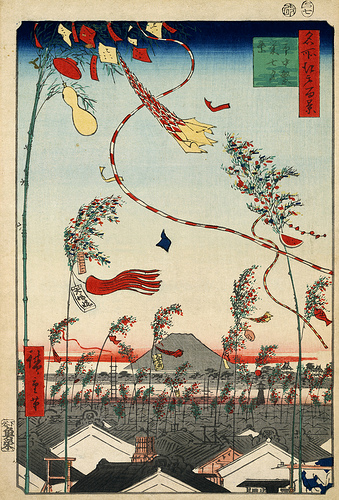
Hiroshige, The City Flourishing, Tanabata Festival (1857)


Thursday, 3/3/11

You have no idea one moment what’s going to happen the next (assuming, that is, you’re not following the score).

This can be disorienting, or exhilarating, or both.

Milton Babbitt (1916-2011), Composition for Four Instruments (flute, clarinet, violin, cello; 1948)

Vodpod videos no longer available.

More? Here.

**********

lagniappe

musical thoughts

Babbit was not quite as difficult as he seemed. He may have been dealing in abstruse relationships among myriad elements, but his listeners didn’t have to digest too many at once. From Webern, Babbit learned the art of deriving a set from successive transformations of a group of just three notes (“trichord”), which becomes a microcosm of the series. With these tiny motives in play, the texture tends to be less complicated than in the average post-Schoenbergian work. Composition for Four Instruments gives the impression of economy, delicacy, and extreme clarity; flute, clarinet, violin, and cello play solos, duets, and trios, coming together as a quartet only in the final section, and even there the ensemble dissolves into softly questing solo voices at the end. Thick dissonances are rare; like Japanese drawings, Babbitt’s scores are full of empty space.

—Alex Ross, The Rest Is Noise (2007)

***

There was only one.  There were no “simultaneities” in this particular musical equation. Milton Byron Babbitt stands alone.  He will never be popular. Nor will he cease to inspire.

Ethan Iverson (The Bad Plus)

Monday, 1/24/11

Does anyone play Mozart with more verve?

Mozart, Piano Concerto No. 20 in D minor, KV. 466, first movement;
Friedrich Gulda (piano and conducting), Munich Philharmonic Orchestra, live, Germany (Munich), 1986

Part 1

Vodpod videos no longer available.

***

Part 2

Vodpod videos no longer available.

More? Here.

**********

lagniappe

Friedrich Gulda has refused to succumb to the increasing specialization of our age, refused to limit his horizons to one small portion of the musical spectrum. A prodigious talent, whom Harold Schonberg once hailed in The New York Times as “a continuation of the great German traditions of piano playing exemplified by Schnabel and Backhaus,” he chose to reject the cloistered life of a virtuoso in favor of a career that paid equal attention to jazz and classical music, to performance, composition and improvisation.

“There can be no guarantee that I will become a great jazz musician, but at least I shall know that I am doing the right thing,” he once said.  “I don’t want to fall into the routine of the modern concert pianist’s life, nor do I want to ride the cheap triumphs of the Baroque bandwagon.” His insistence on shaping his career in his own image has been costly: once a household name among piano aficionados, he has not toured America in nearly two decades. Yet a spate of recent releases – both jazz and classical – suggest that it may be time for him to reclaim the fame once so deservedly his.

Born in Vienna in 1930, Mr. Gulda began piano studies at the age of 7, entered the Vienna Music Academy at 12 and won a major competition at 16 – first prize in the Geneva International Music Festival. His career catapulted with meteoric speed: he toured Europe and South America in 1949, and made his much-heralded Carnegie Hall debut in 1950. Mr. Gulda’s playing, however, always shunned excessive showmanship, favoring an intellectual, objective stance. His concentration on Bach, Mozart and Beethoven reflected these innate tendencies.

Mr. Gulda’s life changed in 1951: after an appearance with the Chicago Symphony, he joined Dizzy Gillespie in jazz improvisations – his first taste of freedom, so it would seem. Jazz offered “the rhythmic drive, the risk, the absolute contrast to the pale, academic approach I had been taught.” By 1956 Mr. Gulda had made his American jazz debut at New York’s Birdland, subsequently participating in the Newport Jazz Festival. Later he founded a jazz combo and in 1964 a big band grandly titled the Eurojazz Orchestra. Refusing to be limited to the piano, Mr. Gulda quickly mastered both flute and baritone sax.

What happened to his career as a classical pianist? By the late 1950’s he had rejected the traditional recital format, instead combining classical music and jazz on the same programs. By the 1970’s he had begun to irritate concert promoters by refusing to announce the content of his programs in advance and by fearlessly juxtaposing Bach, Debussy, his own jazz and freely improvised new music. Not surprisingly, many ridiculed him, claiming he had thrown away a promising career, had succumbed to egotistical eccentricity.

A sudden burst of new releases proves how wrong his critics were. “The Meeting: Chick Corea and Friedrich Gulda” (Philips CD 410 397-2), recorded at a live performance in Munich in 1982, consists exclusively of two-piano improvisations. Chick Corea is hardly a novice at either improvisations – readers may recall his 1978 two-record set with Herbie Hancock (CBS PC2 35663) – or at a crossover stance that melds both classical and jazz approaches. The result is a disk that consists of three gigantic essays, each beginning in a rhapsodic manner and only gradually coalescing into a structured commentary on familiar tunes –  “Someday My Prince Will Come,” Miles Davis’s “Put Your Little Foot Out,” Brahms’s Lullaby. Most remarkable are the completely free sections in which the players must rely entirely on listening, responding, sensing each other’s every whim. Ironically enough, the music is often angular and dissonant – occasionally approaching the intricacies of atonal modernism – yet always possessing a tightly disciplined structure. Both Mr. Corea and Mr. Gulda display dazzling technique together with fertile imaginations that dart unfettered from classical to jazz idioms.

“Gulda Plays Gulda” (Philips CD 412 115-2) consists almost entirely of his own piano compositions. The finest are those in which he adopts the conventions of both jazz and classical music to traditional forms – a virtuosic set of Variations, a Prelude and Fugue, a three-movement Sonatina. If Mr. Gulda is not an innovator, he shows remarkable ability at absorbing, integrating, synthesizing diverse idioms. Even at his most derivative – the spirits of Count Basie and Miles Davis haunt these works – the pieces are never less than formally skilled and overflowing with vitality. Only  “For Paul” and “For Rico,” bathed in pop-rock cliches, sound both dated and embarrassingly trivial.

Mr. Gulda’s  “Winter Meditation”, paired with Beethoven’s Sonata in C minor, Op. 111 (Philips 412 114-1), provides the link from his own compositions to the realm of classical music. There are no references to jazz here: instead  “Winter Meditation” conjures up images of a barren, ominous, frozen landscape. Dissonant and fragmented, it explores extremes of register and dynamic range; it deliberately eschews traditional form or melodic content. Ultimately, though, it reaches for profundity, it appears far less successful than his jazz, remaining shapeless and self-indulgent. The Beethoven, however, is a revelation: rarely have I heard such a riveting performance of the composer’s last Sonata. Mr. Gulda’s Beethoven is driving, lean, hard-edged, its propulsive power more than matched by a probing, intellectual musicianship that penetrates to the core of this most complex work.

Schumann’s  “Fantasiestukce”, Op. 12 and “Liederkreis”, Op. 39 (Philips CD 412 113-2) find Mr. Gulda in similarly evocative form. It takes him no more than a few moments to capture the essence of these moody, impassioned, sometimes haunted texts. Mr. Gulda is joined in the “Liederkreis” by the soprano Ursula Anders, who opts for a childlike purity of tone, performing these songs almost entirely without vibrato. Such a vocal timbre can be appealing but here seems a bit excessive in its application; though she may have been reaching for naturalistic, folklike simplicity the result severely limits her expressive range.

In all of Mr. Gulda’s recent releases he favors a percussive, hammered attack in forte passages, eliciting a clangorous, metallic sound from his beloved Bosendorfer. His own jazz benefits from such an approach, and to a certain extent even the Beethoven Sonata – with its explosive sforzandos and ensuing pianos – is not harmed. In the Schumann, however, Mr. Gulda’s pianistic touch can seem needlessly brutal. Yet his manner provides the hidden benefit of creating chiseled, transparent textures; even in massive passages, all lines stand out in relief.

Mr. Gulda’s approach fits perfectly with the conductor Nikolaus Harnoncourt’s, and the result in their new recording of Mozart’s Concertos Nos. 23 and 26 (Telarc CD 8. 42970 ZK) is nothing less than a radical rethinking of these familiar works. Mr. Harnoncourt stamps his imprint on the Concertgebouw Orchestra: he has it imitate the manner of an original-instrument ensemble, with biting articulations, crisp bow strokes and transparent textures in which brass and tympani stand out with startling clarity. To further enhance textural lucidity, Mr. Harnoncourt occasionally reduces the strings to a small concertino group during solo piano passages. Mr. Gulda plays throughout, even during orchestral tuttis, sometimes adding arpeggiated figuration or bass reinforcement in full instrumental sections.

Mr. Harnoncourt and Mr. Gulda possess no less a unity of vision than do Mr. Corea and Mr. Gulda in ”The Meeting.” Mr. Gulda’s playing is rhythmically precise, keenly articulated, objective and unsentimentalized, yet never insensitive to phrasing or mood. The result is the ultimate vindication of this enigmatic, fiercely independent musician, a man whose wide-ranging efforts have – to judge from recent recordings – succeeded far more often than they have failed.

—K. Robert Schwartz, New York Times, 9/29/85
*****

reading table

The John Cage of status updates?

The Led Zeppelin of sensitive screenwriters?

The Willie Nelson of pin-up girls?

All these, and more, can be found at The Rosa Parks of Blogs.

Thursday, 11/4/10

Violins teach us what it would be like to fly.

Henry Cowell, Symphony No. 13 (“Madras,” 1956-58), excerpt (first two movements), San Francisco Composers Chamber Orchestra, live, San Francisco, 2005

Want to hear all five movements? Here.

**********

lagniappe

Henry Cowell, the all-American composer of the 20th century, did it all. “I want to live in the whole world of music,” he said. He was “the open sesame of new music in America,” John Cage said.

He was famous once and is now all but forgotten. There was a time when Leopold Stokowski championed him in New York, as did Eugene Ormandy in Philadelphia and Serge Koussevitzky in Boston. Schoenberg thought the world of him. So did Busoni. But since Cowell’s death in 1965, the musical establishment has concluded his music, and particularly the plentiful late orchestral music, doesn’t hold up.

***

A century ago, he was a teenage piano pioneer in Menlo Park, Calif. He was the first to hit clusters of tones on the piano with fist and forearm (Bartók noticed) and the first to play directly on the piano strings. He all but invented the concept of world music and was on the front line of flexible phrasing, extreme polyrhythms, percussion music and mechanical music. He was a celebrated pedagogue. Cage, Burt Bacharach, George Gershwin and Lou Harrison were among those who found their own voices through him. Cowell, who was born in 1897, was known in New York, Berlin and Moscow by the ’20s. He helped found the study of ethnomusicology at UC Berkeley. He published and organized the concerts of progressive music from all over.

Cowell is primarily known for is his Bohemianism, which led to the creation of the California school of music and, sadly, for his arrest on morals charges. He was publicly shamed in a celebrity trial for having had consensual oral sex with young men and sentenced to 15 years in San Quentin.

After four years of incarceration, he was paroled and eventually pardoned by Gov. Earl Warren so that he could become a musical ambassador for the State Department. He moved to New York and taught at the New School for Social Research, traveled and absorbed the musics of Asia and Latin America, wrote 21 symphonies and much else. When Malaysia was looking for a national anthem in the ’50s, the country turned to him and Benjamin Britten for help.

—Mark Swed, Los Angeles Times (blog), 1/31/10

Saturday, 10/23/10

Your 16-year-old daughter dies, suddenly, in a car accident.

What do you do?

If you’re pianist/composer Kenny Werner, what you do is create music.

Kenny Werner, No Beginning No End (featuring Joe Lovano, tenor saxophone), recording session, New York (NYU), 2009