Elliott Carter (December 11, 1908-), Esprit Rude/Esprit Doux (1985); Claire Chase (flute),* Joshua Rubin (clarinet), International Contemporary Ensemble; live, Brazil (Sao Paulo), 2012
**********
lagniappe
musical thoughts
The “opportunity cost” of listening to something you already know, to borrow from the dreary world of economics, is that you’re forgoing an opportunity to discover something new.
*****
found words
Last night, after a concert at the University of Chicago’s Mandel Hall (Takacs Quartet), I stopped at Harold’s Chicken Shack on 53rd Street, as much for old times’ sake as anything else (Harold got me through law school), and found this at the bottom of the receipt:
Anton Bruckner (1824-96), Symphony No. 5 in B flat major; Berlin Philharmonic (Wilhelm Furtwangler, cond.), live, Berlin, 1942
(Yeah, I realize this performance took place in Nazi Germany during World War II and, no, I don’t have anything profound, or even interesting, to say about how such beauty and such horror could coexist.)
Anton Bruckner (1824-96), Symphony No. 8 in C minor; Vienna Philharmonic (Herbert von Karajan, cond.), live, Austria (Abbey of St. Florian), 1979
**********
lagniappe
musical thoughts
Once upon a time, before the human attention span began to shrink, people could actually sit still and pay attention to something—a single thing—for over an hour.
John Cage, composer, September 5, 1912-August 12, 1992
Today, celebrating his centennial, we revisit past clips.
*****
10/9/09
No matter where you are, this landscape is just around the corner.
John Cage (1912-1992), In a Landscape (1948); Stephen Drury, piano
**********
lagniappe
musical thoughts
Music is a means of rapid transportation.
***
What I’m proposing, to myself and other people, is what I often call the tourist attitude—that you act as though you’ve never been there before. So that you’re not supposed to know anything about it. If you really get down to brass tacks, we have never been anywhere before.
***
As far as consistency of thought goes, I prefer inconsistency.
—John Cage
*****
5/22/10
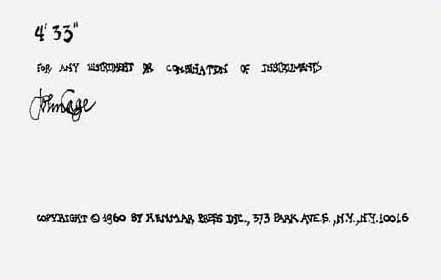
Here’s a piece that sounds different every time you hear it.
John Cage, 4’ 33” (1952); David Tudor, piano
lagniappe
***
*****
musical thoughts
I didn’t wish it [4′ 33″] to appear, even to me, as something easy to do or as a joke. I wanted to mean it utterly and be able to live with it.
***
Until I die there will be sounds. And they will continue following my death. One need not fear about the future of music.
Monday, n. the day the weekly tide of confusion rolls in.
How about something simple?
John Cage (1912-1992), Six Melodies (for violin and keyboard; dedicated to Josef & Anni Albers), 1950; Annelie Gahl (violin) & Klaus Lang (electric piano), 2010
You don’t need to be asleep to be lost in a dream.
Maurice Ravel, Piano Concerto in G Major (1929-31); Martha Argerich, piano; Orchestre National de France (Charles Dutoit, cond.); live, Germany (Frankfurt), 1990
George Lewis (1952-), “Will to Adorn” (2011)
International Contemporary Ensemble (ICE), Chicago, 2012
[W]hen writing “The Will To Adorn,” Lewis was especially “interested in this idea of adornment—color, color, color everywhere.” The piece represents Lewis’ current musical goal to get “more color energy into the pieces.”
In February, when I left this concert, which took place on a Sunday afternoon at Chicago’s Museum of Contemporary Art, I felt both exhilarated and wistful. This performance, which had been such a joy to hear, I would never be able to experience again. Or so I thought, until, just the other day, I discovered this recording online. Young people, many of them, anyway, would see nothing remarkable in being able, thanks to the ’net, to return to a musical experience whenever, and wherever, you want. To me it seems a small miracle.
*****
reading table
I was trying to assert myself as the man in the house, taking charge of things no one could control.
Q. This is a tough question, but what would be your five Desert Island disks?
John Luther Adams: I’d want music I could live inside for a long time; music that’s complex and enigmatic enough that there’s always something new to discover. Off the top of my head, my choices might be . . .
One of Morton Feldman’s major works, probably the Second String Quartet. Or maybe For Philip Guston.
Pete Cosey, guitar player, October 9, 1943-May 30, 2012
Miles Davis, “Ife,” live, Austria (Vienna), 1973
With Pete Cosey, guitar (solo begins at 5:30) and percussion; Dave Liebman, flute, soprano and tenor saxophones; Reggie Lucas, guitar; Michael Henderson, bass; Al Foster, drums; James Mtume Forman, conga and percussion
*****
Here’s an earlier post (12/31/09):
In the public imagination, the guitar’s associated with freedom and individuality. The musical reality’s different. Guitarists travel in herds; few stray from the pack. One who has gone his own way is this man, who’s played with everyone from Muddy Waters (as a session musician for Chicago-based Chess Records) to Miles Davis (as a member of his group [1973-1975]). He employs a variety of unusual tunings and effects. He sounds like no one else.
Pete Cosey, guitar
“Calypso Frelimo” (excerpt), Pete Cosey’s Children of Agharta (JT Lewis, drums; Gary Bartz and John Stubblefield, saxophones & flute; Matt Rubano, bass; Johnny Juice, turntables; Baba Israel, words and beats; Kyle Jason, voice; Bern Pizzitola, guitar; Wendy Oxenhorn, harmonica), live, 2002, New York
*****
Live (with Melvin Gibbs, bass; JT Lewis, drums; Johnny Juice, congas and turntables)
**********
lagniappe
. . . the guy who, after Hendrix, showed you how ‘out’ you could go with guitar playing, particularly in the improvised context.
Charles Mingus Quintet,* “So Long Eric,” “Peggy’s Blue Skylight,” “Meditations On Integration” (all by Mingus), live (TV show), Belgium, 1964
Mingus’s music, it seems, has everything. Call it “simple” or “complex” and you’d be both right and wrong—it’s both. Compositional elegance is balanced, exquisitely, with improvisational unruliness. Rhythmic momentum is no less—and no more—important than melodic invention. Like Ellington and Monk, he will, I’m confident, still be listened to a hundred years from now.
(Excerpts from this program have been posted previously.)
**********
lagniappe
art beat: yesterday at the Art Institute of Chicago
Ludovico Carracci, The Vision of Saint Francis, c. 1602
Going to the Art Institute again, after being away for a while, I felt a bit like someone who doesn’t realize he’s starving until he finds himself at a feast.
*****
*CM, bass; Eric Dolphy, alto saxophone, flute, bass clarinet; Clifford Jordan, tenor saxophone; Jaki Byard, piano; Dannie Richmond, drums.
Music doesn’t care who you are, where you come from, what you know. It asks only that you pay attention.
Stefan Wolpe (1902-1972), Piece in Three Parts for Piano and Sixteen Instruments (1961), Peter Serkin (piano), Chamber Music Society of Lincoln Center (Oliver Knussen, cond.)


 music clip of the day